
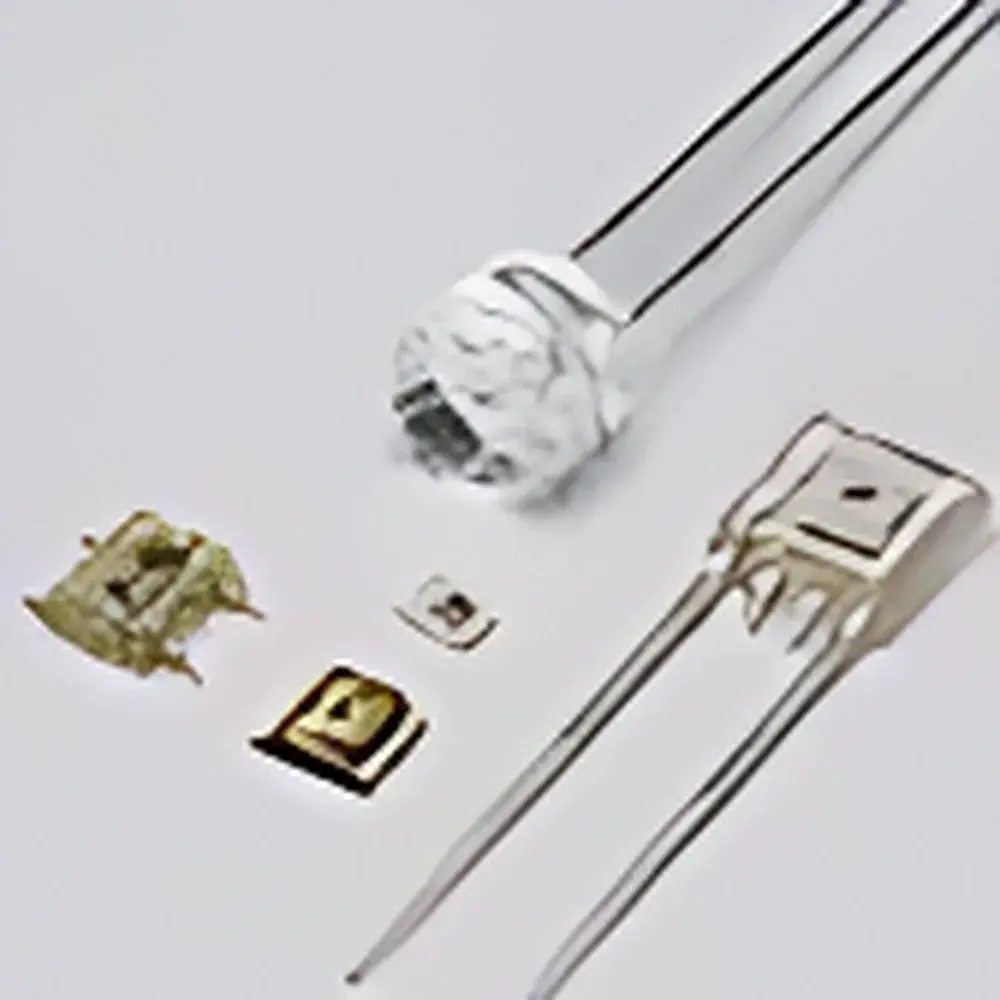
Hamamatsu S9 Series Photopic Illuminance Sensors
| Brand | Hamamatsu |
|---|---|
| Origin | Japan |
| Manufacturer Type | Original Equipment Manufacturer (OEM) |
| Import Status | Imported |
| Model Series | S9 |
| Component Category | Optical Sensor ICs |
| Spectral Response Range | 300–820 nm (standard photopic), up to 1000 nm (IR-enhanced variants) |
| Peak Wavelength | 560 nm (standard), 550–650 nm (model-dependent) |
| Output Type | Analog current (0.11–1.8 mA), digital CMOS (S9705) |
| Operating Temperature | –40 °C to +100 °C (S11153-01MT) |
| Human Eye Spectral Match | CIE 1931 Photopic Luminosity Function compliant |
| IR Immunity | Enhanced rejection of 850–950 nm remote-control interference |
| Color-Temperature Stability | < ±3% output variation across 2700 K–6500 K white-light sources |
Overview
The Hamamatsu S9 Series represents a family of integrated photopic illuminance sensors engineered for high-fidelity ambient light measurement in scientific, industrial, and regulatory-compliant environments. Unlike generic photodiodes or uncalibrated photoresistors, each S9 variant incorporates an on-chip optical filter and signal-conditioning circuitry optimized to replicate the CIE 1931 photopic luminosity function (V(λ)), ensuring metrological alignment with human visual perception under photopic (daylight-adapted) conditions. These devices operate on the principle of spectrally weighted photocurrent generation: incident photons within the 300–820 nm range are converted into proportional analog current output (or CMOS-compatible digital pulses in the S9705 variant), with peak responsivity centered at 560 nm — the wavelength of maximum cone photoreceptor sensitivity. The monolithic design eliminates external calibration dependencies, enabling direct integration into embedded systems, environmental monitoring nodes, lighting control interfaces, and GLP-compliant optical test benches.
Key Features
- CIE 1931 V(λ)-matched spectral response across standard models (S9066-111, S10604-01CT, S11153-01MT), validated per ISO/CIE TR 19527:2015
- High-output photodiode architecture: delivers 0.11–1.8 mA photocurrent under 1000 lx illumination, eliminating need for external transimpedance amplification in many applications
- Exceptional color-temperature invariance: ≤ ±3% output deviation across correlated color temperatures from 2700 K (warm white) to 6500 K (cool daylight), critical for architectural lighting validation and display backlight characterization
- Integrated IR suppression: minimal sensitivity drift (< 0.5% relative) when exposed to common 850 nm and 940 nm infrared remote-control emissions, enabling reliable operation in consumer electronics test environments
- Extended thermal stability: S11153-01MT rated for continuous operation from –40 °C to +100 °C, supporting automotive cabin sensing and outdoor instrumentation
- Digital option available: S9705 integrates a precision current-to-frequency converter with CMOS-level TTL/CMOS output, compatible with microcontroller timer-capture inputs and immune to analog noise in high-EMI settings
Sample Compatibility & Compliance
The S9 Series is designed for direct integration into optical subassemblies requiring traceable illuminance quantification. Its plastic TO-can package (standard JEDEC outline) supports surface-mount reflow (lead-free compatible) and mechanical coupling with diffusers, cosine correctors (e.g., Hamamatsu L11-011), or fiber-optic input adapters. All standard photopic models comply with IEC 60825-1:2014 (laser safety classification support), RoHS 2011/65/EU, and REACH SVHC criteria. For regulated applications—including medical device ambient light sensing (IEC 62304), building automation per EN 15232, and display luminance verification per ISO 9241-307—the S9’s documented V(λ) conformity enables inclusion in system-level uncertainty budgets under GUM (JCGM 100:2008) frameworks. Device-level calibration certificates (NIST-traceable reference illuminants) are available upon request for audit-ready deployments.
Software & Data Management
While the S9 is a hardware-level sensor IC, its analog output is fully compatible with industry-standard data acquisition platforms including National Instruments DAQmx, Keysight U2300A series, and Raspberry Pi ADC HATs (e.g., MCP3008, ADS1115). Hamamatsu provides open-source Python and C firmware libraries (GitHub-hosted) for S9705 digital variants, featuring configurable frequency scaling, automatic temperature compensation lookup tables (based on internal thermistor readings in select models), and timestamp-synchronized multi-channel logging. For traceability in GLP/GMP workflows, raw current outputs can be mapped to lux via factory-provided responsivity coefficients (A/lx), with optional integration into LabVIEW-based validation protocols that enforce 21 CFR Part 11 audit trails for electronic records.
Applications
- Automated lighting control systems in smart buildings (ANSI/ASHRAE Standard 90.1 compliance verification)
- Luminance uniformity mapping of OLED/LCD panels during production QA (per ISO 13406-2 Annex B)
- Photobiological safety assessment of LED luminaires (IEC 62471:2006, Group Exempt & Risk Group 1)
- In-vehicle ambient light sensing for adaptive dashboard dimming (AEC-Q102 qualified variants available)
- Environmental light logging in ecological field stations (IP67-housed OEM modules)
- Reference-grade illuminance monitoring in metrology labs performing spectral irradiance intercomparisons
FAQ
What distinguishes the S9 Series from conventional silicon photodiodes?
The S9 integrates a V(λ)-shaping optical filter and low-noise amplifier on-die, delivering true photopic-weighted output without external optics or software correction—unlike bare photodiodes requiring post-processing against CIE tables.
Can the S9 be used under pulsed or modulated light sources?
Yes; rise/fall times are < 10 µs for analog variants and < 5 µs for S9705, supporting PWM dimming analysis and flicker metric computation (IEEE 1789-2015).
Is NIST-traceable calibration available for purchase?
Calibration reports referenced to NIST SRM 2252a (illuminance standard lamp) are offered as optional add-ons for S9066-111, S10604-01CT, and S11153-01MT.
How is temperature drift compensated in long-term deployments?
S11153-01MT includes an integrated thermistor; Hamamatsu’s firmware libraries apply polynomial correction using coefficients supplied in the datasheet.
Are custom spectral response profiles supported?
Hamamatsu offers OEM spectral tailoring (e.g., scotopic, melanopic, or plant PAR-weighted variants) under NDA for volume orders ≥ 5k units.




