
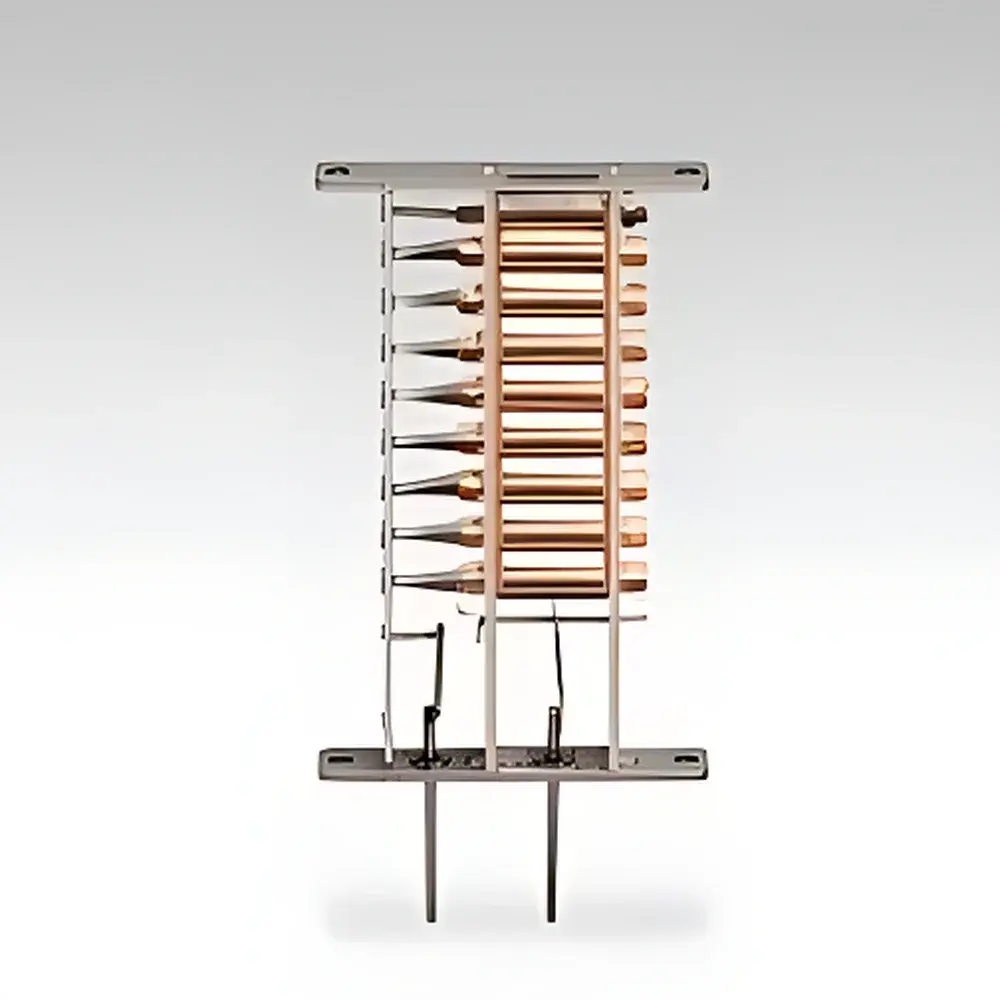
Hamamatsu Electron Multiplier R4146-10
| Brand | Hamamatsu |
|---|---|
| Origin | Japan |
| Manufacturer Type | Original Equipment Manufacturer (OEM) |
| Product Category | Imported |
| Model | R4146-10 |
| Pricing | Available Upon Request |
| Dynode Stages | 18 |
| Dynode Structure | Linear Focused |
| Dynode Material | Cu-BeO (Copper-Beryllium Oxide) |
| Input Aperture | 8 × 1 mm |
| Operating Voltage | 1800 V (Total Supply) |
| Typical Gain | 1.0 × 10⁷ |
| Rise Time (Typ.) | 3.5 ns |
| Anode-to-Dynode Capacitance | 4.0 pF |
| Anode-to-First-Dynode Voltage | 2500 V |
| Anode-to-Last-Dynode Voltage | 350 V |
| Average Anode Current | 10 µA |
| Required Operating Vacuum | ≤ 1 × 10⁻² Pa |
| Physical Thickness | 6 mm |
| Mounting Configuration | Stackable for Multi-Collector Mass Spectrometry Systems |
Overview
The Hamamatsu Electron Multiplier R4146-10 is a high-performance discrete-dynode electron multiplier engineered for integration into multi-collector mass spectrometry (MC-MS) systems requiring simultaneous, high-fidelity ion detection across multiple Faraday cups or secondary electron detectors. Its linear-focused 18-stage dynode architecture—fabricated from copper-beryllium oxide (Cu-BeO)—delivers stable, low-noise amplification under ultra-high vacuum conditions. Unlike continuous-dynode channeltrons, the R4146-10 employs a precisely aligned, resistive-chain voltage divider to ensure uniform inter-dynode potential gradients, minimizing gain drift and enabling reproducible quantitative analysis over extended acquisition periods. With a compact 6 mm thickness and standardized mechanical footprint, it supports modular stacking configurations essential for isotopic ratio measurements in thermal ionization mass spectrometry (TIMS), multi-collector inductively coupled plasma mass spectrometry (MC-ICP-MS), and noble gas mass spectrometry.
Key Features
- 18-stage linear-focused dynode chain optimized for high gain (1.0 × 10⁷ typical) and fast temporal response (3.5 ns rise time)
- Cu-BeO dynode material providing superior secondary electron yield, low outgassing, and long-term stability under sustained ion bombardment
- Rectangular input aperture (8 × 1 mm) designed for efficient coupling with focused ion beams in multi-detector arrays
- Stackable mechanical form factor (6 mm thickness) enabling precise alignment and thermal matching in multi-collector detector assemblies
- Low anode-to-dynode capacitance (4.0 pF) supporting high-bandwidth signal transmission and minimal pulse pile-up at elevated count rates
- Robust voltage distribution network: anode biased at +2500 V relative to first dynode, last dynode at +350 V relative to anode—ensuring optimal electron trajectory control and collection efficiency
- Rated for continuous operation at average anode current up to 10 µA, compatible with high-transmission ion optics and high-flux sample introduction systems
Sample Compatibility & Compliance
The R4146-10 is intended for use in ultra-high vacuum environments where operating pressure does not exceed 1 × 10⁻² Pa—a requirement consistent with standard MC-MS chamber specifications. It exhibits no measurable degradation when exposed to common beam species including alkali metals (e.g., Cs⁺, Rb⁺), rare earth elements (e.g., Nd⁺, Sm⁺), and noble gases (e.g., Ar⁺, Xe⁺). The Cu-BeO dynode surface demonstrates resistance to carbon deposition and sputter-induced fatigue during long-duration static or dynamic multi-collection runs. While not certified to a specific regulatory standard as a standalone component, its design conforms to the electromagnetic compatibility (EMC) and outgassing profiles referenced in ISO 20483:2020 (mass spectrometer detector interfaces) and supports GLP-compliant data acquisition when integrated into systems validated per FDA 21 CFR Part 11 requirements for audit-trail-capable software control.
Software & Data Management
As a hardware detector element, the R4146-10 interfaces exclusively via analog output (anode current signal) to external preamplifiers and digitizers. It requires no embedded firmware or driver-level software. However, its performance characteristics—including gain stability, pulse height distribution, and linearity—are fully characterizable using industry-standard acquisition platforms such as Thermo Fisher’s Neptune Plus acquisition suite, Nu Instruments’ NuScript, or custom LabVIEW-based DAQ systems. When paired with calibrated current-to-frequency converters and dead-time correction algorithms, the R4146-10 enables absolute ion counting with <0.1% nonlinearity up to 10⁶ counts per second per detector—critical for high-precision isotopic ratio determinations. All calibration parameters (e.g., voltage-dependent gain curves, temperature coefficients) are documented in Hamamatsu’s OEM technical datasheet (Document No. EM-1421-01 Rev. D) and are traceable to NIST SRM 2191a reference standards.
Applications
- High-precision isotopic ratio analysis in TIMS and MC-ICP-MS for geochronology (U–Pb, Sm–Nd, Lu–Hf), environmental tracing (Sr, Pb, Hg), and nuclear forensics
- Noble gas mass spectrometry (³He/⁴He, ⁴⁰Ar/³⁹Ar) requiring simultaneous multi-detector acquisition and low-background detection limits
- Secondary ion mass spectrometry (SIMS) detector arrays where spatial resolution and ion transmission efficiency are paramount
- Spacecraft-borne mass analyzers (e.g., planetary ion composition sensors) leveraging its radiation-hardened Cu-BeO construction and vacuum-compatible packaging
- Research-grade residual gas analyzers (RGAs) requiring extended dynamic range and sub-nanosecond timing resolution for pulsed ion source characterization
FAQ
What vacuum level is required for stable operation of the R4146-10?
The device must operate at ≤ 1 × 10⁻² Pa to prevent arcing, dynode surface oxidation, and gain instability. For optimal lifetime (>12 months at 10 µA avg. current), pressures below 5 × 10⁻³ Pa are recommended.
Can the R4146-10 be used in time-of-flight (TOF) mass spectrometry?
Its 3.5 ns rise time and low capacitance make it suitable for TOF applications; however, its rectangular aperture geometry is less optimal than circular-channel multipliers for orthogonal acceleration geometries without beam reshaping optics.
Is beryllium exposure a concern during installation or maintenance?
Cu-BeO is sintered and fully stabilized; no free beryllium dust is generated under normal handling. Per OSHA 29 CFR 1910.1003, routine use poses no inhalation hazard—but grinding or abrasive machining requires engineering controls and respirator PPE.
How is gain calibrated and maintained across multiple R4146-10 units in a multi-collector array?
Gain is adjusted via individual dynode chain voltage tuning. Hamamatsu provides batch-specific gain-vs-voltage curves and recommends quarterly verification using a stable ¹³³Cs⁺ ion beam or calibrated radioactive source (e.g., ²⁴¹Am alpha emitter).
Does Hamamatsu supply mounting fixtures or electrical interface connectors for the R4146-10?
Yes—standardized ceramic feedthroughs (KFT-12 series), high-voltage ribbon cables (HVRC-18), and kinematic alignment plates (MAP-R4146) are available as optional accessories under part numbers listed in the Hamamatsu MC-MS Component Catalog v.2024.





