
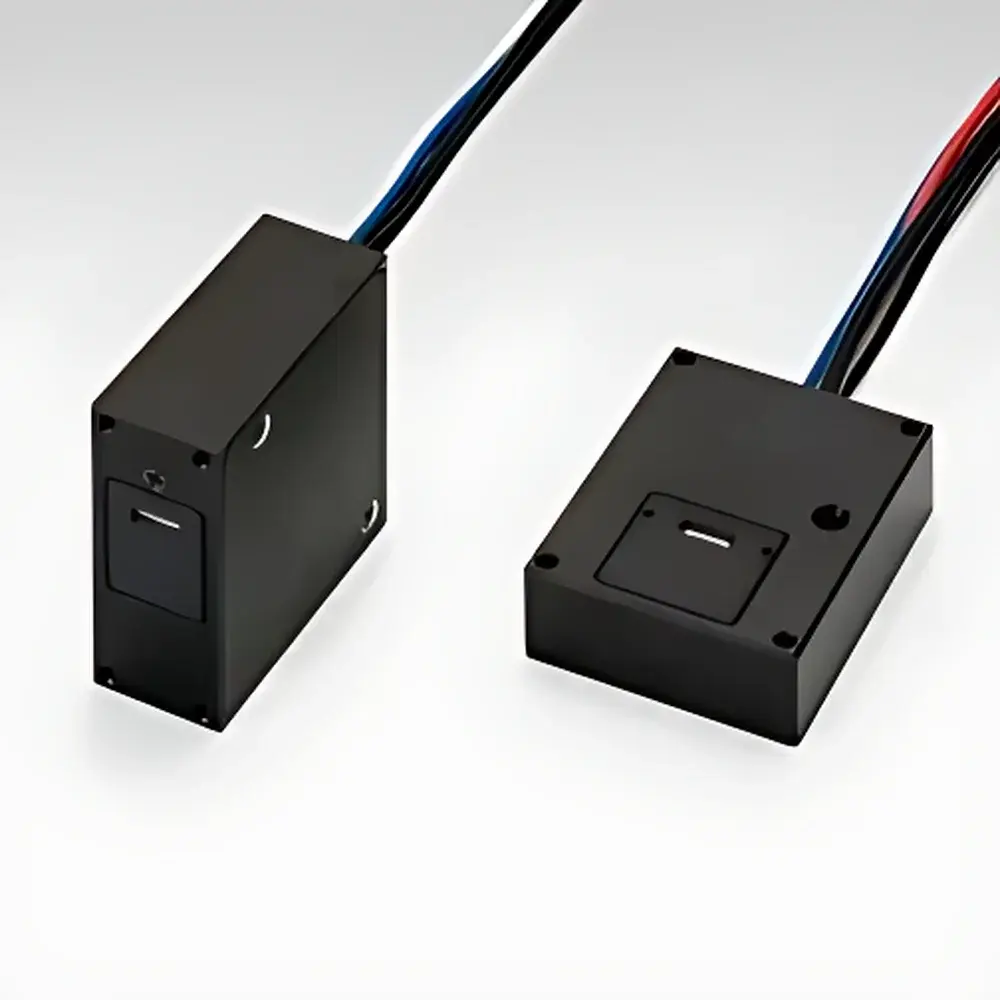
Hamamatsu H12402 Miniature Photomultiplier Tube Module
| Brand | Hamamatsu |
|---|---|
| Origin | Japan |
| Manufacturer Type | Original Equipment Manufacturer (OEM) |
| Product Category | Imported Optical Component |
| Model | H12402 |
| Component Type | Optical Sensor Module |
| Operating Voltage Input | +5 V DC (single supply) |
| Spectral Response Range | 300–650 nm (typical, bialkali photocathode) |
| Cathode Luminous Sensitivity | ≥80 µA/lm (typical) |
| Anode Gain | ~1 × 10⁶ (at Vₕᵥ = −800 V) |
| Rise Time | ≤2.2 ns (typical) |
| Dark Current | ≤1 nA (at 25°C, Vₕᵥ = −800 V) |
| Dimensions (L × W × H) | 25.4 × 25.4 × 40.0 mm |
Overview
The Hamamatsu H12402 Miniature Photomultiplier Tube Module is a fully integrated, compact optical detection solution engineered for high-sensitivity, low-noise photon counting and analog current measurement in space-constrained or portable instrumentation. Built around a side-on bialkali photocathode PMT (R12402), the module incorporates a precision-resistor voltage divider network and a miniature high-voltage DC-DC converter—enabling stable operation from a single +5 V DC input. Unlike discrete PMT assemblies requiring external high-voltage supplies and custom base circuits, the H12402 delivers factory-optimized gain stability, thermal compensation, and electrical shielding within a hermetically sealed, epoxy-encapsulated metal housing. Its design adheres to fundamental principles of secondary electron multiplication under controlled electrostatic focusing, ensuring consistent pulse-height distribution and linear response over six decades of incident light intensity (10⁻¹⁵–10⁻⁹ W). This architecture makes it suitable for applications demanding rapid signal acquisition, low-power operation, and repeatable quantum efficiency across UV-Vis wavelengths.
Key Features
- Integrated high-voltage generation: Onboard DC-DC converter provides regulated negative high voltage (adjustable up to −1000 V) with ripple < 0.01% RMS, eliminating need for external HV supplies.
- Compact footprint: 25.4 × 25.4 × 40.0 mm package enables direct integration into OEM spectrometers, flow cytometers, radiation monitors, and handheld fluorescence readers.
- Bialkali photocathode (Sb-Rb-Cs): Peak quantum efficiency >25% at 420 nm; spectral responsivity optimized for 300–650 nm range—ideal for scintillation detection (e.g., NaI:Tl, plastic scintillators) and chemiluminescence assays.
- Low dark current performance: ≤1 nA at 25°C and −800 V, supporting sub-picoampere-level signal resolution in photon-starved conditions.
- Shielded construction: Mu-metal magnetic shielding and grounded aluminum housing suppress EMI/RFI interference and external field-induced gain drift.
- Factory-calibrated linearity: Guaranteed ≤±2% deviation from ideal response across 10⁶ dynamic range (anode current: 10 pA – 10 µA).
Sample Compatibility & Compliance
The H12402 module interfaces directly with standard 50 Ω coaxial output circuitry and supports both analog current output (via anode or dynode tap) and photon-counting mode when coupled with compatible discriminators and TCSPC electronics. It complies with IEC 61000-6-3 (emissions) and IEC 61000-6-2 (immunity) for industrial electromagnetic environments. While not certified for medical devices per IEC 62304, its design conforms to GLP-relevant traceability requirements: each unit carries a unique serial number, calibrated gain data sheet, and batch-specific dark current characterization report. For regulatory workflows involving analytical instrument qualification (AIQ), the module supports documented IQ/OQ protocols via Hamamatsu’s OEM support package—including temperature coefficient data (gain drift: −0.05%/°C) and long-term stability metrics (gain variation < ±1.5% over 1,000 hrs at rated voltage).
Software & Data Management
As a hardware sensor module, the H12402 does not include embedded firmware or native software drivers. However, it is fully interoperable with industry-standard data acquisition platforms including National Instruments DAQmx, Keysight IO Libraries Suite, and open-source frameworks such as Python-based PyVISA and QCoDeS. When used in photon-counting configurations, it integrates seamlessly with time-correlated single-photon counting (TCSPC) systems (e.g., PicoQuant HydraHarp, Becker & Hickl DPC-230) and multichannel analyzers (MCAs) compliant with USB/PCIe digitizer standards. Hamamatsu provides comprehensive technical documentation—including pinout schematics, noise spectral density curves, and pulse height distribution histograms—to facilitate system-level uncertainty budgeting per ISO/IEC 17025 Annex A.3 guidelines.
Applications
- Laser-induced fluorescence (LIF) detection in microfluidic cytometry and capillary electrophoresis systems.
- Low-light radioluminescence monitoring in nuclear safeguards instrumentation and environmental radon detectors.
- UV-Vis absorbance and emission spectroscopy in compact benchtop spectrophotometers and process analytical technology (PAT) sensors.
- Time-resolved luminescence decay analysis in material science labs studying phosphor lifetimes and triplet-state kinetics.
- Bioluminescence resonance energy transfer (BRET) assays requiring high temporal resolution and minimal background contribution.
- OEM integration into FDA-submitted IVD platforms where component-level validation records (DHF/DHR) are required for 510(k) submissions.
FAQ
What is the recommended operating temperature range for stable gain performance?
The H12402 is specified for continuous operation between −20°C and +50°C. For optimal gain stability (< ±1% variation), ambient temperature should be maintained within ±1°C of the calibration point (typically 25°C), or compensated using the published temperature coefficient (−0.05%/°C).
Can the high-voltage output be externally adjusted?
Yes—the module includes an HV ADJ pin (pin 5) accepting a 0–5 V analog control signal, enabling precise gain tuning from ~1×10⁵ to 1×10⁷ without hardware modification.
Is the module compatible with positive high-voltage PMT bases?
No—it is designed exclusively for negative high-voltage operation (cathode at −HV, anode at ground), consistent with bialkali photocathode polarity requirements and standard scintillation detector architectures.
Does Hamamatsu provide NIST-traceable calibration certificates?
Standard units ship with factory-measured gain, dark current, and spectral response data. NIST-traceable calibration (including absolute quantum efficiency verification) is available as an optional service under Hamamatsu’s OEM Calibration Program (Order Code: CAL-H12402-NIST).
What is the expected lifetime under continuous operation at rated voltage?
Based on accelerated life testing per JIS C 5017, median operational lifetime exceeds 10,000 hours at −800 V and 25°C, assuming clean, vibration-free mounting and avoidance of exposure to >10⁻³ Pa vacuum or organic solvent vapors.





