
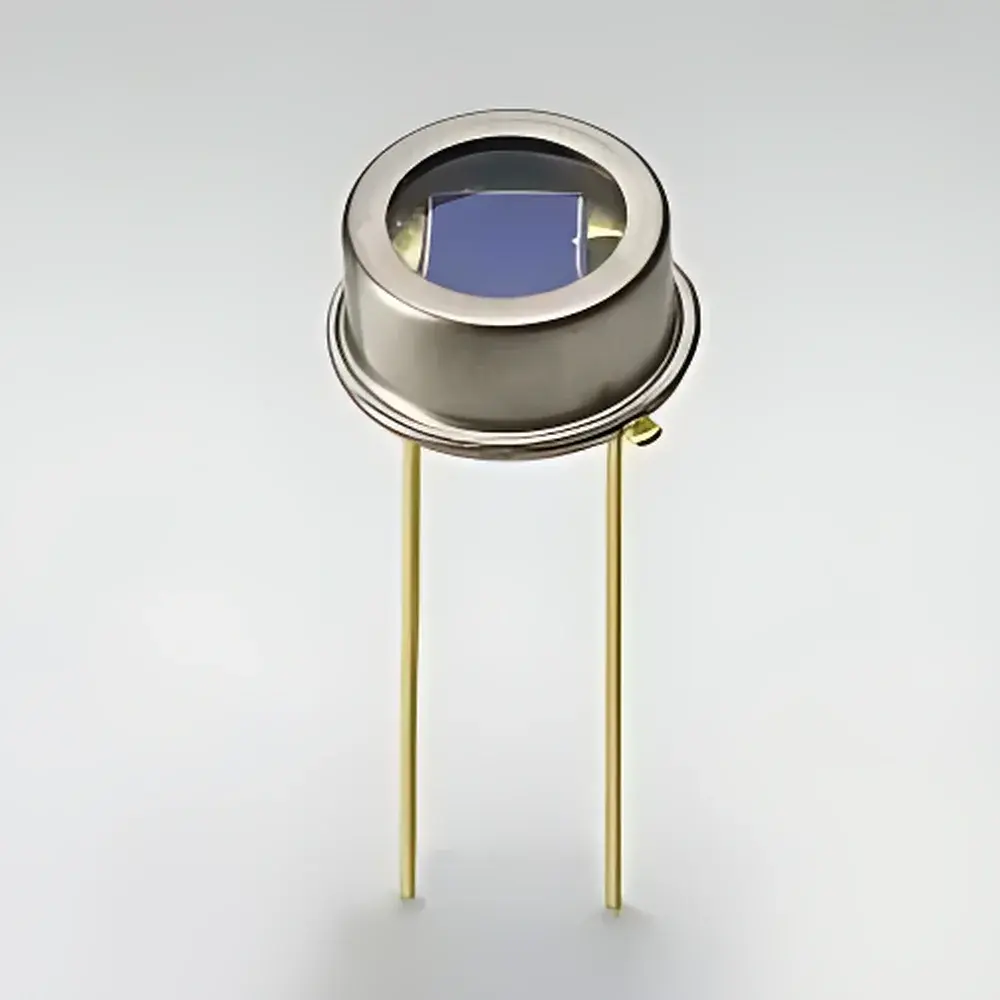
Hamamatsu S1223-01 Silicon Photodiode
| Brand | Hamamatsu |
|---|---|
| Origin | Japan |
| Manufacturer Type | Original Equipment Manufacturer (OEM) |
| Product Category | Imported Optical Component |
| Model | S1223-01 |
| Component Type | Silicon Photodiode |
| Active Area | 3.6 × 3.6 mm² |
| Spectral Range | 320–1100 nm |
| Peak Wavelength | 960 nm |
| Responsivity | 0.52 A/W @ 780 nm |
| Dark Current | 10,000 pA @ VR = 20 V |
| Cutoff Frequency | 20 MHz @ VR = 20 V |
| Junction Capacitance | 20 pF @ VR = 20 V, f = 1 MHz |
| Maximum Reverse Voltage | 30 V |
| Package | TO-5 Metal Can |
| Operating Temperature | Ta = 25 °C (typical) |
Overview
The Hamamatsu S1223-01 is a high-performance, single-element silicon photodiode engineered for precision photometric and radiometric applications across the visible to near-infrared (VIS-NIR) spectrum. Based on a planar-diffused junction structure with a hermetically sealed TO-5 metal package, this device delivers stable spectral response, low noise characteristics, and excellent temporal fidelity—making it suitable for integration into calibrated optical measurement systems, spectrophotometers, laser power monitors, and industrial process control sensors. Its responsivity curve exhibits broad uniformity from 320 nm (UV-A edge) to 1100 nm (beyond the Si bandgap limit), with peak sensitivity at 960 nm—ideal for alignment with common NIR light sources such as InGaAs LEDs and 980 nm pump diodes. The device operates under reverse bias and is optimized for high-speed detection, achieving a −3 dB electrical bandwidth of 20 MHz when biased at 20 V, enabling real-time monitoring of rapidly modulated optical signals.
Key Features
- Single-element silicon photodiode with 3.6 × 3.6 mm² active area for balanced sensitivity and spatial resolution
- Wide spectral response range: 320–1100 nm; peak responsivity at 960 nm (0.52 A/W @ 780 nm)
- Low junction capacitance of 20 pF (measured at VR = 20 V, f = 1 MHz), supporting high-frequency signal integrity
- Fast temporal response: cutoff frequency up to 20 MHz under standard reverse bias conditions (VR = 20 V)
- Robust TO-5 metal-can hermetic packaging ensures long-term stability, thermal resilience, and immunity to environmental contamination
- Maximum reverse voltage rating of 30 V provides operational headroom for circuit design flexibility and noise suppression
- Specified performance parameters are traceable to Hamamatsu’s in-house calibration protocols at Ta = 25 °C, consistent with ISO/IEC 17025-aligned test environments
Sample Compatibility & Compliance
The S1223-01 is compatible with standard analog transimpedance amplifier configurations and OEM optical subassemblies requiring stable, linear photocurrent output. Its metal-can TO-5 housing facilitates direct mounting onto PCBs or mechanical optomechanical stages using industry-standard socketing or soldering techniques. While not a complete system, the component meets RoHS Directive 2011/65/EU compliance requirements and conforms to JEDEC J-STD-020 moisture sensitivity level (MSL) 1 specifications. As a bare photodetector element, it does not carry CE marking or FDA clearance per se—but its performance characteristics align with foundational requirements outlined in IEC 60747-5-2 (semiconductor optoelectronic devices) and ASTM E275 (standard practices for describing and measuring performance of photodetectors).
Software & Data Management
As a passive, analog-output photodiode, the S1223-01 requires external signal conditioning—including transimpedance amplification, filtering, and analog-to-digital conversion—for digitized data acquisition. When integrated into validated instrumentation platforms (e.g., LabVIEW-controlled spectrometers or custom DAQ systems), its linear photocurrent output supports traceable calibration workflows compliant with ISO/IEC 17025 and GLP/GMP documentation standards. Hamamatsu provides comprehensive datasheets with temperature-dependent responsivity curves, dark current vs. bias voltage plots, and spectral response data in CSV format—enabling users to implement correction algorithms for wavelength-specific irradiance quantification. No proprietary firmware or embedded software is associated with this component.
Applications
- High-fidelity optical power monitoring in laser diode characterization setups (e.g., L-I-V testing)
- Spectral sensor elements in compact VIS-NIR absorption and reflectance analyzers
- Reference detectors in radiometric calibration chains traceable to NIST or PTB standards
- Position-sensitive feedback elements in closed-loop optical alignment systems
- Low-noise photodetection in fluorescence lifetime measurement subsystems requiring fast rise time
- OEM integration into medical diagnostic instruments where reliability and long-term drift stability are critical (e.g., pulse oximetry reference channels)
FAQ
What is the recommended reverse bias voltage for optimal linearity and speed?
A reverse bias of 20 V is specified in the datasheet for guaranteed cutoff frequency and junction capacitance performance; operation up to 30 V is permitted but may increase dark current nonlinearly.
Can the S1223-01 be used without cooling in ambient laboratory conditions?
Yes—the device is rated for operation at Ta = 25 °C (typical), and its dark current remains within specification up to +60 °C; however, thermally induced drift should be compensated in high-precision radiometry.
Is the TO-5 package compatible with standard photodiode mounts and collimators?
Yes—the TO-5 metal can features standardized pin spacing and flange dimensions conforming to MIL-STD-1344, enabling direct compatibility with commercial lens tubes, SM1-threaded mounts, and fiber-coupled adapters.
Does Hamamatsu provide NIST-traceable calibration certificates for individual units?
No—calibration is performed at wafer and batch level; end-users requiring unit-level traceability must perform in-house or third-party calibration against primary standards.
How does the S1223-01 compare to PIN photodiodes with epoxy encapsulation?
The hermetic TO-5 metal package offers superior long-term stability, lower outgassing, and enhanced resistance to humidity-induced degradation—critical for vacuum-compatible or field-deployed instrumentation.




