
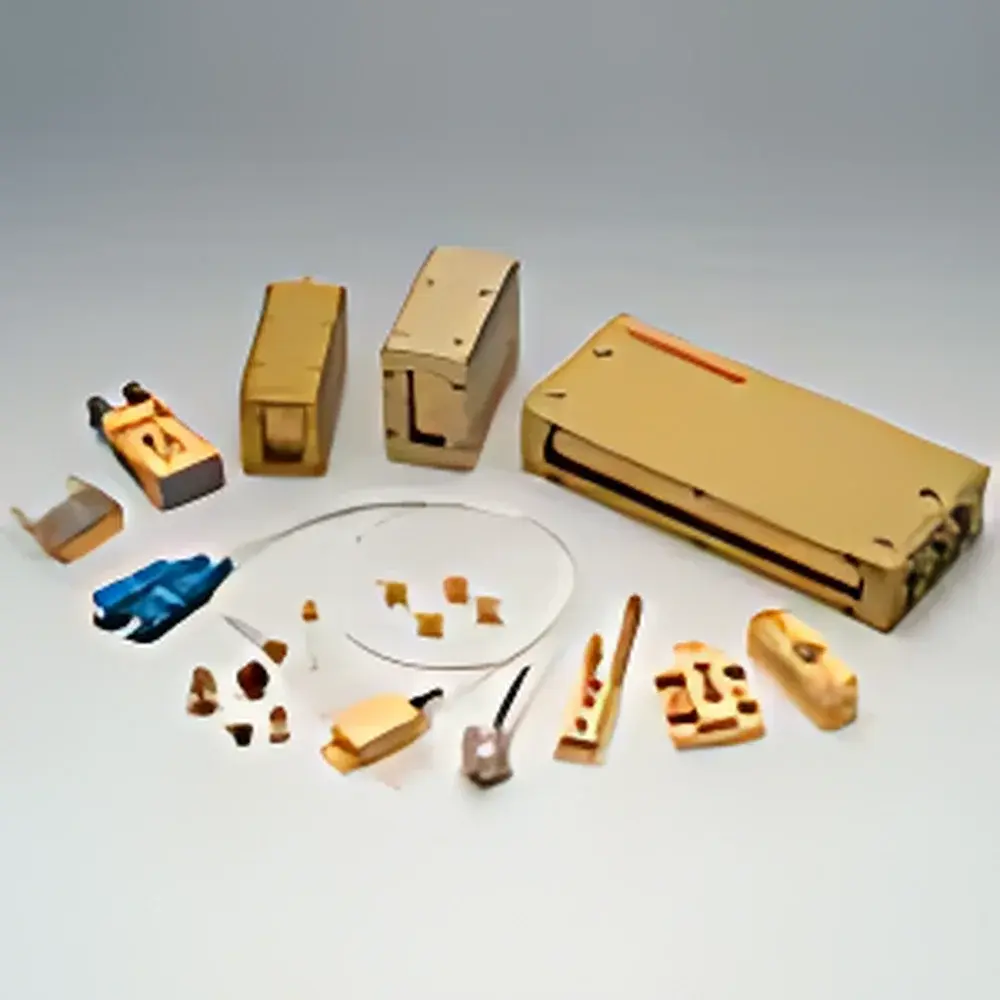
Hamamatsu LD Series Semiconductor Laser Diodes, Bar Modules, Ultrafast Photodetectors & THz Antennas
| Origin | Japan |
|---|---|
| Manufacturer Type | Authorized Distributor |
| Origin Category | Imported |
| Model | L7650 |
| Pricing | Available Upon Request |
Overview
The Hamamatsu LD Series comprises a comprehensive portfolio of high-reliability semiconductor laser diodes (LDs), multi-emitter bar modules, ultrafast photodetectors, and photoconductive terahertz (THz) antennas—engineered for precision optical instrumentation in research, industrial metrology, and advanced manufacturing environments. These devices operate on fundamental principles of stimulated emission in III–V compound semiconductors (e.g., AlGaAs, InGaAs), with emission wavelengths spanning 808 nm to 980 nm for near-infrared (NIR) applications and 830–870 nm for ultrafast and THz-generation configurations. The L7650 model—representing the foundational CW single-emitter platform—delivers stable 850 nm output at 20 mW under 70 mA drive current, optimized for low-noise, long-lifetime operation in closed-loop optical feedback systems. All devices adhere to Hamamatsu’s stringent burn-in and screening protocols, ensuring >10,000 hours MTTF under rated conditions per JIS C 5062 and IEC 60825-1:2014 Class 1/Class 3B laser safety compliance.
Key Features
- Wavelength options from 808 nm to 980 nm, covering key absorption bands for silicon photodetectors, Nd:YAG pumping, and biometric sensing
- Continuous-wave (CW) models with output power ranging from 3 mW (L8414) to 100 W (L8411 bar module), supporting both single-emitter and stacked architectures
- Pulsed variants (e.g., L6690, L7055, L7060) engineered for time-resolved spectroscopy and THz time-domain spectroscopy (THz-TDS), with sub-100 ns pulse widths and peak powers up to 35 W
- Ultrafast photodetectors (e.g., L8414, L10107) featuring <10 ps rise times and integrated RF connectors for direct oscilloscope coupling
- Photoconductive THz antennas (e.g., L11348 series) fabricated on low-temperature-grown GaAs substrates, enabling broadband emission/detection from 0.1–4 THz
- Thermal management solutions including Peltier-cooled packages (L8413), water-cooled modules (L8410, L8412), and hybrid cooling (L8411) compliant with ISO 14644-1 Class 5 cleanroom assembly standards
Sample Compatibility & Compliance
The LD Series is validated for integration into optical calibration systems used in LCD panel luminance uniformity correction, where spatially resolved irradiance mapping requires spectral stability within ±0.5 nm and power drift <±1.5% over 8-hour continuous operation. Devices meet RoHS 2015/863/EU and REACH SVHC requirements. For regulated applications—including medical device manufacturing and pharmaceutical QC—the L7650 and associated modules support full traceability via Hamamatsu’s certified calibration certificates (traceable to NMIJ/AIST, Japan), and are compatible with GLP-compliant data acquisition workflows under 21 CFR Part 11 audit trail requirements when paired with Hamamatsu’s C13271-series DAQ controllers.
Software & Data Management
While the LD Series operates as analog-optical components, system-level integration is supported through Hamamatsu’s LightCrafter™ SDK (v4.2+), providing programmable control of drive current, temperature setpoints (via integrated TEC drivers), and real-time photodiode monitoring. All modules output TTL-synchronized trigger signals for synchronization with external spectrometers, streak cameras, or lock-in amplifiers. Exported measurement logs include timestamped voltage/current/temperature metadata in HDF5 format—natively ingestible by MATLAB, Python (h5py), and LabVIEW™ environments. Firmware updates and device diagnostics are performed via USB-C interface using Hamamatsu’s certified configuration utility, with version history logged in non-volatile memory for GxP audit readiness.
Applications
- LCD/OLED display panel photometric calibration—enabling pixel-level luminance correction using spatial light modulators synchronized to 808/830 nm LD arrays
- Optical encoder and position sensor design—leveraging L8227 12-channel CW array for multi-axis angular displacement detection
- Time-of-flight (ToF) LiDAR development—utilizing L11348-series pulsed stacks for sub-nanosecond gating in automotive and robotics platforms
- THz-TDS systems—integrating L11348 emitters with L8414 detectors for non-destructive testing of polymer composites and pharmaceutical tablet coating thickness analysis
- Laser-induced fluorescence (LIF) excitation in microfluidic cytometers—employing 850 nm (L7650) and 940 nm (L10526) sources for NIR-compatible fluorophore activation
- High-speed optical switching in telecom test benches—using L8410 water-cooled modules for >10 Gb/s intensity modulation under thermal load cycling
FAQ
What is the maximum allowable case temperature for continuous operation of the L7650 diode?
The L7650 is rated for 25 °C heatsink temperature under nominal drive conditions; derating curves are provided in Hamamatsu’s L7650 Datasheet Rev. 4.2 (p. 12).
Are THz antenna modules supplied with bias-T circuits and impedance-matched RF connectors?
Yes—L11348-series antennas include integrated 50 Ω SMA-female RF ports and DC-bias injection capability via built-in bias tees, calibrated to VSWR <1.3 across 0.2–3 THz.
Can the L8411 100 W bar module be operated in quasi-CW mode with 10% duty cycle?
Yes—pulse width modulation up to 1 ms ON time at 10 kHz repetition rate is supported with active water cooling (flow rate ≥2 L/min, ΔT ≤3 K).
Do Hamamatsu LD products include factory calibration reports with spectral radiance measurements?
Spectral calibration (FWHM, centroid wavelength, side-mode suppression ratio) is available upon request as an add-on service (certified to NMIJ SRM-115a reference standard).
Is there a recommended driver for achieving <100 ps current rise time with the L7060 pulsed emitter?
Hamamatsu recommends the C11204-01 high-speed laser driver (20 A peak, <50 ps rise time, 50 Ω matched output) for optimal temporal fidelity in THz generation setups.





