
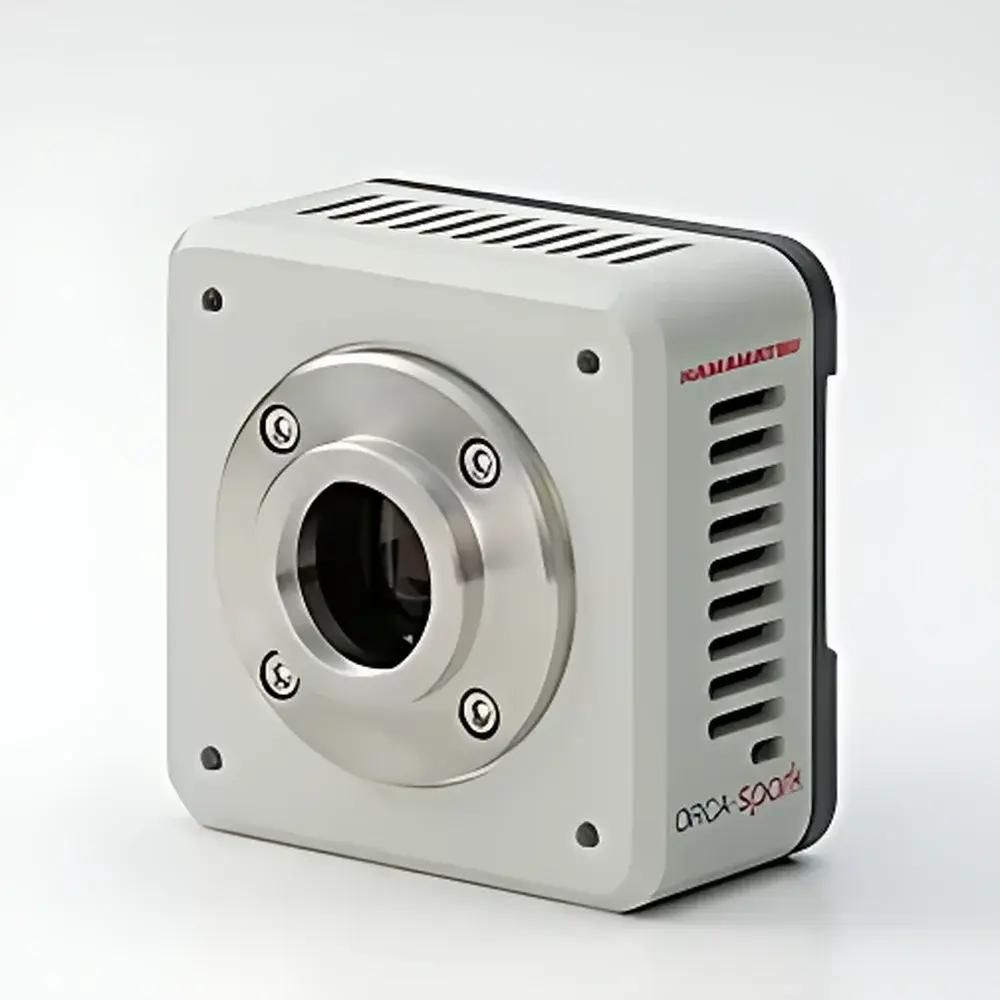
Hamamatsu ORCA®-spark C11440-36U Scientific CMOS Camera
| Brand | Hamamatsu |
|---|---|
| Origin | Japan |
| Manufacturer | Hamamatsu Photonics K.K. |
| Product Category | Imported Scientific Imaging Device |
| Model | C11440-36U |
| Image Resolution | 2.3 MP (1920 × 1200) |
| Readout Speed | 64.9 fps (full resolution), 2008.9 fps (2-row subarray) |
| Read Noise | 6.6 e⁻ RMS |
| Dynamic Range | 5000:1 (typical) |
| Pixel Size | 5.86 µm × 5.86 µm |
| Full Well Capacity | 33,000 e⁻ |
| Exposure Time | 26.17 µs – 10 s |
| Analog Gain | 1× – 15.8× (240 steps) |
| Interface | USB 3.0 Micro-B (USB 3.1 Gen 1 compliant) |
| Shutter Type | Global Shutter |
| ADC | 12-bit |
| Lens Mount | C-mount |
| Operating Temperature | 0–40 °C |
| Power Supply | AC 100–240 V, 50/60 Hz |
| Power Consumption | ~20 VA |
Overview
The Hamamatsu ORCA®-spark C11440-36U is a high-performance scientific complementary metal-oxide-semiconductor (sCMOS) camera engineered for demanding low-light imaging applications in life sciences, materials characterization, and industrial inspection. Built around a 2.3-megapixel global-shutter CMOS image sensor, it delivers precise temporal synchronization across all pixels—eliminating motion-induced distortion during high-speed acquisition of dynamic biological or physical processes. Its architecture prioritizes quantum efficiency, read noise minimization, and dynamic range optimization without compromising frame rate. With a measured read noise of just 6.6 e⁻ RMS and a full-well capacity of 33,000 electrons, the ORCA-spark achieves a typical dynamic range of 5000:1—enabling simultaneous visualization of both dim and saturated signal regions within a single exposure. The camera operates natively at 64.9 frames per second (fps) at full resolution and scales to over 2000 fps in optimized 2-row subarray mode—making it suitable for time-resolved fluorescence, particle tracking, and rapid-stage microscopy.
Key Features
- Global shutter operation ensures artifact-free imaging of fast-moving specimens and synchronized multi-channel acquisitions.
- Low-noise readout electronics deliver 6.6 e⁻ RMS read noise—critical for quantitative intensity measurements in photon-limited regimes.
- High-speed USB 3.0 interface (compliant with USB 3.1 Gen 1) enables sustained data throughput up to 400 MB/s, supporting real-time streaming without frame loss.
- Programmable analog gain (1× to 15.8× in 240 discrete steps) allows fine-tuned signal amplification while preserving digitization fidelity.
- Flexible external triggering supports edge, level, start, and sync-readout modes via SMA input; programmable trigger delay (0–10 s, 1 µs resolution) enables precise temporal alignment with auxiliary hardware.
- C-mount lens interface ensures compatibility with standard microscope objectives and optical train configurations.
- Robust thermal management via forced-air cooling maintains stable sensor performance across extended acquisition sessions (0–40 °C operating range).
Sample Compatibility & Compliance
The ORCA-spark is designed for integration into regulated and research-grade optical systems requiring traceable performance and long-term stability. Its mechanical and electrical specifications conform to CE, FCC Part 15 Class B, and RoHS directives. While not certified under FDA 21 CFR Part 11 or ISO 13485 by default, the camera’s deterministic behavior—including consistent exposure timing, non-volatile configuration storage, and hardware-level trigger logging—supports validation workflows aligned with GLP and GMP principles. It is routinely deployed in applications involving X-ray scintillator readout (e.g., CsI:Tl, Gd₂O₂S), widefield fluorescence microscopy (including TIRF and structured illumination), and microfluidic flow cytometry where pixel-level synchronization and low dark current are essential.
Software & Data Management
Hamamatsu provides the HCImage Live acquisition software (Windows 10/11, 64-bit), offering intuitive control over exposure, gain, ROI selection, subarray mode, and hardware-triggered acquisition sequences. The SDK (HCImage SDK) supports C++, Python (via ctypes or PyHamamatsu wrapper), and MATLAB integration, enabling custom automation, batch processing, and real-time analysis pipelines. All metadata—including exposure time, gain setting, timestamp (with microsecond precision), trigger source, and sensor temperature—is embedded in TIFF and HDF5 file headers. Optional support for NI-IMAQdx and GenICam-compliant drivers facilitates interoperability with third-party platforms such as LabVIEW, Micro-Manager, and MetaMorph.
Applications
- Live-cell fluorescence imaging requiring high temporal fidelity and minimal phototoxicity.
- Quantitative phase contrast and differential interference contrast (DIC) microscopy with pixel-accurate intensity linearity.
- X-ray and electron beam detection using scintillating screens in synchrotron beamlines and electron microscopy facilities.
- High-speed industrial inspection of printed circuit boards, semiconductor wafers, and MEMS devices.
- Time-resolved spectroscopy and pump-probe experiments leveraging precise external trigger synchronization.
- Automated quality control in pharmaceutical manufacturing environments where repeatability and audit-ready data provenance are required.
FAQ
Does the ORCA-spark support hardware binning or on-chip pixel merging?
No—hardware binning is not implemented. However, digital pixel merging (2×2) is available in firmware, applied post-readout without altering sensor charge integration characteristics.
Is the camera compatible with Linux or macOS operating systems?
Native driver support is provided only for Windows. Linux users may access the device via USB Video Class (UVC) fallback mode with limited functionality; macOS compatibility is not supported.
What is the maximum sustained acquisition duration at full resolution and 64.9 fps?
Thermal design permits continuous operation for ≥2 hours under forced-air cooling at ambient temperatures ≤30 °C. Prolonged use above 35 °C may require active environmental conditioning.
Can exposure time be controlled externally with sub-millisecond precision?
Yes—external trigger modes support exposure timing with 1 µs resolution via programmable delay and edge-triggered start/stop signals.
Is the 5000:1 dynamic range measured at unity gain?
Yes—the specified dynamic range reflects the ratio of full-well capacity (33,000 e⁻) to read noise (6.6 e⁻) at 1× analog gain and standard readout settings.



