
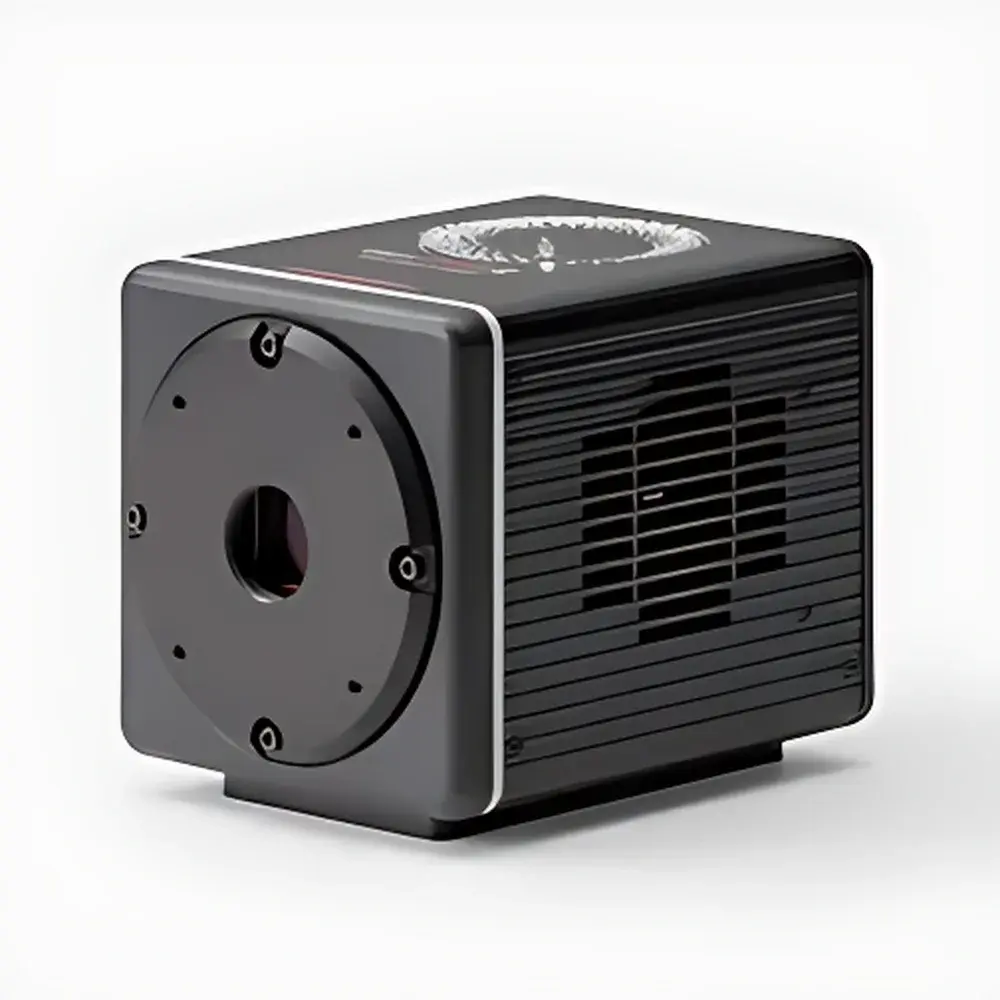
Hamamatsu ORCA-Quest² qCMOS Camera C15550-22UP
| Brand | Hamamatsu |
|---|---|
| Origin | Japan |
| Manufacturer Type | Original Equipment Manufacturer (OEM) |
| Import Status | Imported |
| Model | C15550-22UP |
| Readout Speed | Standard Scan (Normal Region Readout): 120 fps (full resolution, CoaXPress), 17.6 fps (full resolution, USB 3.0) |
| Ultra-Quiet Scan (PNR, Raw) | 25.4 fps (full resolution, CoaXPress), 17.6 fps (full resolution, USB 3.0) |
| Dynamic Range | 23,000:1 (rms, typical), 28,000:1 (median, typical) — calculated from full-well capacity vs. read noise in Ultra-Quiet Scan mode |
| Quantum Efficiency | 85% (peak, typical) |
Overview
The Hamamatsu ORCA-Quest² qCMOS Camera C15550-22UP is a scientific-grade quantitative CMOS imaging sensor engineered for ultra-low-noise, high-dynamic-range fluorescence microscopy, single-molecule localization, light-sheet imaging, and time-resolved biophotonics applications. Built upon Hamamatsu’s proprietary back-illuminated qCMOS architecture, the camera leverages pixel-level correlated multiple sampling (CMS) and on-chip PNR (Photon Number Resolving) capability to achieve sub-electron read noise performance across all operational modes. Its core measurement principle relies on photon-limited signal acquisition with deterministic charge-to-voltage conversion, enabling true quantitative intensity linearity and shot-noise-limited detection sensitivity. Unlike conventional sCMOS sensors constrained by rolling-shutter artifacts or frame-rate penalties under external triggering, the ORCA-Quest² implements a hardware-synchronized, trigger-ready architecture that decouples exposure initiation from data readout—enabling deterministic temporal fidelity without sacrificing throughput.
Key Features
- True zero-latency external triggering: Trigger input is permitted during active sensor readout, eliminating dead time between frames and supporting sustained high-speed acquisition at up to 120 fps (CoaXPress) with precise inter-frame timing control.
- Ultra-Quiet Scan mode: Combines pixel-level CMS, optimized clocking, and low-noise analog front-end design to deliver ≤0.9 e⁻ rms read noise (typical) and dynamic range exceeding 23,000:1 (rms), validated against full-well capacity of 80,000 e⁻.
- Peak quantum efficiency of 85% (typical) at 560 nm, with broad spectral response from 200 nm (deep UV, with optional quartz window) to 1100 nm (NIR), optimized for common fluorophores including GFP, mCherry, Cy5, and IR dyes.
- Dual-interface architecture: Simultaneous CoaXPress 2.0 (up to 12.5 Gbps) and USB 3.2 Gen 1 (5 Gbps) output paths, each with independent trigger-ready signaling (TTL-compatible), jitter ≤1 pixel clock cycle (≤4 ns at 250 MHz), and programmable delay (4H minimum).
- Hardware-based exposure synchronization: Internal exposure timing is fully decoupled from readout; exposure start of the next frame can be initiated during ongoing readout—enabling seamless frame stitching in multi-camera or multi-modal setups compliant with IEEE 1588 Precision Time Protocol (PTP) requirements.
Sample Compatibility & Compliance
The ORCA-Quest² supports standard C-mount and F-mount optical interfaces and is compatible with inverted and upright microscopes from Nikon, Olympus, Zeiss, and Leica via OEM adapter kits. Its mechanical and electrical design conforms to CE, FCC, and RoHS directives. For regulated environments, the camera firmware supports audit-trail-enabling metadata embedding (including timestamp, exposure duration, gain, temperature, and trigger source) aligned with GLP/GMP documentation workflows. While not FDA-cleared as a medical device, its performance characteristics meet ASTM E1957-21 criteria for digital image sensor validation in quantitative biological imaging, and raw data output complies with TIFF 6.0 and HDF5 1.12 specifications for long-term archival integrity.
Software & Data Management
Hamamatsu provides the unified HCImage Live acquisition suite (v6.5+), supporting real-time histogram analysis, ROI-based photon counting, and non-uniformity correction with factory-calibrated flat-field and dark-reference frames. The SDK (C++, Python 3.8+, MATLAB R2021b+) exposes low-level register access for custom timing sequences and hardware-triggered burst acquisition. All acquired data includes embedded EXIF-like metadata compliant with MIAME and FAIR data principles. When integrated with third-party platforms such as Micro-Manager 2.0gamma or NIS-Elements AR, the camera maintains full support for 21 CFR Part 11-compliant electronic signatures and user-access logging when deployed on Windows Server environments with domain authentication.
Applications
- Single-molecule fluorescence tracking requiring photon-counting accuracy and sub-10 ms temporal resolution.
- High-content screening with multi-well plate imaging under pulsed LED illumination and hardware-synchronized exposure gating.
- Light-sheet fluorescence microscopy (LSFM) where inter-frame latency must remain below 1 µs to avoid motion-induced stripe artifacts.
- Time-resolved Förster resonance energy transfer (TR-FRET) assays leveraging precise external trigger alignment with laser pulse trains.
- Quantitative phase imaging (QPI) and digital holographic microscopy (DHM), where linear response over 4.5 decades of intensity enables robust optical path difference reconstruction.
FAQ
Does the ORCA-Quest² support global shutter operation?
No—it uses a true rolling shutter architecture; however, its trigger-ready design and sub-microsecond exposure timing jitter effectively emulate global shutter behavior in externally triggered applications.
What is the maximum sustained acquisition duration in Ultra-Quiet Scan mode?
Limited only by host storage bandwidth and thermal management; continuous acquisition at 25.4 fps (CoaXPress) has been validated for >12 hours with ambient cooling at 20 °C.
Can trigger-ready signals be used for synchronization with other Hamamatsu devices?
Yes—the TTL-compatible trigger-ready outputs are electrically matched to Hamamatsu’s C13440 series cameras and L11640 PMT modules, enabling deterministic multi-sensor synchronization within ±2 ns jitter.
Is dark current compensated in real time during acquisition?
Dark reference frames are applied post-acquisition using factory-measured temperature-dependent models; real-time on-chip dark subtraction is not implemented to preserve photon number resolution fidelity.
How is calibration traceability maintained for quantitative intensity measurements?
Each unit ships with NIST-traceable responsivity calibration data (photons per ADU) measured at 488 nm, 561 nm, and 640 nm, recorded in the sensor’s EEPROM and accessible via SDK query.





