
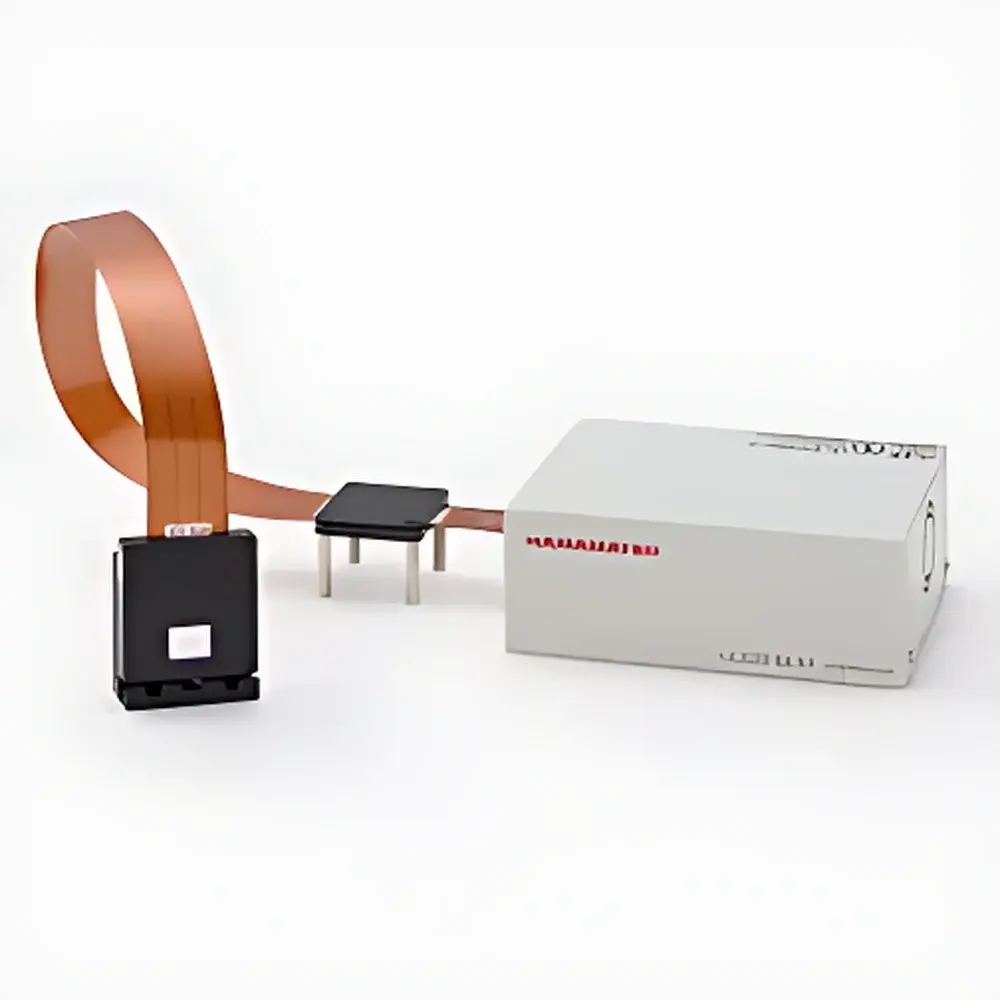
Hamamatsu LCOS-SLM X15213-15R Reflective Pure-Phase Spatial Light Modulator
| Brand | Hamamatsu |
|---|---|
| Origin | Japan |
| Manufacturer | Hamamatsu Photonics K.K. |
| Type | Imported |
| Model | X15213-15R |
| Pricing | Upon Request |
| Pixel Pitch | 12.5 µm |
| Active Area | 15.9 × 12.8 mm |
| Resolution | 1272 × 1024 pixels (SXGA) |
| Fill Factor | 96% |
| Input Interface | DVI-D + USB-B (2.0 High-Speed) |
| DVI Frame Rate | 60 Hz |
| Gray Levels | 256 (8-bit) |
| Max Spatial Resolution | 40 lp/mm |
| Rise Time | 26 ms |
| Fall Time | 135 ms |
| Operating Wavelength (Readout) | 1050 ± 50 nm |
| Design Wavelength (Optimized) | 1550 ± 50 nm |
| Optical Utilization Efficiency | 97% |
| Modulation Type | Reflective, Pure-Phase |
Overview
The Hamamatsu LCOS-SLM X15213-15R is a high-performance reflective spatial light modulator engineered for precision wavefront control in advanced optical systems. Based on silicon-on-insulator liquid crystal on silicon (LCOS) technology, this device operates as a pure-phase modulator—imposing spatially varying phase delays onto incident light without introducing significant amplitude modulation. Its design centers on minimizing optical loss and diffraction artifacts through optimized pixel architecture, high fill factor (96%), and precise voltage-driven liquid crystal alignment. The X15213-15R is specifically calibrated for operation at telecom-band wavelengths (1550 ± 50 nm), with high-efficiency readout performance validated at 1050 ± 50 nm—making it suitable for ultrafast laser shaping, adaptive optics, quantum optics experiments, and coherent beam combining applications where phase fidelity and thermal stability are critical.
Key Features
- Reflective pure-phase modulation architecture enabling high-fidelity wavefront synthesis with minimal intensity distortion
- 1272 × 1024 SXGA-resolution active array with 12.5 µm pixel pitch and 15.9 × 12.8 mm effective aperture
- 97% optical utilization efficiency under specified measurement conditions (λ = 1550 nm), achieved via anti-reflection coatings and minimized inter-pixel gaps
- DVI-D video interface compatibility ensures seamless integration with standard laboratory PCs—no proprietary frame grabbers or drivers required
- Integrated USB-B (2.0 high-speed) port enables real-time firmware updates, calibration data loading, and bidirectional communication with host software
- Robust phase linearity and low hysteresis across the full 8-bit (256-level) grayscale range, supported by factory-applied pixel-wise nonlinearity correction maps
- Thermally stable LCOS substrate designed for continuous-wave and pulsed high-power laser exposure up to Class 4 levels at 1550 nm
Sample Compatibility & Compliance
The X15213-15R is compatible with collimated, polarized input beams aligned to its specified angle of incidence (typically 45°). It supports both linear and circular polarization states when used with appropriate quarter-wave plates. The device complies with IEC 61000-6-3 (EMC emission standards) and IEC 61000-6-2 (immunity requirements) for laboratory instrumentation. While not certified for medical or aerospace use out-of-the-box, its hardware architecture meets baseline requirements for integration into ISO/IEC 17025-accredited optical metrology setups and GLP-compliant adaptive optics test benches. All calibration files—including phase-response LUTs and pixel defect maps—are stored onboard and traceable to Hamamatsu’s internal metrology lab (JCSS-accredited for radiometric and photometric measurements).
Software & Data Management
Hamamatsu provides the SLM Control Studio suite—a platform-independent application supporting Windows, Linux, and macOS—for real-time phase pattern generation, gamma correction, and temporal sequence scripting. The software exports phase maps in standard formats (e.g., .bmp, .tiff, .bin) and supports Python API integration via ctypes-based bindings for custom algorithm development. Audit-trail logging (including timestamped pattern uploads, parameter changes, and system health reports) can be enabled to satisfy internal QA documentation requirements. For regulated environments, optional configuration packages support 21 CFR Part 11-compliant electronic signatures and user-access role definitions—though full validation must be performed by the end-user per their SOPs.
Applications
- Adaptive optics correction in astronomical telescopes and ophthalmic imaging systems
- Dynamic holography and computer-generated hologram (CGH) projection for optical trapping and structured illumination microscopy
- Ultrafast pulse shaping using 4f spectral filtering configurations
- Coherent beam combining in fiber laser arrays and solid-state amplifier systems
- Quantum information experiments requiring deterministic single-photon wavefront engineering
- Calibration of Shack–Hartmann sensors and interferometric wavefront analyzers
FAQ
What is the maximum average optical power density the X15213-15R can withstand at 1550 nm?
The device is rated for continuous-wave irradiance up to 5 W/cm² at 1550 nm with proper heat sinking; pulsed operation (e.g., nanosecond pulses at 10 kHz repetition rate) is qualified up to 10 MW/cm² peak intensity.
Is the phase response temperature-stabilized?
No active thermal regulation is built-in, but the silicon substrate provides low thermal expansion (2.6 ppm/K) and the LC layer exhibits <0.02 rad/°C phase drift over 20–30°C ambient range when operated within specification.
Can I load custom phase patterns programmatically?
Yes—via the provided DLL libraries or Python bindings, users may generate and upload arbitrary 1272 × 1024 phase maps at up to 60 Hz frame rate using DVI-D output.
Does the unit include factory calibration data?
Each shipped unit includes a serialized calibration certificate with measured phase uniformity map, pixel defect list, and grayscale-to-phase transfer function (GTF) LUT stored in non-volatile memory.
Is USB-B used for data transfer or only for firmware?
USB-B serves dual roles: firmware updates and real-time transmission of auxiliary metadata (e.g., synchronization triggers, status flags); all primary phase pattern data flows exclusively over DVI-D.





