
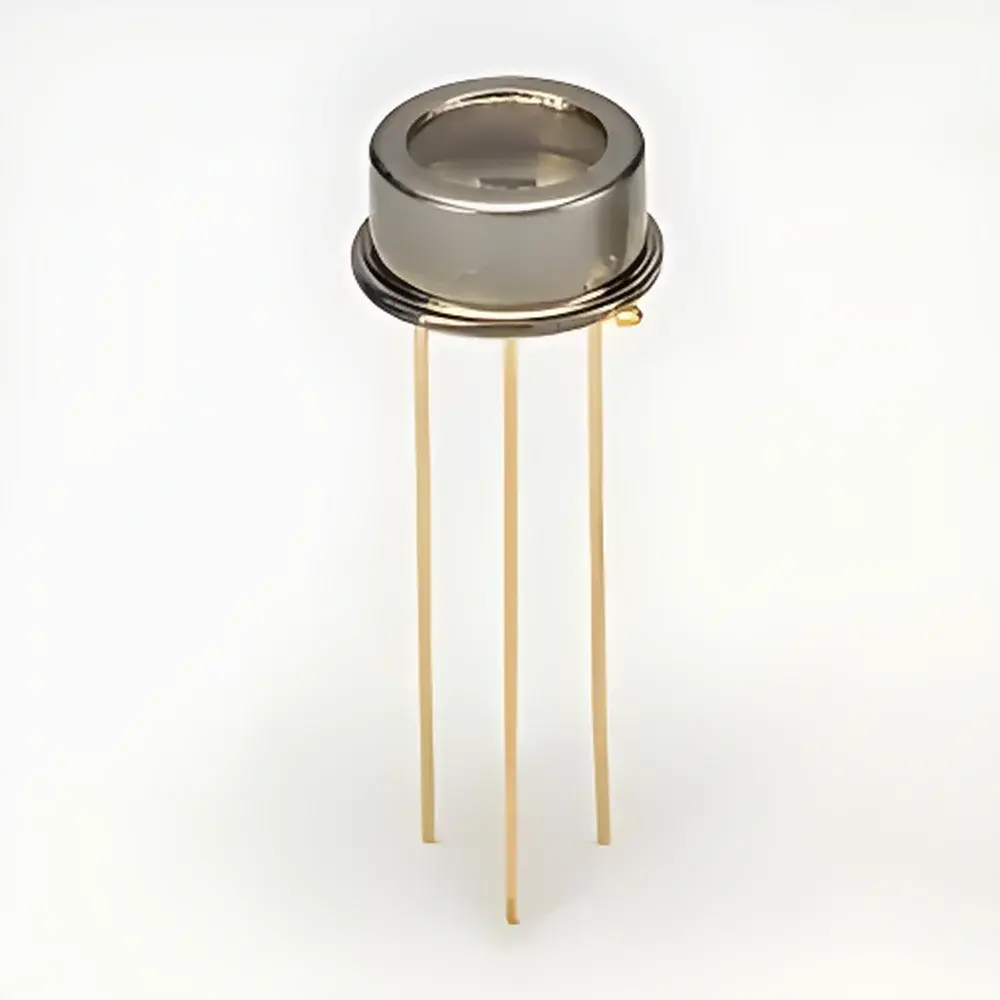
Hamamatsu InGaAs Photovoltaic Detector P10090-01
| Brand | Hamamatsu |
|---|---|
| Origin | Japan |
| Manufacturer Type | Original Equipment Manufacturer (OEM) |
| Product Origin | Imported |
| Model | P10090-01 |
| Price Range | USD 1,350 – 2,700 |
Overview
The Hamamatsu P10090-01 is a high-performance, photovoltaic-mode indium gallium arsenide (InGaAs) infrared detector engineered for precision spectral detection in the 2.0–3.4 µm wavelength range, with peak responsivity centered near 3.0 µm. Unlike photoconductive detectors such as legacy PbS devices, the P10090-01 operates without bias voltage, eliminating dark current drift and enabling inherently lower noise performance and superior long-term stability. Its monolithic photovoltaic architecture delivers fast temporal response (typical rise time < 100 ns), making it suitable for time-resolved IR spectroscopy, tunable diode laser absorption spectroscopy (TDLAS), and real-time gas concentration monitoring in industrial and environmental applications. Designed and manufactured in Japan under ISO 9001-certified cleanroom conditions, the device meets stringent requirements for reproducibility and inter-unit consistency—critical for calibrated field-deployable gas analyzers and OEM integration into continuous emission monitoring systems (CEMS).
Key Features
- Photovoltaic operation: Zero-bias design ensures minimal 1/f noise and thermal drift, supporting stable DC-coupled signal acquisition
- Enhanced detectivity (D*): Optimized for 3.0 µm band, achieving D* > 1 × 1011 cm·√Hz/W at 295 K—comparable to PbS but with superior speed and reliability
- Low-noise performance: 30% reduction in RMS noise density relative to Hamamatsu’s prior-generation P8079 series under identical optical and thermal conditions
- Hermetically sealed TO-8 package with AR-coated silicon window (transmission > 92% from 2.0–3.4 µm)
- Operating temperature range: −40 °C to +85 °C; storage range: −40 °C to +100 °C
- OEM-ready interface: Standard 4-pin configuration with defined pinout per Hamamatsu datasheet Rev. E (2023)
Sample Compatibility & Compliance
The P10090-01 is optimized for detecting mid-infrared absorption features of key environmental and industrial gases—including CO, CO₂, CH₄, NO, N₂O, and H₂S—whose fundamental vibrational bands fall within its spectral response window. When integrated into extractive or open-path gas analyzers, it supports compliance with EPA Method 3A (for CO/CO₂), EN 15267-3 (performance certification of CEMS), and ISO 14064-1 (GHG quantification). The detector itself conforms to RoHS Directive 2011/65/EU and REACH Regulation (EC) No. 1907/2006. Its hermetic packaging satisfies IEC 60068-2-68 for dust and moisture resistance (IP54 equivalent), ensuring robustness in outdoor monitoring enclosures.
Software & Data Management
While the P10090-01 is a bare detector element (no onboard electronics), it is fully compatible with industry-standard low-noise transimpedance amplifiers (e.g., Femto DHPCA-100, Stanford Research SR570) and data acquisition platforms compliant with NI-DAQmx, MATLAB Data Acquisition Toolbox, or LabVIEW Real-Time. Hamamatsu provides comprehensive calibration reports traceable to NIST standards, including spectral responsivity curves (±2% uncertainty), NEP values, and linearity characterization (R² > 0.9999 over 5-decade dynamic range). For regulated environments, integration with FDA 21 CFR Part 11-compliant software (e.g., Thermo Fisher OMNIC Paradigm, Siemens Desigo CC) enables full audit trail, electronic signature, and data integrity management in GLP/GMP-aligned QA/QC workflows.
Applications
- Continuous emissions monitoring (CEM) for combustion sources (boilers, incinerators, cement kilns)
- Portable and fixed-mount methane leak detection systems (LDAR programs per EPA OOOOa)
- Industrial process control in petrochemical refining and syngas production
- Atmospheric research instrumentation (FTIR spectrometers, solar occultation sensors)
- OEM integration into multi-gas analyzers with dual-beam referencing and temperature-stabilized optics
- Calibration transfer standards for field-deployable IR sensors requiring traceable responsivity
FAQ
Is the P10090-01 suitable for room-temperature operation without thermoelectric cooling?
Yes. It is specifically designed for uncooled operation at ambient temperatures (20–25 °C), with performance specifications validated at 295 K.
What is the recommended load resistance for optimal SNR in DC-coupled configurations?
A 10 kΩ–100 kΩ transimpedance gain is typically used; exact value depends on amplifier noise floor and required bandwidth—see Hamamatsu Application Note AN-003-2022.
Can this detector be supplied in linear array format?
Yes. Custom multi-element arrays (up to 16-element linear configurations) are available under NDA; contact Hamamatsu OEM Solutions for mechanical drawings and ROHS-compliant assembly options.
Does Hamamatsu provide spectral calibration certificates with each unit?
Yes. Every shipped P10090-01 includes a factory calibration certificate with spectral responsivity, NEP, and linearity data, traceable to NIST SRM 2210b.
How does the P10090-01 compare to InSb or MCT detectors in the 3 µm region?
It offers comparable responsivity to cooled InSb/MCT at significantly lower system cost and power consumption, though with reduced sensitivity beyond 3.2 µm where those materials extend further.







