
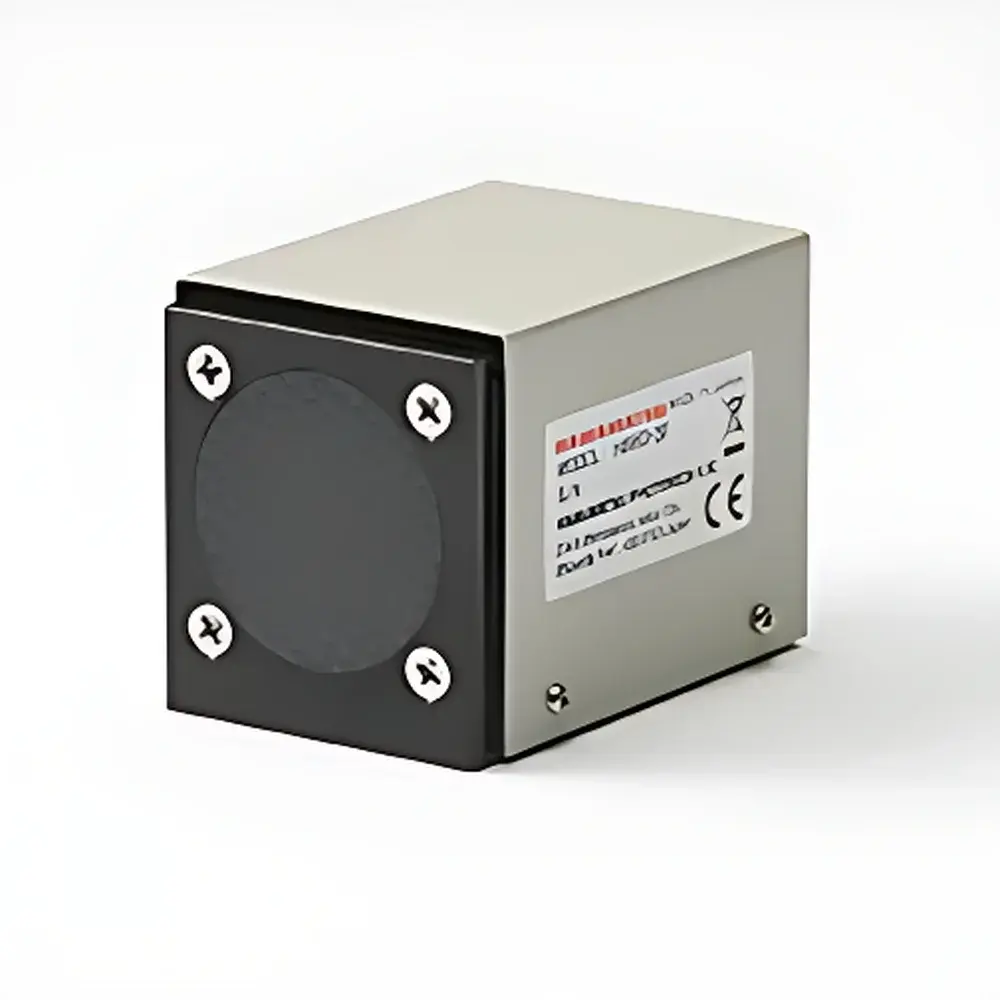
Hamamatsu H8953-30 Compact X-ray CMOS Camera
| Brand | Hamamatsu |
|---|---|
| Origin | Japan |
| Manufacturer | Hamamatsu Photonics K.K. |
| Product Type | Imported Industrial X-ray Imaging Camera |
| Model | H8953-30 |
| Image Resolution | 20 Lp/mm (typ.) |
| Pixel Size | 5.86 × 5.86 µm (H × V) |
| Effective Field of View | 20 × 12.5 mm |
| Sensor Format | 1/1.2" Global Shutter CMOS |
| Active Pixels | 1936 × 1216 |
| Bit Depth | 8/10/12-bit selectable |
| Max Frame Rate | 165.5 fps |
| Power Input | PoCL (12 ± 10% V, 2.76 W) or 4-pin connector (12–24 ± 10% V) |
| Operating Temperature | +10 to +40 °C |
| Humidity | <60% RH (non-condensing) |
| Scintillator | CsI(Tl) deposited on carbon-fiber reinforced polymer (CFRP) entrance window |
Overview
The Hamamatsu H8953-30 is a compact, high-sensitivity X-ray imaging camera engineered for industrial non-destructive testing (NDT) and real-time radiographic inspection. It integrates a custom-designed thallium-doped cesium iodide (CsI:Tl) scintillator directly bonded to a high-performance global shutter CMOS image sensor—specifically the JAI GO-2400M-PMCL—enabling efficient X-ray photon conversion with minimal spatial distortion and high modulation transfer function (MTF). Unlike conventional indirect-conversion detectors relying on fiber-optic tapers or lens coupling, the H8953-30 employs a direct-deposition architecture on a lightweight carbon-fiber reinforced polymer (CFRP) entrance window, ensuring mechanical robustness, thermal stability, and minimal absorption in the diagnostic and industrial X-ray energy range (typically 20–150 kVp). Its palm-sized form factor (approx. 90 × 70 × 45 mm) and low power consumption (<2.76 W) make it suitable for integration into portable NDT systems, inline quality assurance stations, and space-constrained X-ray cabinets.
Key Features
- Compact footprint (90 × 70 × 45 mm) with integrated CsI:Tl scintillator on CFRP substrate — optimized for geometric magnification and reduced parallax error
- 1/1.2″ global shutter CMOS sensor (1936 × 1216 active pixels) delivering high temporal fidelity for dynamic inspection sequences
- Pixel pitch of 5.86 µm enabling Nyquist-limited resolution up to 20 line pairs per millimeter (Lp/mm) at typical 100 kVp tube voltage and moderate geometric magnification (1.4× to 3.1×)
- Flexible bit-depth output: 8-, 10-, or 12-bit pixel data via Camera Link interface; supports partial readout modes including single and multiple regions of interest (ROI)
- Power-over-Camera-Link (PoCL) compatibility alongside optional 4-pin DC input (12–24 V), simplifying system cabling and reducing EMI susceptibility
- Onboard video processing: real-time scratch correction, gamma adjustment, and automatic level control (ALC) with integration time range from 79 µs to 8 s (10-bit mode)
Sample Compatibility & Compliance
The H8953-30 is validated for use with sealed-tube and microfocus X-ray sources operating between 20 kV and 150 kV. Its CsI:Tl scintillator exhibits peak quantum detection efficiency (QDE) above 65% at 40–80 keV, making it particularly well-suited for inspecting lithium-ion battery cells, flexible printed circuit boards (FPCBs), solder joints, composite laminates, and thin-walled metal components. The device conforms to IEC 61223-3-5 for acceptance and constancy testing of X-ray imaging systems and supports traceable calibration protocols aligned with ASTM E2737 (Standard Practice for Digital Detector Array Performance Evaluation). While not a medical device, its performance metrics meet requirements for ISO 17025-accredited NDT laboratories performing internal audits under EN ISO 9712 or ASNT SNT-TC-1A guidelines.
Software & Data Management
The camera operates natively with standard Camera Link frame grabbers (e.g., Teledyne DALSA, Euresys, BitFlow) and is supported by Hamamatsu’s proprietary HCImage Live software for acquisition, real-time contrast enhancement, and MTF analysis. Third-party SDKs (C/C++, Python, LabVIEW) enable integration into custom QA/QC workflows compliant with FDA 21 CFR Part 11 (electronic records/signatures) when deployed with audit-trail-enabled host applications. Raw frame buffers support TIFF, HDF5, and DICOM-SR export formats—facilitating long-term archiving, AI-based defect classification training, and cross-platform interoperability within enterprise PLM or MES environments.
Applications
- Real-time X-ray inspection of lithium-ion battery electrodes, separators, and protection circuit modules (PCBMs)
- In-line void and bridging detection in BGA and QFN solder joints during electronics manufacturing
- Porosity and inclusion analysis in aluminum die-castings and additive-manufactured titanium parts
- Geometric magnification imaging of microfluidic devices and MEMS packaging
- Field-deployable NDT for aerospace composite repair verification and weld integrity screening
FAQ
What X-ray energy range is the H8953-30 optimized for?
The CsI:Tl scintillator and thin CFRP window provide optimal sensitivity between 30 keV and 90 keV, with usable response extending from 20 keV to 150 keV depending on beam filtration and detector alignment.
Does the camera support synchronization with pulsed X-ray sources?
Yes — the global shutter CMOS sensor and programmable trigger delay (0–100 ms, 1 µs resolution) enable precise external synchronization with gated X-ray generators or rotating anode tubes.
Is dark current correction included in firmware?
Yes — factory-calibrated offset maps are applied per-frame; user-updatable dark frames can be acquired and stored for extended integration times.
Can the H8953-30 be used in vacuum or high-radiation environments?
No — it is rated for ambient air operation only (IP20 enclosure); prolonged exposure to >100 mGy/h cumulative dose may degrade scintillator light yield.
What is the maximum sustained frame rate at full resolution and 12-bit depth?
165.5 fps is achievable at 1936 × 1216 with 8-bit output; at 12-bit, maximum frame rate reduces to 112.3 fps due to Camera Link bandwidth constraints.




