
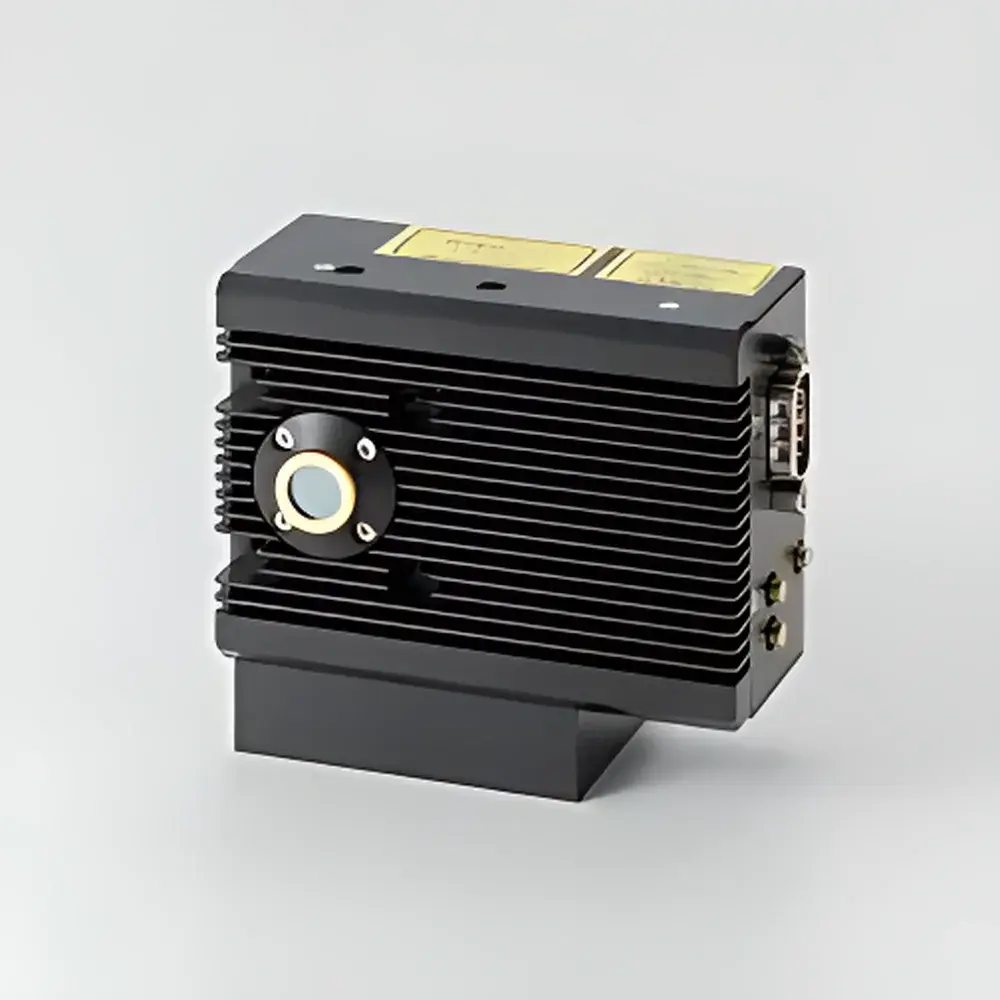
Hamamatsu C11635 TO-8 Pulsed Quantum Cascade Laser Driver
| Brand | Hamamatsu |
|---|---|
| Origin | Japan |
| Manufacturer Type | Original Equipment Manufacturer (OEM) |
| Product Category | Imported Instrumentation |
| Model | C11635 |
| Core Component | Pulsed Semiconductor Laser Driver for TO-8-Packaged QCLs |
| Pulse Width | 10 ns (typ.) |
| Repetition Rate | < 1 MHz |
| Output Noise | Low, Optimized for Spectroscopic Stability |
| Mounting Form Factor | Integrated OEM Module Designed for In-Instrument Installation |
| Compatible Optical Interface | Direct integration with Aspheric ZnSe Lens Unit A11331-0xH |
Overview
The Hamamatsu C11635 is a compact, OEM-grade pulsed current driver engineered specifically for quantum cascade lasers (QCLs) housed in standard TO-8 metal can packages. It operates on the principle of precision-controlled current pulsing to enable time-resolved mid-infrared (MIR) emission from QCLs—critical for high-sensitivity absorption spectroscopy, trace gas detection, and industrial process monitoring. Unlike continuous-wave (CW) drivers, the C11635 delivers nanosecond-scale current pulses with minimal overshoot and ringing, preserving laser diode integrity while maximizing peak optical power. Its low-noise design minimizes amplitude jitter and baseline drift, ensuring spectral stability essential for Fourier-transform infrared (FTIR)-compatible or direct-absorption measurement architectures. The module is not intended as a benchtop instrument but rather as a fully integrated subsystem—designed for embedding into larger analytical platforms such as portable gas analyzers, environmental monitoring stations, or laboratory-grade tunable laser spectrometers.
Key Features
- Optimized pulse generation for TO-8-packaged QCLs, supporting direct mechanical and electrical interfacing without adapter boards or custom fixtures.
- Typical pulse width of 10 ns—engineered to match the gain recovery time of mid-IR QCL active regions, enabling efficient photon extraction and reduced thermal loading.
- Maximum repetition rate below 1 MHz, configurable via external TTL trigger input; supports both internally gated and externally synchronized operation modes.
- Low-output-current-noise architecture (< 100 µA RMS over 10 kHz–10 MHz bandwidth), verified under load conditions typical of 100–500 Ω QCL dynamic impedance.
- Thermally stable current regulation circuitry with integrated temperature monitoring output (analog voltage proportional to internal heatsink temperature), facilitating system-level thermal management.
- Compact footprint (32.5 × 22.5 × 12.5 mm) and through-hole or surface-mount compatible PCB layout—designed for high-density instrument integration.
Sample Compatibility & Compliance
The C11635 is mechanically and electrically compatible with all industry-standard TO-8-can QCLs operating in the 4–12 µm wavelength range, including those from Hamamatsu Photonics, Thorlabs, and Block Engineering. It supports direct coupling to Hamamatsu’s aspheric ZnSe collimating lens unit A11331-0xH, enabling rapid beam shaping without realignment. From a regulatory standpoint, the driver complies with IEC 61000-6-3 (emission) and IEC 61000-6-2 (immunity) for industrial environments. While not certified as a standalone medical or safety-critical device, its design adheres to IPC-A-610 Class 2 workmanship standards and incorporates reinforced creepage/clearance distances suitable for Class I insulation per IEC 60950-1. No CE marking is applied, as it is supplied exclusively as an embedded component—not a final-user product.
Software & Data Management
As a hardware-only analog driver, the C11635 does not include onboard firmware, USB interface, or digital control bus. It accepts only TTL-level trigger signals (3.3 V / 5 V compatible) and analog current-set inputs (0–5 V, corresponding to 0–1.5 A typical output range). Integration with host systems requires external microcontroller or FPGA-based timing controllers capable of generating sub-microsecond jitter-free triggers. For traceable calibration and GLP/GMP-aligned instrumentation, users are advised to log trigger timing, set-voltage values, and thermal sensor outputs via their host DAQ system. While the C11635 itself provides no audit trail, its deterministic analog behavior enables full reproducibility when paired with compliant data acquisition hardware meeting FDA 21 CFR Part 11 requirements for electronic records.
Applications
- Portable and fixed-site trace gas analyzers for NH₃, CH₄, CO, NOₓ, and VOCs using pulsed QCL-based direct absorption or wavelength modulation spectroscopy (WMS).
- OEM integration into FTIR accessories requiring synchronized pulsed MIR sources for rapid-scanning or step-scan interferometry.
- Research-grade laser diagnostics in combustion chambers and plasma reactors, where nanosecond temporal resolution is required to resolve transient species kinetics.
- Industrial leak detection systems operating in hazardous area zones (when installed within appropriately rated enclosures).
- Calibration sources for infrared radiometers and spectral radiance standards in metrology laboratories.
FAQ
Is the C11635 compatible with QCLs other than Hamamatsu’s TO-8 devices?
Yes—provided the QCL uses a standard TO-8 mechanical footprint and exhibits comparable forward voltage and dynamic impedance characteristics. Users must verify pinout alignment and thermal interface requirements independently.
Does the driver include built-in temperature control or TEC drive capability?
No. The C11635 provides only pulsed current drive. External thermoelectric cooler (TEC) control must be implemented separately using a dedicated TEC controller matched to the QCL’s thermal load.
Can pulse width or shape be adjusted via external control?
Pulse width is fixed by internal circuit topology (10 ns typ.). Rise/fall times may vary slightly with load capacitance, but no user-adjustable shaping features are included.
What is the maximum recommended average power dissipation during continuous operation?
When mounted on a 25 cm² aluminum heatsink with forced air cooling (1 m/s airflow), sustained operation at 500 kHz repetition rate and 1.2 A peak current is supported per Hamamatsu’s thermal derating guidelines.
Is documentation available in English with schematics and layout recommendations?
Yes—Hamamatsu provides an English-language datasheet (PN: C11635-DATA-EN), application note AN-QCL-DRV-01, and Gerber files for reference PCB layout upon NDA execution with authorized distributors.






