
OK-TS-9 Custom Thermal Shock Test Chamber
| Brand | OK Instruments |
|---|---|
| Origin | Guangdong, China |
| Manufacturer Type | Manufacturer |
| Origin Category | Domestic |
| Model | OK-TS-9 |
| Price | ¥89,000 |
| High-Temperature Range (°C) | 150 |
| Low-Temperature Range (°C) | -40 |
| Thermal Shock Range (°C) | -40 to 150 |
| Temperature Stability (°C) | ±2 |
| Heating Rate (°C/min) | 10 |
| Cooling Rate (°C/min) | 10 |
Overview
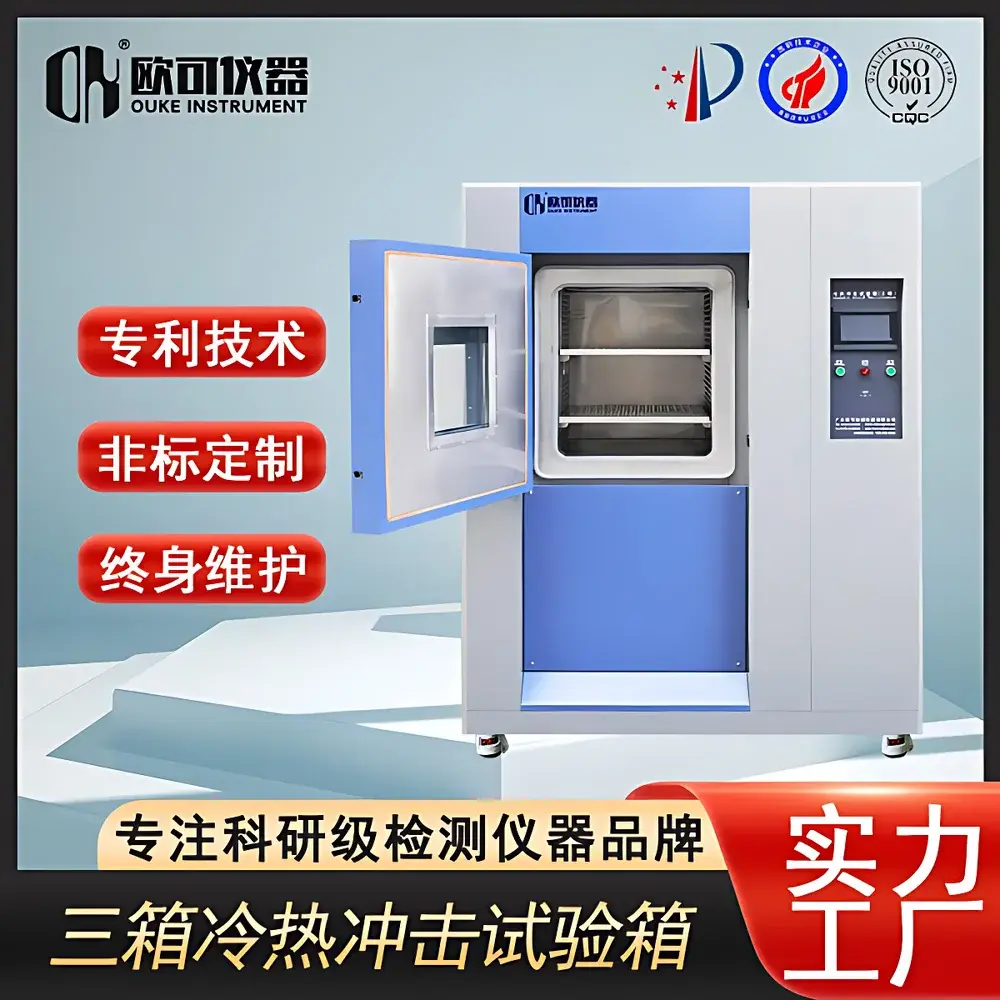
The OK-TS-9 Custom Thermal Shock Test Chamber is an engineered environmental test system designed to evaluate the structural integrity, material compatibility, and functional reliability of electronic components, automotive modules, aerospace assemblies, and industrial materials under rapid, repetitive transitions between extreme high- and low-temperature conditions. Based on the two-zone (hot/cold) forced-air thermal shock architecture, the chamber employs independent refrigeration and heating circuits with pneumatically actuated sample transfer to achieve precise, repeatable thermal cycling—critical for simulating real-world operational stresses such as solder joint fatigue, seal degradation, or delamination in multilayer substrates. Its design complies with the fundamental thermal shock test methodology defined in IEC 60068-2-14 (Test N), MIL-STD-810H Method 503.7, and GB/T 2423.22—ensuring data traceability and test validity for qualification and accelerated life testing.
Key Features
- Independent dual-zone temperature control: Separated hot chamber (up to +150 °C) and cold chamber (down to −40 °C), minimizing cross-contamination and enabling stable setpoint maintenance.
- Pneumatic basket transfer mechanism: Achieves ≤10-second transition time between zones, meeting stringent timing requirements for qualification-grade thermal shock protocols.
- High-fidelity temperature stability: ±2 °C uniformity across the working volume under no-load conditions, verified per IEC 60068-3-5.
- Controlled ramp rates: Programmable heating and cooling at 10 °C/min (typical), supporting both standard and custom-defined thermal profiles (e.g., dwell time, cycle count, ramp slope).
- SUS304 stainless steel interior: Seamless welded construction with 100 mm thick polyurethane insulation (foam density ≥40 kg/m³) ensures long-term thermal efficiency and corrosion resistance.
- Integrated safety architecture: Independent over-temperature cut-off, compressor high-pressure/low-pressure protection, phase failure detection, and leakage current monitoring—all compliant with IEC 61000-6-2 EMC and IEC 61000-6-4 emission standards.
Sample Compatibility & Compliance
The OK-TS-9 accommodates samples up to standard internal dimensions (depth × width × height, customizable upon request), with optional through-wall ports (Φ25–Φ50 mm) for power, signal, or fluid routing during active testing. Load capacity supports passive thermal mass up to 15 kg; active thermal loading (e.g., powered PCBs) requires pre-validation to maintain specified ramp rates and stability. All configurations meet GLP-relevant documentation requirements—including factory calibration certificates traceable to NIM (National Institute of Metrology, China) and full performance validation reports (empty-load temperature mapping, transition time verification, stability verification). Optional upgrade paths include ISO/IEC 17025-compliant third-party certification and audit-ready 21 CFR Part 11–enabled data logging.
Software & Data Management
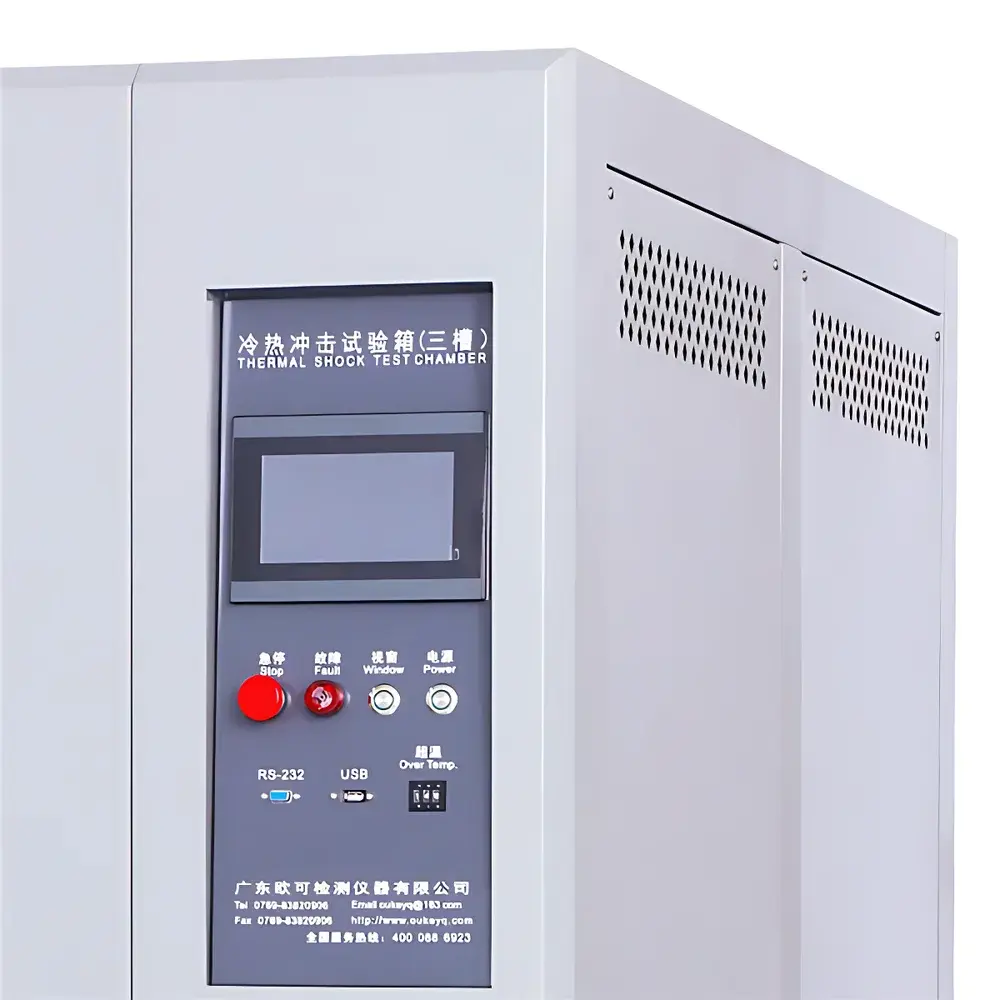
Equipped with a programmable 10.4″ color touchscreen controller (OYO 8226 or equivalent), the system supports multi-segment thermal profiles, real-time graphing, and event-triggered data capture. Standard USB export enables CSV-formatted temperature logs with timestamps, channel ID, and alarm status. Optional Ethernet (RJ45) connectivity enables remote monitoring via Modbus TCP or HTTP API, integration into MES/LIMS environments, and automated report generation. Audit trail functionality records all parameter changes, user logins, and system events—supporting GMP/GLP-aligned quality systems and internal QA review processes.
Applications
- Electronics reliability: Solder joint evaluation per IPC-9701, BGA interconnect fatigue, conformal coating adhesion under thermal cycling.
- Automotive electronics: ECUs, sensors, and infotainment units per AEC-Q200 stress screening and qualification.
- Aerospace components: Avionics housings, composite fasteners, and optical mounts subjected to MIL-STD-810H thermal shock validation.
- Medical devices: Sterile packaging integrity, polymer-based implant housings, and battery management systems under regulatory thermal aging protocols.
- Materials science: Coefficient of thermal expansion (CTE) mismatch analysis, adhesive bond strength degradation, and phase-change behavior in phase-change materials (PCMs).
FAQ
What international standards does the OK-TS-9 support out of the box?
It natively supports test execution per IEC 60068-2-14, GB/T 2423.22, and MIL-STD-810H Method 503.7. Custom profile libraries can be loaded to replicate JEDEC JESD22-A104 or ASTM D6987 requirements.
Can the chamber accommodate powered devices during thermal shock cycles?
Yes—optional feedthrough ports (with EMI shielding) and load-rated internal wiring allow real-time electrical biasing and signal monitoring during cycling. Power dissipation must be declared during specification finalization.
Is third-party calibration and validation available before shipment?
Yes—NIST-traceable calibration (temperature sensors, controllers) and full IEC 60068-3-5 compliance verification (uniformity, stability, transition time) are available as add-on services with formal certificate issuance.
What is the typical lead time for a fully customized OK-TS-9 configuration?
Standard configurations ship within 6–8 weeks; fully engineered variants (e.g., non-standard dimensions, special gas purge, integrated data acquisition) require 10–14 weeks from technical agreement sign-off.
Does the system support automated pass/fail reporting aligned with internal QA workflows?
Yes—via optional software module, users can define acceptance criteria (e.g., max deviation, dwell tolerance), auto-generate PDF test reports with digital signatures, and export results directly to SharePoint or QMS platforms.



