
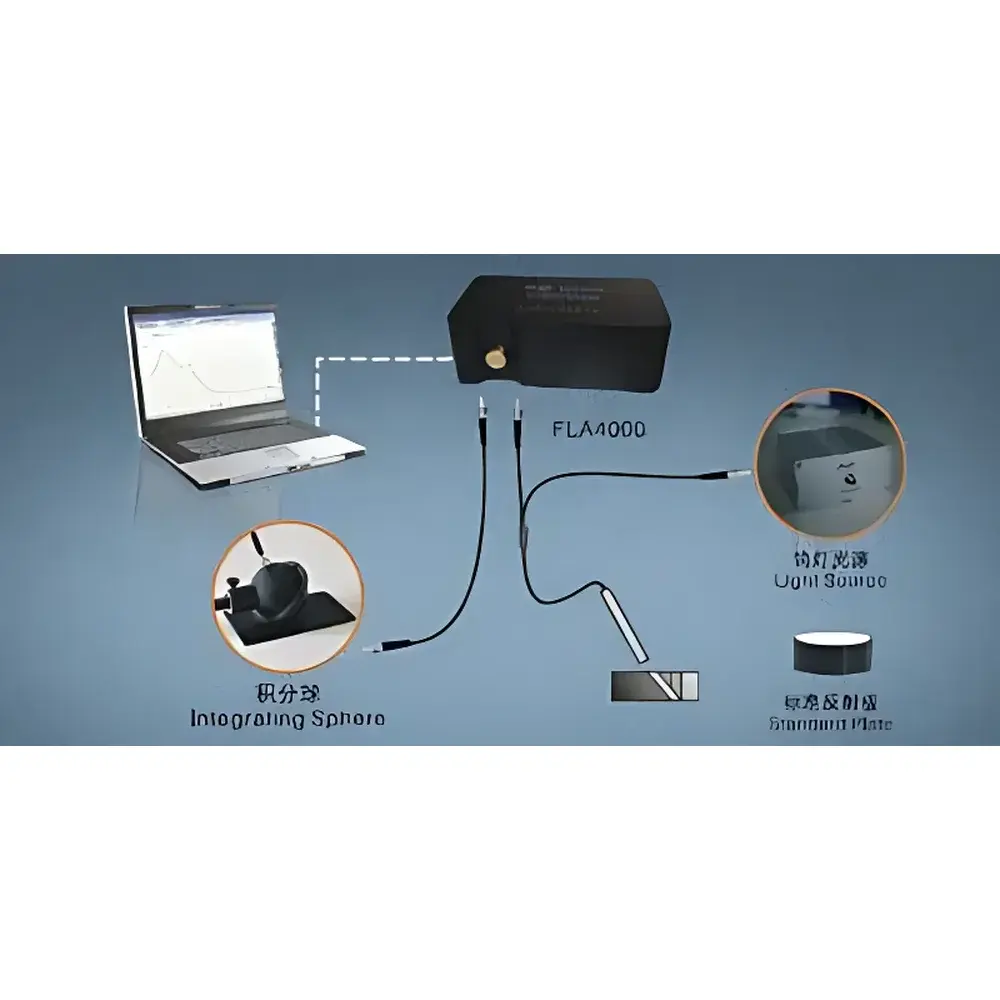
Jingfei FLA Series Fiber Optic Spectrometer-Based Color Analysis System
| Brand | Jingfei |
|---|---|
| Origin | Zhejiang, China |
| Manufacturer Type | OEM Manufacturer |
| Country of Origin | China |
| Model | FLA Series |
| Pricing | Available Upon Request |
Overview
The Jingfei FLA Series Fiber Optic Spectrometer-Based Color Analysis System is a precision optical metrology platform engineered for quantitative color characterization of non-emissive materials. It operates on the principle of diffuse reflectance spectroscopy—measuring spectral reflectance (380–780 nm visible range) from a sample surface under controlled illumination, then converting the acquired reflectance spectrum into standardized colorimetric coordinates (e.g., CIE 1931 XYZ, L*a*b*, L*C*h°) using CIE standard illuminants (D65, A, F2) and 2° or 10° standard observer functions. Unlike emission-based systems designed for LEDs or displays, this configuration is optimized for reflective substrates where surface geometry, texture, and scattering behavior significantly influence color perception. The system’s modular architecture integrates a high-stability tungsten-halogen or pulsed xenon light source, a calibrated bifurcated fiber-optic probe, a 150 mm diameter integrating sphere with >99% BaSO₄ coating, NIST-traceable diffuse reflectance standards (e.g., certified white tile, black trap), and a thermoelectrically cooled CCD-array fiber optic spectrometer (typical resolution: 1.5–3.0 nm FWHM). This ensures high photometric repeatability (<0.2% ΔE*ab inter-measurement variation under stable thermal conditions) and compliance with fundamental requirements of ISO/CIE 15:2004, ISO 13655:2017, and ASTM E308-22.
Key Features
- Modular optical design supporting interchangeable probe geometries (e.g., 0°/45°, d/8°) and integration sphere configurations for diverse sample types—from flat printed sheets to curved plastic housings and irregular gemstone facets.
- Thermally stabilized spectrometer core with onboard dark-current compensation and pixel binning capability, enabling robust signal-to-noise ratio (>500:1 at full integration time) across low-reflectance blacks and high-gloss whites.
- Factory-calibrated spectral response traceable to NIST SRM 2035 and 2036, with optional annual recalibration services aligned with ISO/IEC 17025-accredited laboratories.
- Real-time spectral acquisition at up to 10 Hz frame rate, facilitating batch inspection workflows in production environments without compromising spectral fidelity.
- Ruggedized aluminum housing with IP52-rated enclosure for resistance to ambient dust and incidental moisture—suitable for QC labs and factory-floor deployment.
Sample Compatibility & Compliance
The FLA Series accommodates solid, opaque, and semi-opaque non-emissive samples with minimum dimensions ≥10 mm × 10 mm and surface roughness < Ra 5 µm. It supports measurement of textured surfaces (e.g., embossed packaging, woven textiles) via adjustable integration sphere port geometry and configurable incident angle. Sample holders include magnetic fixtures for metallic substrates and vacuum chucks for thin films. All hardware and calibration protocols comply with ISO 13655:2017 (spectral measurement of graphic arts materials), ISO 11664-4:2019 (CIE colorimetric observers), and ASTM D2244-22 (calculation of color differences). Data output formats meet GLP/GMP documentation requirements, including embedded metadata (timestamp, operator ID, instrument serial, calibration certificate ID, ambient temperature/humidity logs).
Software & Data Management
The included Jingfei ColorLab v4.x software provides full spectral analysis, color space visualization (2D chromaticity diagrams, 3D L*a*b* scatter plots), tolerance mapping (ΔE*ab, ΔE00, CMC l:c), and batch statistical reporting (X̄-R charts, Cp/Cpk indices). It supports FDA 21 CFR Part 11-compliant user access control, electronic signatures, and full audit trail logging—including parameter changes, calibration events, and result exports. Raw spectral data is exportable in CSV, JDX, and CIE-15:2004 XML formats; integration with LIMS platforms (e.g., LabVantage, Thermo Fisher SampleManager) is achieved via RESTful API or ODBC drivers. Software validation packages (IQ/OQ/PQ documentation templates) are available upon request for regulated industries.
Applications
- Print quality assurance: Spot color verification (Pantone®, DIC, TOYO), ink formulation consistency, substrate metamerism evaluation.
- Plastics & polymer manufacturing: Batch-to-batch color matching of injection-molded components, masterbatch dispersion analysis, weathering-induced hue shift quantification.
- Cable & wire insulation: UV-stabilized jacket color stability monitoring per UL 1581 and IEC 60811-503.
- Jewelry & gemology: Differentiation of natural vs. synthetic stones (e.g., sapphire, ruby) via spectral absorption fingerprinting in the visible-NIR region; identification of dye treatments through characteristic band suppression.
- Automotive interior trim: Multi-angle color assessment (MAV) for soft-touch surfaces, conforming to GMW14872 and Ford CETP 00.00-L-467 specifications.
FAQ
Does the FLA Series support transmission color measurement?
No—the system is configured exclusively for reflectance-based analysis. Transmission mode requires separate optical path design (e.g., collimated beam + detector arm) and is not supported in standard FLA Series configurations.
Can it measure metallic or pearlescent coatings?
Yes, when equipped with multi-angle reflectance probe accessories (e.g., 15°/45°/75° gonio setup); standard configuration uses fixed 45° illumination for general-purpose matte/gloss evaluation.
Is spectral calibration required before each use?
A daily white reference measurement is recommended for optimal accuracy; full wavelength and radiometric recalibration is advised every 6 months or after mechanical shock or ambient temperature shifts exceeding ±5°C.
What is the minimum measurable sample area?
With the standard 6 mm diameter measuring port, the effective sampling area is ~28 mm²; optional 3 mm micro-port reduces this to ~7 mm² for small features such as PCB solder masks or textile yarns.
Does the software support custom color tolerance ellipsoids in L*a*b* space?
Yes—users may define elliptical tolerances based on industry-specific weighting factors (e.g., higher sensitivity to Δa* for red plastics) via the Advanced Tolerance Editor module.





