Stainless Steel Foil (SS Foil) by合肥科晶
No specifications available.
Overview
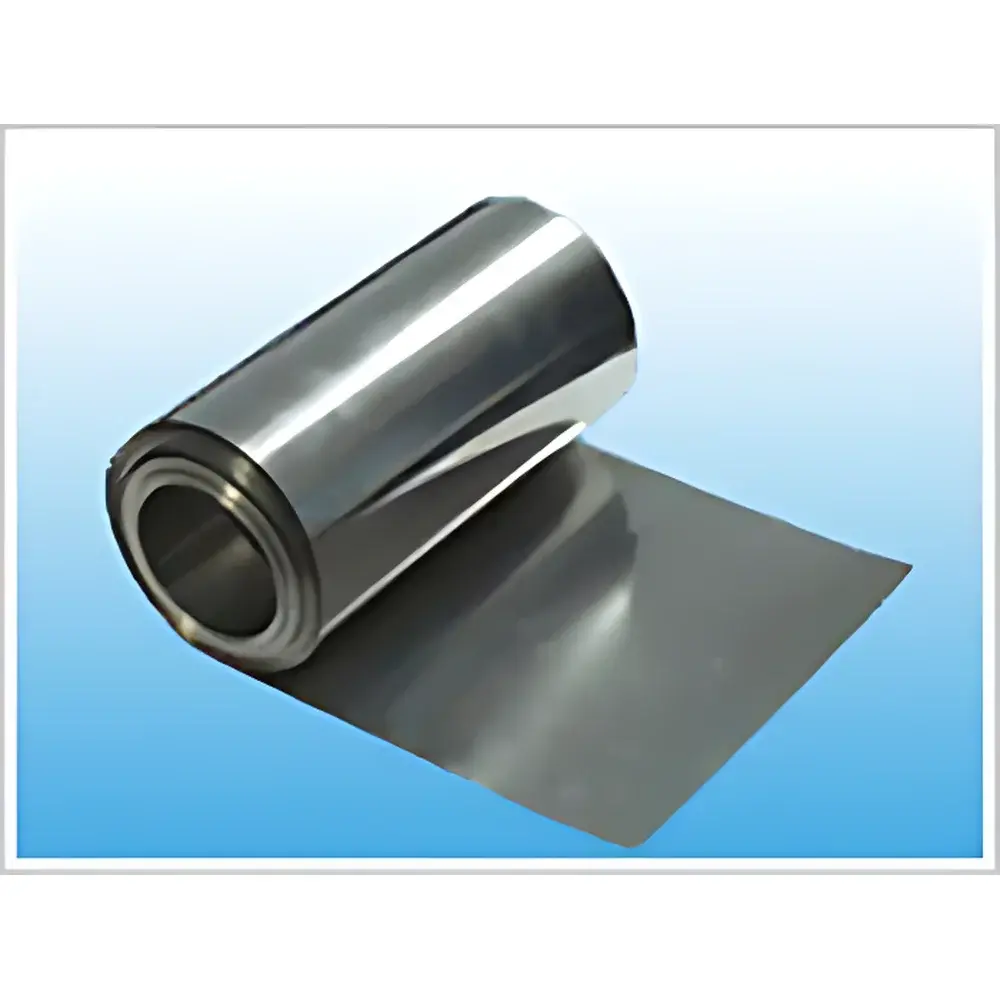
Stainless steel foil (SS foil) is a precision-engineered thin metallic sheet widely employed in vacuum deposition systems, thin-film research, battery electrode fabrication, and high-purity material handling applications. This SS foil is manufactured to meet stringent dimensional consistency and surface purity requirements for use in controlled environments such as Class 1000 cleanrooms and ultra-high-vacuum (UHV) chambers. Composed of austenitic stainless steel (typically AISI 304 or 316 grade), it offers excellent corrosion resistance, thermal stability up to 800 °C in inert atmospheres, non-magnetic properties, and low outgassing characteristics—critical for maintaining vacuum integrity and minimizing contamination during sputtering, evaporation, or electrochemical testing.
Key Features
- Dimensional specification: 300 mm length × 0.1 mm thickness; width customizable upon request (standard slit widths available per application demand)
- Surface finish: Double-sided electrolytic polish yielding Ra < 0.05 µm, verified via atomic force microscopy (AFM) profiling
- Cleanroom packaging: Supplied in ISO Class 5 (Class 100) laminar flow clean bags, sealed under vacuum with aluminum-laminated barrier film to prevent oxidation and particulate ingress
- Material certification: Mill test report (MTR) provided per ASTM A666, including tensile strength ≥ 515 MPa, yield strength ≥ 205 MPa, and elongation ≥ 40% (in 50 mm)
- Traceability: Each lot traceable to heat number, rolling batch, and final annealing cycle; certified for residual element content (e.g., Fe, Cr, Ni, Mo, C < 0.03 wt%) per EN 10088-1
Sample Compatibility & Compliance
This stainless steel foil is compatible with standard thermal evaporation sources (e.g., tungsten boats, molybdenum heaters), magnetron sputtering targets, and roll-to-roll (R2R) coating substrates. Its low hydrogen permeability and minimal volatile organic compound (VOC) emission comply with ASTM E595 for spacecraft materials outgassing testing. The foil meets ISO 14644-1 Class 5 cleanroom handling standards and is suitable for use in GLP-compliant laboratories conducting USP particulate matter analysis or ISO 13485-certified medical device R&D workflows. It is not intended for direct food contact or implantable biomedical devices without additional biocompatibility validation per ISO 10993.
Software & Data Management
As a passive instrumentation component, this stainless steel foil does not incorporate embedded electronics or firmware. However, its dimensional and metallurgical data are fully integrable into laboratory information management systems (LIMS) and electronic lab notebooks (ELN) via standardized metadata templates (e.g., ISA-Tab, AnIML). Batch-specific certificates of conformance (CoC) and MTRs are delivered in PDF/A-1b format with embedded digital signatures compliant with FDA 21 CFR Part 11 requirements for audit trail retention. Traceability records—including packaging environmental logs (temperature/humidity during sealing) and cleanroom particle count reports—are archived for ≥10 years per ICH GCP guidelines.
Applications
- Substrate masking and shadow deposition in multilayer thin-film stacks for optoelectronic devices (e.g., OLEDs, perovskite solar cells)
- Current collector backing for lithium-ion and solid-state battery anode/cathode slurry casting trials
- Reference standard for X-ray fluorescence (XRF) calibration and electron backscatter diffraction (EBSD) pattern indexing
- Gas diffusion layer (GDL) support in proton exchange membrane (PEM) fuel cell prototyping
- High-temperature crucible liner for thermogravimetric analysis (TGA) and differential scanning calorimetry (DSC) sample containment
- Electrode substrate for cyclic voltammetry (CV) and electrochemical impedance spectroscopy (EIS) in corrosive electrolytes (e.g., 1 M H₂SO₄, LiPF₆ in EC/DMC)
FAQ
Is this stainless steel foil suitable for ultra-high-vacuum (UHV) applications?
Yes—its low outgassing rate (<1×10⁻¹⁰ Pa·m³/s·cm² after 24 h bakeout at 150 °C) meets UHV compatibility criteria per ISO 14523-2.
Can the foil be laser-cut or etched for custom aperture patterns?
Yes—AISI 304/316 stainless steel exhibits excellent processability with UV nanosecond lasers (355 nm) and ferric chloride-based wet etching; minimum feature size achievable is 25 µm.
What is the maximum continuous operating temperature in air?
The recommended upper limit is 650 °C for prolonged exposure; short-term excursions to 750 °C are permissible with accelerated surface oxide formation.
Do you provide pre-annealed or stress-relieved variants?
Yes—custom annealing cycles (e.g., 1050 °C/1 h in H₂/Ar atmosphere followed by rapid quenching) are available to achieve full recrystallization and eliminate residual rolling stresses.
Is RoHS and REACH compliance documented?
Yes—full substance declaration per EU Directive 2011/65/EU and Annex XVII of REACH Regulation (EC) No. 1907/2006 is included in the CoC package.
Related Products