
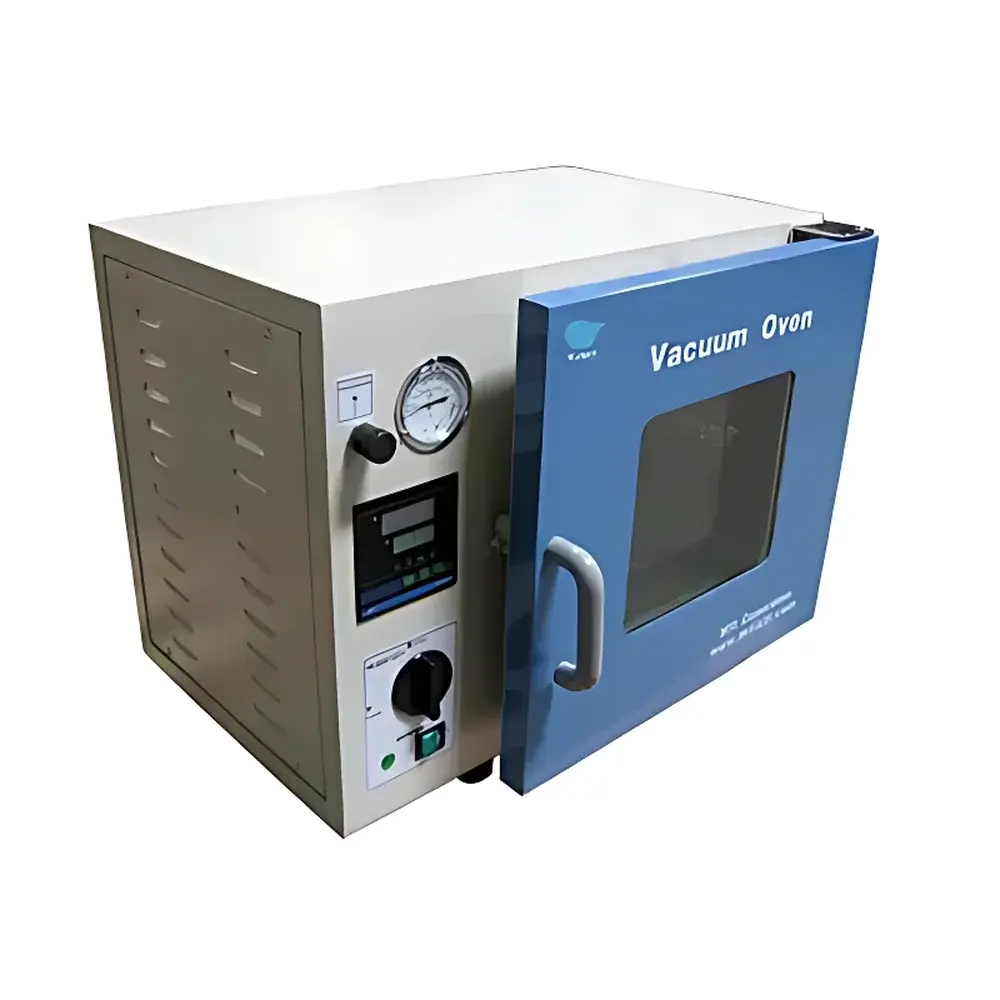
Hefei Kejing DZF-6020-220 25-Liter Vacuum Drying Oven
| Brand | Hefei Kejing |
|---|---|
| Origin | Anhui, China |
| Model | DZF-6020-220 |
| Chamber Volume | 25 L (300 × 300 × 275 mm) |
| Max Operating Temperature | 200 °C |
| Temperature Control Accuracy | ±1.5 °C |
| Temperature Uniformity | ±5 °C (at center heating zone) |
| Vacuum Range | 0–30 inHg (≤133 Pa) |
| Heating Power | 1000 W |
| Voltage | 220 V AC, 60 Hz |
| Chamber Material | 304 Stainless Steel |
| Insulation | 76 mm Glass Wool |
| Door Seal | Silicone Gasket with Mechanical Latch |
| Vacuum Port ID | 6.35 mm (¼") |
| Standard Shelving | 2 Electroplated Carbon Steel Trays + 1 Movable Anodized Aluminum Rack |
| Vacuum Requirement | Single-Stage Rotary Vane Pump Required |
Overview
The Hefei Kejing DZF-6020-220 is a benchtop vacuum drying oven engineered for precise thermal processing under reduced pressure environments. It operates on the principle of vacuum-assisted dehydration—lowering the ambient pressure to reduce the boiling point of volatile solvents and moisture, thereby enabling gentle, low-temperature drying of heat-sensitive, hygroscopic, or oxidation-prone samples. Unlike conventional forced-air ovens, this unit eliminates convective heat transfer and relies on conductive and radiant heating from insulated chamber walls, minimizing thermal gradients and preventing sample degradation during extended dwell cycles. Designed for routine laboratory workflows in materials science, pharmaceutical development, polymer research, and quality control labs, it supports critical processes including solvent removal from thin-film precursors, moisture analysis per ASTM E121-22, vacuum curing of adhesives, and pre-weighing preparation of reference standards under inert or controlled-atmosphere conditions.
Key Features
- Uniform radiant heating system with 76 mm thick glass wool insulation ensures minimal thermal loss and stable cavity temperature distribution across the full 25-liter working volume.
- 304 stainless steel interior chamber—electropolished and seamless—resists corrosion from acidic vapors, residual solvents, and cleaning agents; facilitates ISO 14644-compliant cleaning protocols.
- Digital PID temperature controller with single-point setpoint interface delivers ±1.5 °C accuracy and maintains uniformity within ±5 °C at the central heating zone under vacuum conditions.
- Vacuum-tight sealing architecture: dual-action mechanical door latch combined with high-elasticity silicone gasket achieves leak rates <1.0 × 10⁻² mbar·L/s, verified per ISO 2859-1 sampling plans.
- Corrosion-resistant stainless steel vacuum and vent lines (¼” ID) eliminate contamination pathways and support long-term integrity in cyclic vacuum/vent operations.
- Modular shelving system includes two electroplated carbon steel trays rated for continuous use up to 200 °C and one lightweight anodized aluminum rack for flexible sample staging.
Sample Compatibility & Compliance
This vacuum drying oven accommodates a broad range of sample formats—including Petri dishes, crucibles, vials, wafers, and coated substrates—without requiring custom fixtures. Its chamber geometry supports ASTM D2243-20-compliant placement for moisture content determination and aligns with USP <1251> guidelines for loss-on-drying (LOD) testing. The unit meets general electrical safety requirements per IEC 61010-1 and incorporates overtemperature cut-off protection. While not certified for Class I Division 1 hazardous locations, its construction complies with GLP documentation prerequisites when paired with external vacuum pump logging and temperature validation tools (e.g., NIST-traceable thermocouple probes). Vacuum performance is validated using calibrated analog gauges traceable to NIST SRM 2460/2461.
Software & Data Management
The DZF-6020-220 operates as a standalone instrument with no embedded firmware or network interface. All operational parameters—including setpoint temperature, dwell time, and vacuum gauge readings—are manually recorded. For regulated environments (e.g., FDA-regulated QC labs), users integrate third-party data loggers compliant with 21 CFR Part 11 requirements. Optional accessories include calibrated digital thermometers (±0.1 °C accuracy) and vacuum transducers with analog 4–20 mA output for connection to SCADA or LIMS platforms. Audit trails must be maintained externally; the unit itself provides no electronic record retention or user-access control features.
Applications
- Removal of residual solvents from battery electrode slurries prior to calendaring (IEC 62660-1).
- Drying of hygroscopic reference standards for gravimetric calibration (ISO/IEC 17025).
- Deaeration of ceramic green bodies before sintering to prevent blistering.
- Stabilization of lyophilized biologics intermediates under nitrogen-purged vacuum.
- Accelerated aging studies of polymer films per ASTM D570-21 (water absorption testing).
- Preparation of anhydrous reagents for organometallic synthesis where oxygen exclusion is critical.
FAQ
What vacuum pump is required for optimal operation?
A single-stage rotary vane pump capable of reaching ≤133 Pa (≤1 Torr) base pressure is mandatory. Pumps with ≥4 m³/h displacement and oil mist filtration are recommended for extended service life.
Can this oven be used for inert gas purging?
No—it lacks dedicated gas inlet/outlet valves or flow control hardware. Modifications void warranty and compromise vacuum integrity.
Is temperature mapping validation supported?
Yes. The chamber’s uniform geometry and accessible probe ports (via door gasket gap or optional feedthrough) allow placement of up to five Class A PT100 sensors per ICH Q5C Annex 3 guidance.
Does the unit include vacuum gauge calibration documentation?
The analog Bourdon-tube vacuum gauge is factory-set and supplied without NIST-traceable calibration certificate; users must perform initial verification using a certified reference manometer.
What maintenance intervals are recommended?
Silicone door gaskets should be inspected quarterly; glass wool insulation requires replacement only if physically compressed or contaminated. Vacuum line filters must be cleaned after every 200 hours of pump runtime.
Related Products



