
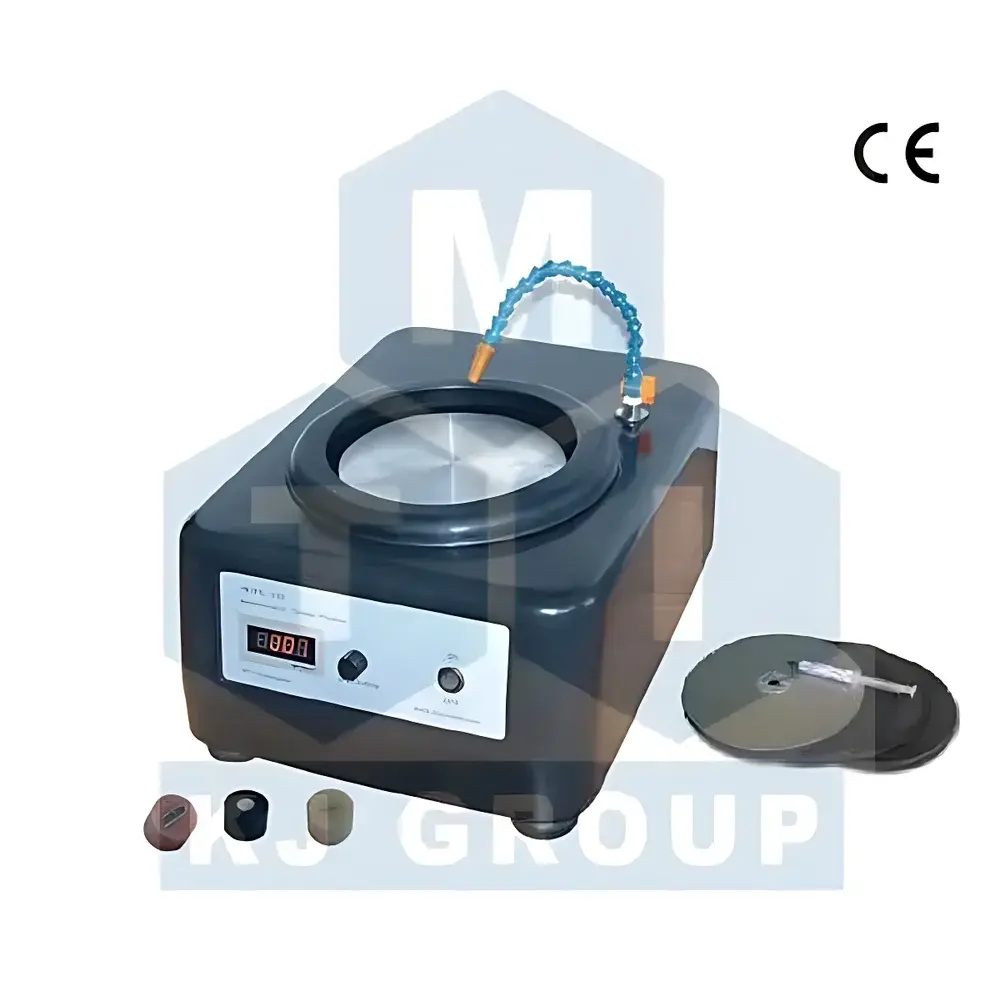
Unipol-830 Metallographic Grinding and Polishing Machine
| Brand | Hefei Kejing |
|---|---|
| Origin | Anhui, China |
| Manufacturer Type | Authorized Distributor |
| Country of Origin | China |
| Model | Unipol-830 |
| Voltage | 110 V / 220 V AC |
| Speed Range | 50–600 rpm |
| Platen Diameter | 203 mm |
| Dimensions (L×W×H) | 580 × 420 × 350 mm |
| Weight | 24 kg |
| Standard Accessories | 1 magnetic plate, 5 grinding/polishing base plates, 2 sheets each of 240#, 400#, 800#, and 1500# abrasive papers, 1 each of suede and synthetic polishing cloths, 1 tube of W2.5 diamond suspension |
| Optional Accessories | Electroplated diamond grinding discs, resin-bonded diamond polishing plates |
| Warranty | 1 year limited warranty with lifetime technical support |
Overview
The Unipol-830 Metallographic Grinding and Polishing Machine is a precision-engineered benchtop system designed for reproducible, planar surface preparation of metallographic, ceramic, semiconductor, and composite specimens. It operates on the principle of controlled mechanical abrasion—employing rotational motion of a flat platen to deliver uniform shear stress across the specimen–abrasive interface under precisely regulated load and speed conditions. This enables progressive material removal from coarse grinding through fine polishing, ultimately yielding deformation-free, scratch-minimized surfaces suitable for high-magnification optical microscopy, SEM imaging, EBSD analysis, and quantitative microstructural characterization. The system adheres to core metallurgical sample preparation standards including ASTM E3, ISO 14487, and GB/T 13298, supporting laboratories requiring GLP-compliant documentation workflows when integrated with optional digital load control and time-stamped operation logs.
Key Features
- Variable-speed DC motor drive delivering stable rotational speeds from 50 to 600 rpm, enabling optimization for both aggressive grinding (e.g., 300–600 rpm with coarse SiC papers) and gentle final polishing (e.g., 100–200 rpm with diamond suspensions on synthetic cloths).
- Dual mounting system: interchangeable magnetic plate and mechanical pressure ring configurations—eliminating fabric wrinkling common in traditional clamping, ensuring full-contact adhesion of pressure-sensitive polishing cloths and abrasive papers.
- Robust cast-aluminum chassis with vibration-dampening base, contributing to long-term mechanical stability and minimizing runout (<0.05 mm TIR at 600 rpm), critical for maintaining consistent material removal rates across multi-step protocols.
- Integrated splash guard and drainage channel design facilitates safe handling of aqueous slurries and organic lubricants while preventing cross-contamination between preparation stages.
- Modular accessory compatibility—including electroplated diamond discs and resin-bonded diamond plates—extends applicability to hard-brittle materials such as sapphire, silicon carbide, and tungsten carbide, where conventional alumina or silica abrasives exhibit insufficient cutting efficiency.
Sample Compatibility & Compliance
The Unipol-830 accommodates specimens up to 40 mm in diameter (standard) and supports custom holders for irregular geometries via optional vacuum chucks or thermosetting resin mounts. It is routinely deployed for preparing ferrous and non-ferrous alloys, refractory metals, oxide and nitride ceramics, fused silica and borosilicate glass substrates, FR-4 and polyimide-based PCB laminates, and engineering thermoplastics (e.g., PEEK, PEI). All standard accessories meet ISO 6344 (coated abrasives) and ISO 12100 (machine safety) requirements. While the base unit does not include FDA 21 CFR Part 11–compliant audit trails, its operational repeatability supports validation under ISO/IEC 17025-accredited quality management systems when paired with external calibration records and SOP-controlled parameter logging.
Software & Data Management
The Unipol-830 is a manually operated, analog-control instrument without embedded firmware or digital connectivity. However, its mechanical consistency enables seamless integration into laboratory information management systems (LIMS) via external process documentation: users record speed, duration, abrasive grade, lubricant type, and applied load per step using standardized templates aligned with ASTM E407 and ISO 15510. Optional third-party timers with programmable presets (e.g., dual-stage countdown units) allow semi-automated protocol execution—reducing operator-induced variability and supporting traceable, repeatable workflows required for inter-laboratory round-robin studies.
Applications
- Routine metallographic sectioning of steel, aluminum, titanium, and nickel-based superalloys for grain size analysis per ASTM E112 and phase quantification via image analysis.
- Surface planarization of ceramic matrix composites prior to TEM lamella extraction using FIB-SEM.
- Edge retention enhancement for optical-grade glass components undergoing interferometric inspection.
- Controlled thinning of PCB cross-sections to expose multilayer copper traces without delamination or smearing.
- Preparation of polymer blends and filled thermoplastics for dispersion homogeneity assessment using polarized light microscopy.
FAQ
What types of polishing cloths are compatible with the Unipol-830?
Standard configurations include suede and synthetic polishing cloths; all cloths with pressure-sensitive adhesive backing (PSA) adhere reliably to the supplied magnetic base plates.
Can the Unipol-830 be used for electrolytic polishing?
No—it is strictly a mechanical grinding and polishing system. Electrolytic polishing requires separate DC power supplies, electrolyte baths, and corrosion-resistant electrode fixtures.
Is speed calibration traceable to national standards?
Yes—speed accuracy is verified during factory calibration using NIST-traceable tachometers; users may perform periodic verification with handheld optical tachometers compliant with ISO 5348.
What maintenance intervals are recommended for optimal performance?
Lubrication of the platen shaft bearing every 500 operating hours and annual inspection of motor brush wear are advised; all service procedures follow ISO 13849-1 functional safety guidelines.
Does the Unipol-830 support automated force control?
Not natively—but external pneumatic or servo-driven specimen holders (e.g., Struers DAP-02 or Buehler AutoMet 250) can be integrated for closed-loop load regulation in advanced metrology environments.



