
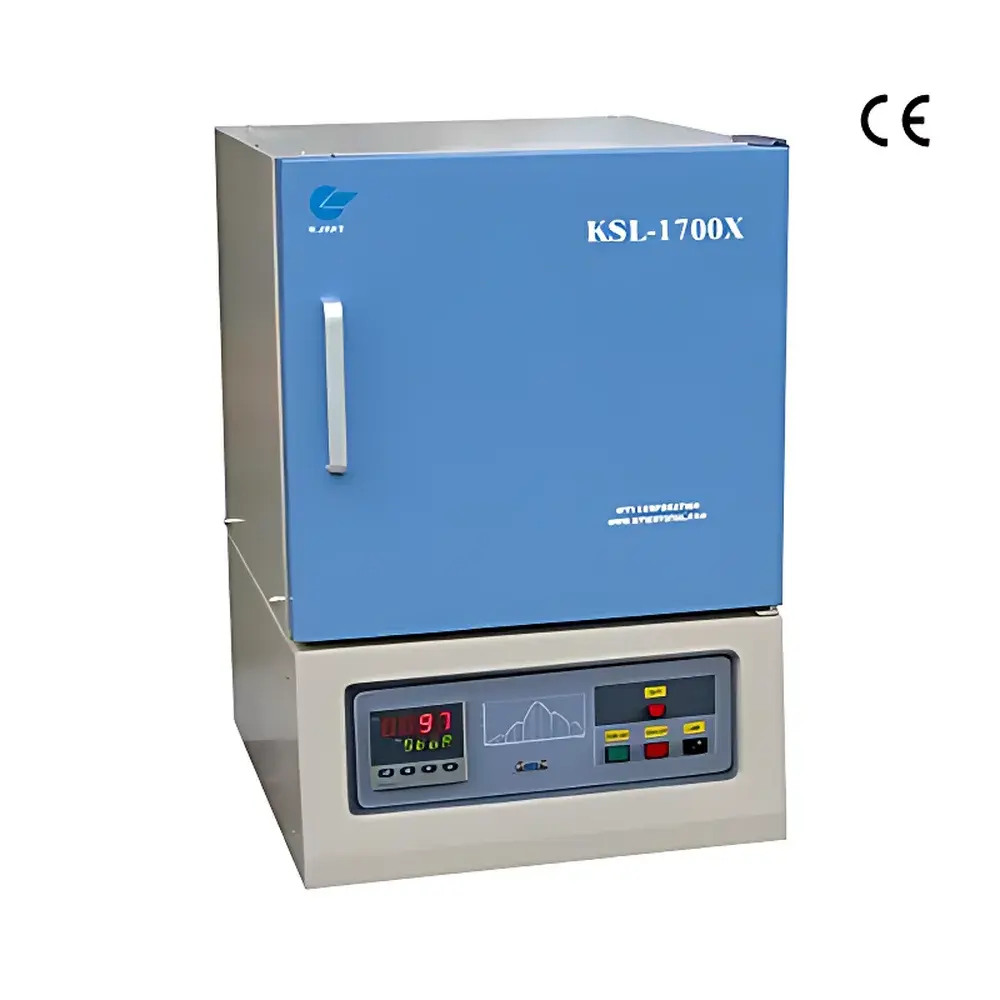
KSL-1700X-A1 High-Temperature Box Furnace (1700°C, 3.4 L Capacity)
| Brand | Hefei Kejing |
|---|---|
| Model | KSL-1700X-A1 |
| Chamber Dimensions | 150 × 150 × 150 mm |
| Max Temperature | 1700 °C |
| Operating Temperature | ≤1650 °C |
| Heating Element | Silicon Molybdenum (MoSi₂) Rods |
| Thermocouple Type | Type B (PtRh30/PtRh6) |
| Temperature Control | 30-Stage Programmable Controller (708P) |
| Accuracy | ±1 °C at Setpoint |
| Ramp Rate | Up to 10 °C/min |
| Power Supply | AC 220 V, 50 Hz |
| Rated Power | 3 kW |
| External Dimensions | 500 × 490 × 700 mm |
| Net Weight | 120 kg |
| Compliance | CE Certified |
| Chamber Volume | 3.4 L |
| Door Type | Side-Swing |
Overview
The KSL-1700X-A1 is a precision-engineered high-temperature box furnace designed for demanding laboratory and R&D applications requiring stable thermal environments up to 1700 °C. Built around a robust refractory chamber lined with high-purity alumina insulation and protected by an imported yttria-stabilized zirconia (YSZ) coating, this furnace delivers exceptional thermal uniformity and long-term stability under repeated high-temperature cycling. Its core heating system employs silicon molybdenum (MoSi₂) rods—known for excellent oxidation resistance and consistent emissivity above 1200 °C—ensuring reliable heat generation in air atmospheres without protective gas requirements. Temperature measurement and regulation are performed via a calibrated Type B (PtRh30/PtRh6) thermocouple integrated with a 708P intelligent programmable controller, enabling precise closed-loop feedback control across the full operational range (room temperature to 1700 °C). The furnace operates within a nominal working envelope of 1650 °C for extended service life, maintaining ±1 °C temperature uniformity at setpoint under steady-state conditions.
Key Features
- High-temperature capability: Maximum rated temperature of 1700 °C with continuous operation up to 1650 °C
- Advanced thermal insulation: Multi-layer ceramic fiber board combined with YSZ-coated internal surfaces minimizes heat loss and enhances thermal retention
- Precision temperature control: 30-segment programmable controller supports complex thermal profiles—including ramp-hold-cool sequences—with independent slope and dwell parameter assignment
- Robust heating architecture: Dual-zone MoSi₂ heating elements ensure symmetrical heat distribution across the 3.4 L cubic chamber (150 × 150 × 150 mm)
- Side-swing door design with high-temperature gasket seal enables rapid sample access while preserving chamber integrity during thermal cycling
- CE-certified electrical safety architecture compliant with IEC 61000-6-3 (EMC) and IEC 61000-6-2 (immunity), including over-temperature cut-off and ground-fault protection
Sample Compatibility & Compliance
The KSL-1700X-A1 accommodates standard high-temperature crucibles (e.g., alumina, zirconia, or graphite) and supports solid-state synthesis, sintering, ashing, calcination, and annealing protocols for ceramics, battery cathode materials, catalysts, and refractory metals. Its chamber geometry and thermal profile meet ASTM E1112 (Standard Specification for Laboratory Furnaces) for uniformity classification. All materials in direct contact with the hot zone—including insulation, thermocouple sheaths, and door gaskets—are RoHS-compliant and certified free of asbestos, heavy metals, and halogenated flame retardants. The unit satisfies ISO 14001 environmental management requirements through low standby power consumption (<5 W) and absence of hazardous off-gassing during operation. Occupational health compliance aligns with OHSAS 18001 (now ISO 45001) standards, incorporating surface temperature limits on external housing (<60 °C at ambient +25 °C) and integrated ventilation interlocks.
Software & Data Management
While the base configuration features standalone 708P controller operation, optional RS485/Modbus RTU interface enables integration with LabVIEW, MATLAB, or custom SCADA systems for remote monitoring and data logging. The optional computer control software provides real-time temperature traceability, automated report generation (CSV/PDF), and audit-ready event logs—including power interruptions, alarm triggers, and manual override actions. When deployed in regulated environments (e.g., GLP/GMP labs), the software package supports 21 CFR Part 11-compliant user authentication, electronic signatures, and immutable audit trails for all critical parameters and thermal cycles.
Applications
- Solid-state reaction studies for oxide-based cathode materials (e.g., NMC, LFP, LNMO)
- Densification and grain growth analysis in advanced ceramics (Al₂O₃, ZrO₂, SiC)
- Thermal gravimetric pre-treatment prior to XRD or SEM characterization
- Controlled atmosphere-compatible sintering when coupled with optional gas inlet kits (N₂, Ar, forming gas)
- Calibration verification of secondary temperature sensors using fixed-point reference materials (e.g., Pd, Ni, Co-C)
- High-temperature aging tests for electronic packaging substrates and metallization layers
FAQ
What is the recommended maintenance schedule for the MoSi₂ heating elements?
MoSi₂ elements require no routine replacement under normal use but should be inspected visually every 50–100 operating hours for signs of embrittlement or surface scaling. Avoid thermal shock by limiting ramp rates to ≤10 °C/min below 1000 °C and ≤5 °C/min above.
Can this furnace be used under inert or reducing atmospheres?
Yes—when equipped with optional quartz or stainless-steel gas inlet/outlet ports and compatible sealing hardware, the KSL-1700X-A1 supports controlled N₂, Ar, H₂/N₂, or vacuum (down to 10⁻² mbar with auxiliary pump) operation. Note that MoSi₂ oxidation kinetics accelerate significantly below 1700 °C in oxygen-deficient environments.
Is the CE marking valid for export to the UK post-Brexit?
The CE mark remains accepted for UKCA transition purposes until December 31, 2024; for new installations after that date, UKCA certification will be required and can be provided upon request with additional testing.
How is temperature uniformity validated across the working zone?
Uniformity is characterized per ASTM E2203 using a 9-point thermocouple mapping grid at three representative temperatures (800 °C, 1200 °C, and 1600 °C); typical deviation is ≤±3 °C across the central 80% volume.
Does the furnace include data export functionality for quality documentation?
Standard units log temperature history internally for up to 100 cycles; optional USB data logger or Modbus-enabled controllers support direct export to CSV files with timestamps, setpoints, and actual PV values—fully traceable for ISO/IEC 17025 calibration records.



