
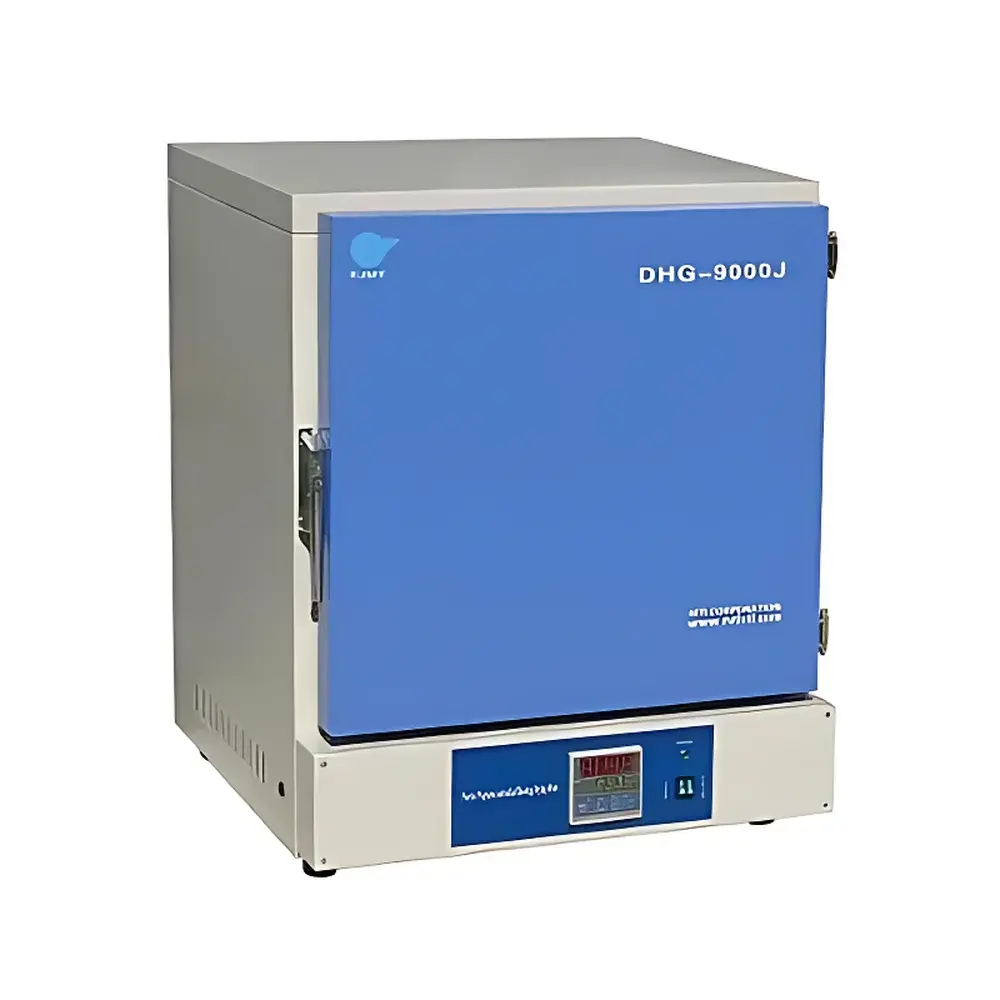
Hefei KEJING DHG-9000J Forced-Air Laboratory Drying Oven
| Brand | Hefei KEJING |
|---|---|
| Model | DHG-9000J |
| Chamber Dimensions | 35 cm × 45 cm × 45 cm |
| Internal Volume | 71 L |
| Operating Temperature Range | 25 °C to 400 °C |
| Temperature Uniformity | ±5 °C |
| Control Accuracy | ±1 °C |
| Max Heating Rate | 7 °C/sec |
| Rated Power | 3.2 kW |
| Voltage | 208–240 V AC, 50/60 Hz |
| Current Rating | 16 A |
| Chamber Material | Anodized Aluminum |
| Safety Features | Over-Temperature Alarm, LED Status Indicator, Programmable Timer |
Overview
The Hefei KEJING DHG-9000J Forced-Air Laboratory Drying Oven is an industrial-grade thermal processing instrument engineered for precision drying, curing, baking, and heat-treating applications in research laboratories, quality control environments, and materials science facilities. It operates on the principle of forced convection—using a precisely positioned axial fan and optimized internal airflow channels—to ensure consistent thermal distribution across the entire chamber volume. Unlike natural-convection ovens, the DHG-9000J actively circulates heated air downward along the chamber walls and upward through the center, minimizing thermal stratification and reducing localized overheating or sample desiccation artifacts. Its maximum operating temperature of 400 °C enables high-temperature protocols required for ceramic sintering pre-bake steps, polymer crosslinking validation, residual solvent removal from battery electrode slurries, and ash content determination per ASTM E1755–01. The oven’s structural integrity is maintained via a double-wall insulated enclosure with mineral wool insulation and a corrosion-resistant anodized aluminum interior—designed to withstand prolonged exposure to elevated temperatures without oxidation-induced particulate shedding.
Key Features
- Forced-air convection system with adjustable airflow velocity and directional flow path to enhance thermal homogeneity and minimize sample disturbance
- Digital PID temperature controller with ±1 °C accuracy and programmable ramp/soak profiles for process reproducibility
- Integrated mechanical timer (0–999 minutes) supporting unattended operation with automatic power cutoff
- Over-temperature safety cutoff circuit independent of the main controller, compliant with IEC 61000-6-2 immunity requirements
- LED digital display showing real-time chamber temperature, setpoint, and status indicators (including alarm activation)
- Front-access dual-layer door with silicone gasket seal and heat-resistant viewing window for operational monitoring without thermal loss
- Robust chassis construction with reinforced corner brackets and casters for stable floor placement in shared lab environments
Sample Compatibility & Compliance
The DHG-9000J accommodates standard laboratory ware including porcelain crucibles, stainless steel trays, quartz boats, and aluminum sample pans—compatible with both inert and mildly oxidizing atmospheres. Its anodized aluminum chamber eliminates iron contamination risks critical for semiconductor precursor drying or catalyst thermal activation. The unit conforms to general electrical safety standards per UL 61010-1 and EN 61010-1 for laboratory equipment. While not certified for Class I Div 1 hazardous locations, it includes grounding continuity verification and overcurrent protection aligned with GLP-compliant infrastructure requirements. Temperature uniformity mapping (per ISO 17025 Annex B) is achievable using calibrated PT100 probes at nine defined spatial points; users are advised to perform quarterly verification under routine QA protocols.
Software & Data Management
The DHG-9000J operates as a standalone instrument with no embedded data logging or network interface. However, its analog voltage output (0–5 V DC proportional to chamber temperature) supports integration with external DAQ systems or SCADA platforms for audit-trail generation. When used in regulated environments—such as pharmaceutical stability chambers or ISO 13485-certified medical device manufacturing—the optional RS-485 Modbus RTU module (sold separately) enables connection to validated LIMS or MES systems. All temperature setpoints, dwell times, and alarm events are traceable via manual logbook entry or third-party chart recorder linkage. The controller firmware retains last-used parameters after power cycle, facilitating repeat-run consistency without reconfiguration.
Applications
- Moisture content analysis per AOAC 950.46 and USP <731> Loss on Drying methodology
- Pre-drying of lithium-ion cathode/anode coatings prior to calendaring or cell assembly
- Thermal aging studies of polymeric encapsulants and conformal coatings (IEC 60068-2-2)
- Baking of printed circuit board solder masks and photoresist layers
- Conditioning of reference standards for gravimetric calibration (e.g., NIST SRM 1976)
- Dehydration of hygroscopic analytical reagents prior to volumetric standardization
FAQ
What is the recommended maintenance interval for the DHG-9000J?
Inspect door gasket integrity and clean chamber interior every 30 operational days; verify temperature uniformity annually using NIST-traceable sensors.
Can this oven be used under nitrogen purge conditions?
No—no gas inlet/outlet ports are provided. For inert-atmosphere processing, consult KEJING’s glove-box-integrated oven variants (e.g., OTF-1200X-S series).
Is the temperature controller compliant with FDA 21 CFR Part 11?
No—this model lacks electronic signature capability, audit trail generation, or user access controls required for Part 11 compliance.
Does the oven include a calibration certificate?
Factory calibration is performed at 100 °C, 200 °C, and 350 °C; a traceable calibration report is available upon request at time of order.
What is the typical recovery time after door opening?
At 200 °C setpoint, full temperature recovery requires ≤4.2 minutes following a 10-second door opening (tested per ASTM E742).
Related Products



