
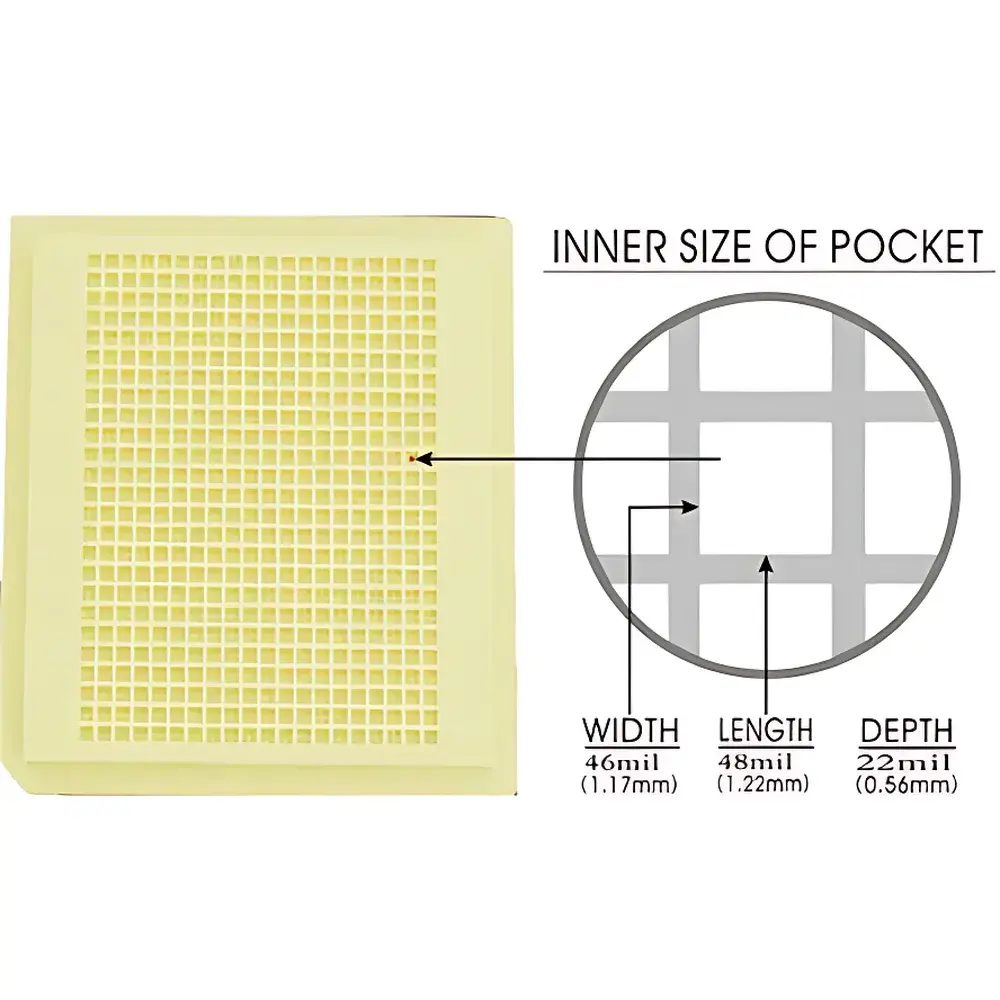
NH20-48×46-22 Quartz Crystal Microbalance (QCM) Sensor Holder Tray
| Brand | Hefei Kejing |
|---|---|
| Origin | Anhui, China |
| Manufacturer Type | Authorized Distributor |
| Origin Category | Domestic |
| Model | NH20-48×46-22 |
| Pricing | Upon Request |
Overview
The NH20-48×46-22 Quartz Crystal Microbalance (QCM) Sensor Holder Tray is an engineered precision accessory designed for high-throughput handling and secure positioning of standard 5–10 MHz AT-cut quartz crystal sensors in controlled laboratory environments. Unlike generic sample carriers, this tray integrates dimensional fidelity with electrostatic mitigation—constructed from antistatic ABS polymer rated for continuous operation up to 70 °C. Its primary function is to maintain mechanical stability and electrical integrity during sensor loading/unloading, thermal equilibration, and vacuum-compatible QCM deposition workflows. The tray supports gravimetric real-time monitoring of nanogram-level mass changes via the Sauerbrey equation, enabling applications in thin-film growth kinetics, interfacial adsorption studies, and electrochemical QCM (EQCM) coupling where sensor alignment and contamination control are critical.
Key Features
- Antistatic ABS construction minimizes electrostatic charge accumulation during handling—critical for preventing particulate adhesion and sensor surface damage in cleanroom-grade QCM setups.
- Precisely machined cavity array (20 × 25 = 500 total wells) ensures uniform spacing and mechanical repeatability across all sensor positions; each well accommodates standard QCM crystals with nominal dimensions of 1.22 mm × 1.17 mm × 0.56 mm (L × W × D).
- Compact footprint (50.67 mm × 50.67 mm × 3.94 mm) enables compatibility with automated loader modules, glovebox transfer ports, and benchtop QCM instrumentation with limited staging area.
- Thermally stable design maintains dimensional integrity within ±0.02 mm tolerance over 25–70 °C operating range—ensuring consistent sensor-to-electrode contact pressure during temperature-dependent measurements.
- Chemically inert surface resists common solvents (e.g., isopropanol, acetone, ethanol) and mild etchants used in pre-deposition cleaning protocols.
Sample Compatibility & Compliance
The NH20-48×46-22 tray is compatible with standard 5.0–10.0 MHz AT-cut quartz resonators (diameter 14 mm or rectangular variants with 1.22 mm × 1.17 mm active area), including gold-, platinum-, or carbon-coated electrodes. It supports integration into ISO/IEC 17025-accredited laboratories when used as part of a validated QCM measurement chain. While the tray itself is not certified to ASTM E2456 (Standard Guide for QCM Use in Thin-Film Characterization) or ISO 14707 (QCM performance testing), its geometric consistency and material traceability support method validation under GLP and GMP frameworks where user-defined qualification protocols are implemented. No RoHS or REACH non-compliance has been reported for the base ABS formulation.
Software & Data Management
This passive mechanical component does not incorporate embedded electronics or firmware. However, it interfaces seamlessly with industry-standard QCM data acquisition systems—including those from Stanford Research Systems (SR830 lock-in + QCM controller), Maxtek QCM-2000 series, and custom LabVIEW- or Python-based DAQ platforms. When deployed in automated workflows, the tray’s repeatable geometry facilitates optical recognition by machine vision systems for position mapping and sensor ID tracking. Audit trails for tray usage (e.g., sterilization cycles, exposure history) may be maintained manually or integrated into LIMS via barcode labeling (not supplied). Full compliance with FDA 21 CFR Part 11 is achievable only when paired with compliant host software and electronic signature workflows.
Applications
- In-situ monitoring of atomic layer deposition (ALD) and chemical vapor deposition (CVD) processes requiring batch-loaded sensor arrays.
- High-density screening of molecular binding kinetics (e.g., antigen–antibody, DNA hybridization) using multiplexed QCM biosensors.
- Electrochemical QCM (EQCM) studies involving corrosion inhibition, polymer film swelling, or ion intercalation in battery electrode materials.
- Accelerated aging tests of sensor coatings under thermal stress, where tray-based uniformity reduces inter-sample variance.
- Teaching laboratories conducting fundamental piezoelectric resonance experiments with standardized, low-cost sensor handling infrastructure.
FAQ
Is this tray compatible with 14-mm-diameter round quartz crystals?
Yes—each well is dimensioned to accommodate both rectangular (1.22 mm × 1.17 mm) and circular crystals up to 14 mm diameter when mounted on standard carrier substrates.
Can the tray be autoclaved?
No—ABS polymer softens above 70 °C and is incompatible with steam sterilization; dry heat (<70 °C) or isopropanol wipe disinfection is recommended.
Does the tray include electrical shielding or grounding provisions?
No—it is a passive mechanical holder without conductive traces or grounding contacts; external Faraday cage integration is required for EMI-sensitive measurements.
What is the maximum number of sensors that can be simultaneously monitored using this tray?
The tray holds 500 sensors physically, but simultaneous real-time monitoring depends on the connected QCM system’s channel count (typically 1–8 channels per instrument); multiplexing or sequential scanning is necessary for full-array interrogation.
Is material certification (e.g., RoHS, UL94) available upon request?
Yes—material safety data sheets (MSDS) and RoHS compliance declarations for the ABS grade are provided by the manufacturer upon formal inquiry.





