
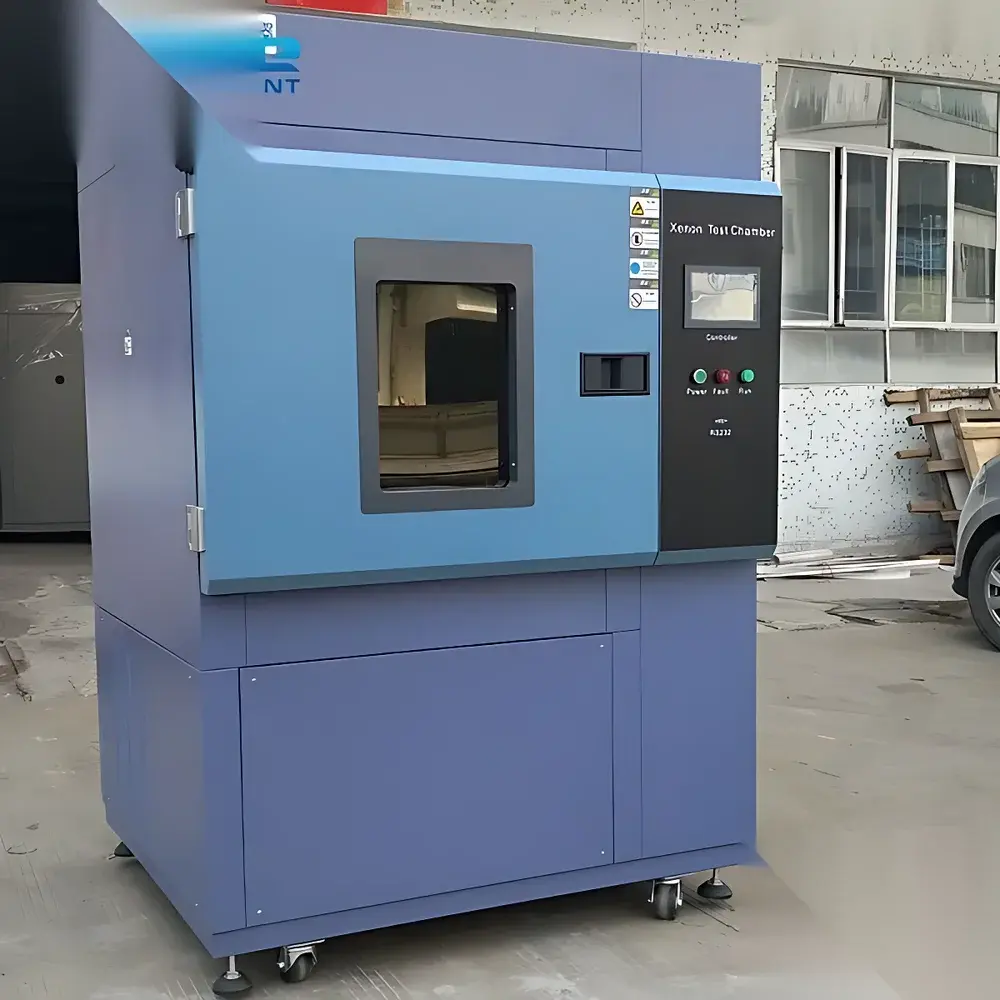
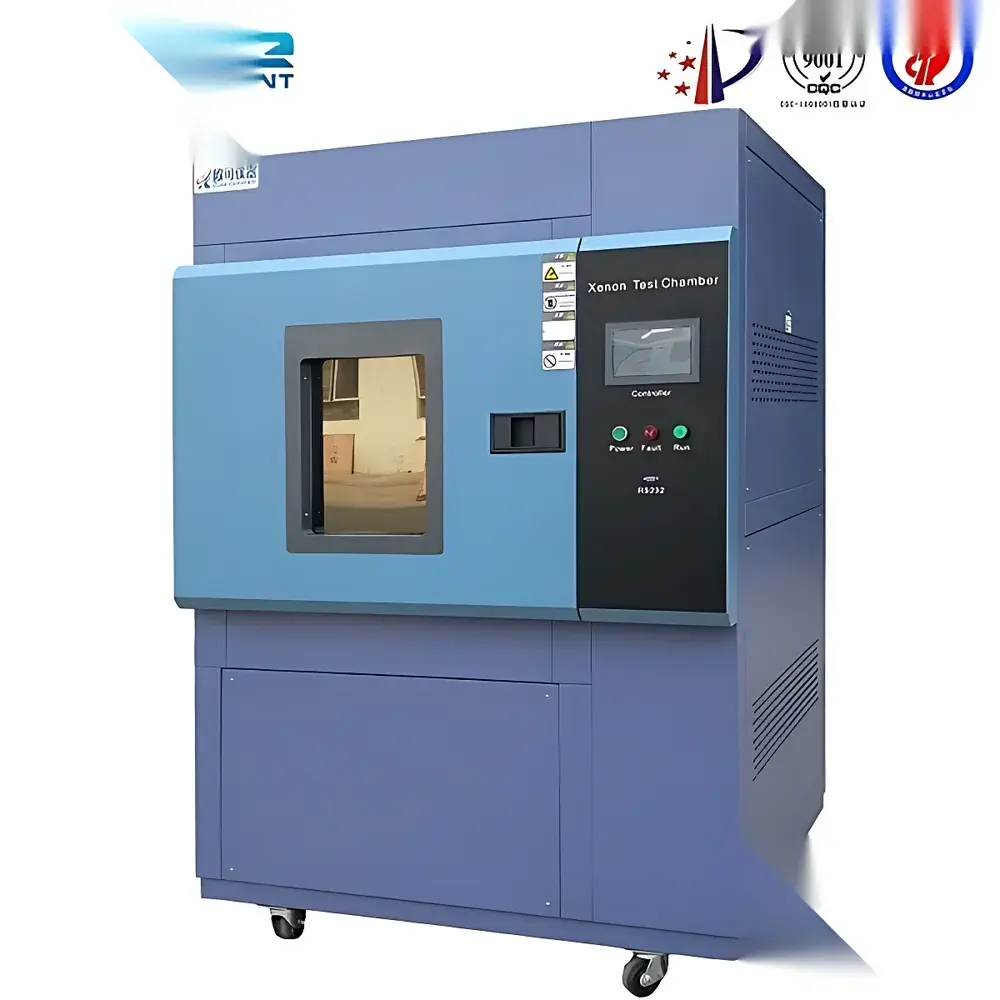
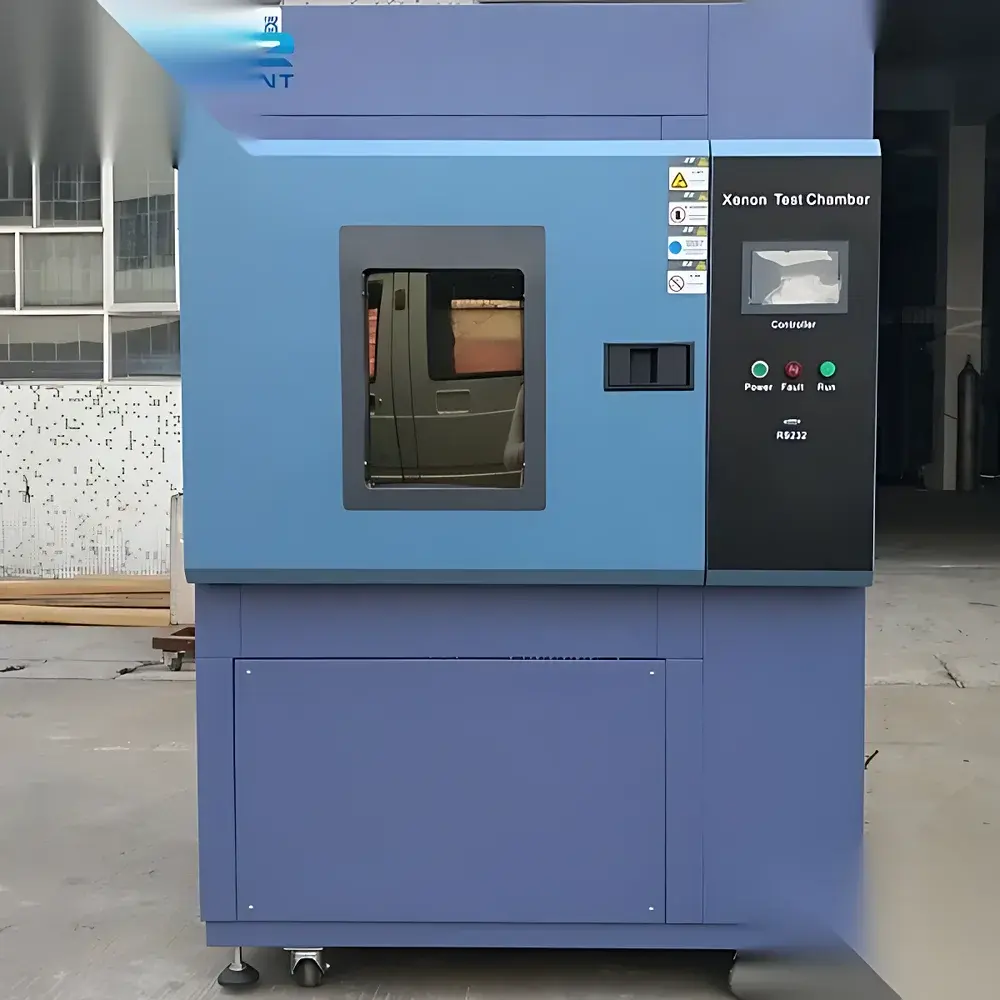
Xenon Arc Weathering Chamber
| Brand | Other Brands |
|---|---|
| Origin | Imported |
| Manufacturer Type | General Distributor |
| Price | USD 4,800 (Reference Only) |
| Internal Volume | 80–1000 L |
| Temperature Range | RT+10°C to 70°C |
| Humidity Range | 65–98% RH |
| Rainfall Duration | 1–9999 min 59 sec (adjustable) |
| Rainfall Cycle | 1–240 min (interval programmable) |
| Irradiance Control | ≤300 W/m² (at 340 nm) |
| Xenon Lamp Power | 12.0 kW (rated life: ~1600 h) |
| Temperature Control Accuracy | ±0.1°C |
| Humidity Control Accuracy | ±1% RH |
| Black Panel Temperature Sensor | Bimetallic |
| Controller | Color Touchscreen + Siemens PLC |
| Heating System | Independent Ni-Cr Alloy Heaters |
| Humidification | External Stainless Steel Surface-Evaporation Type |
| Construction | Cold-Rolled Carbon Steel (Phosphated & Powder-Coated) / SUS304 Stainless Steel Interior |
| Safety Protections | Overtemperature, Dry-Out, Leakage, Short-Circuit, Motor Overload, Current Overload |
Overview
The Xenon Arc Weathering Chamber is an engineered environmental simulation system designed to replicate the combined effects of solar radiation, temperature, and humidity—key stressors in real-world outdoor exposure. It employs a high-intensity xenon arc lamp as the light source, whose spectral output closely matches natural sunlight across the critical UV, visible, and near-infrared ranges (290–800 nm), especially when filtered through borosilicate or quartz outer filters. This enables accelerated aging testing per internationally recognized standards including ISO 4892-2, ASTM G155, SAE J2527, and IEC 60068-2-9. The chamber integrates precise radiant energy control, dynamic temperature/humidity regulation, and programmable wet/dry cycling—including simulated rainfall—to assess material degradation mechanisms such as color fading, gloss loss, chalking, cracking, and polymer chain scission.
Key Features
- High-fidelity xenon arc illumination with spectral irradiance monitoring and closed-loop feedback control at 340 nm (±0.5 W/m²)
- Independent dual-climate control architecture: simultaneous regulation of chamber air temperature (RT+10°C to 70°C), relative humidity (65–98% RH), and black panel temperature (BPT)
- Programmable water spray cycles with adjustable duration (1–9999 min 59 sec) and interval timing (1–240 min), supporting both continuous and intermittent wetting protocols
- Robust thermal management via low-noise, high-efficiency centrifugal blower system and multi-vane airflow distribution for uniform chamber conditions (±1.5°C spatial uniformity)
- Full stainless steel (SUS304) interior chamber and sample rack construction, resistant to corrosion from UV exposure and condensate
- Siemens S7-1200 PLC-based controller with 7-inch color touchscreen interface, supporting multi-step test profiles, real-time data logging, and password-protected parameter access
- Comprehensive safety interlocks: dry-out protection, overtemperature cutoff, xenon lamp arc fault detection, motor thermal overload, leakage current monitoring, and phase-loss protection
Sample Compatibility & Compliance
The chamber accommodates flat-panel, molded, or irregularly shaped specimens up to 1000 L internal volume (OK-XD-1000 model). Standard sample racks are configurable for vertical or inclined mounting per ISO 4892-2 requirements. All models comply with electrical safety standards IEC 61000-6-2/6-4 and carry CE marking. The control system architecture supports audit-ready operation under GLP and GMP environments, with optional timestamped event logs, user access levels, and electronic signature capability compatible with FDA 21 CFR Part 11 requirements when integrated with validated software platforms.
Software & Data Management
Embedded firmware enables storage of ≥100 test programs, each with up to 99 segments. Real-time sensor data—including chamber air temperature, RH, BPT, irradiance, and spray status—is logged at user-defined intervals (1 s to 60 min) and exportable via USB or Ethernet to CSV format. Optional PC-based software provides graphical trend analysis, comparative degradation curve plotting, and automated report generation aligned with ASTM D4329 or ISO 11341 templates. All logged data includes metadata (operator ID, test ID, calibration timestamps) to satisfy traceability requirements in regulated industries.
Applications
- Automotive exterior components (paints, plastics, trim, adhesives) per SAE J2412 and J2527
- Architectural coatings and roofing membranes tested against ASTM D4587 and ISO 11341
- Textile and synthetic fiber durability assessment per AATCC TM16 and ISO 105-B02
- Photovoltaic module encapsulant yellowing and delamination screening (IEC 61215-2 MQT03)
- Packaging materials subjected to retail lighting and ambient climate conditions
- Medical device polymer housings undergoing long-term shelf-life validation
FAQ
What spectral filter configurations are supported?
Standard configuration uses inner quartz and outer borosilicate filters (Daylight-Q/B) per ISO 4892-2; optional UV-cut and extended UV filters available upon request.
Is irradiance calibration traceable to NIST standards?
Yes—integrated radiometer is factory-calibrated against NIST-traceable reference sensors; annual recalibration service is recommended and documented.
Can the chamber operate unattended for extended cycles?
Yes—equipped with auto-restart after power interruption, full safety interlock logging, and remote status monitoring via Modbus TCP or optional Ethernet/IP interface.
What maintenance is required for the xenon lamp system?
Lamp replacement every ~1600 hours; quartz filter cleaning every 200 hours; humidifier tank descaling weekly; full optical alignment verification recommended quarterly.
Does the system support custom test profiles beyond standard methods?
Yes—the PLC-based controller allows user-defined irradiance ramps, temperature/humidity ramps, and multi-phase wet/dry sequences with conditional branching logic.



