
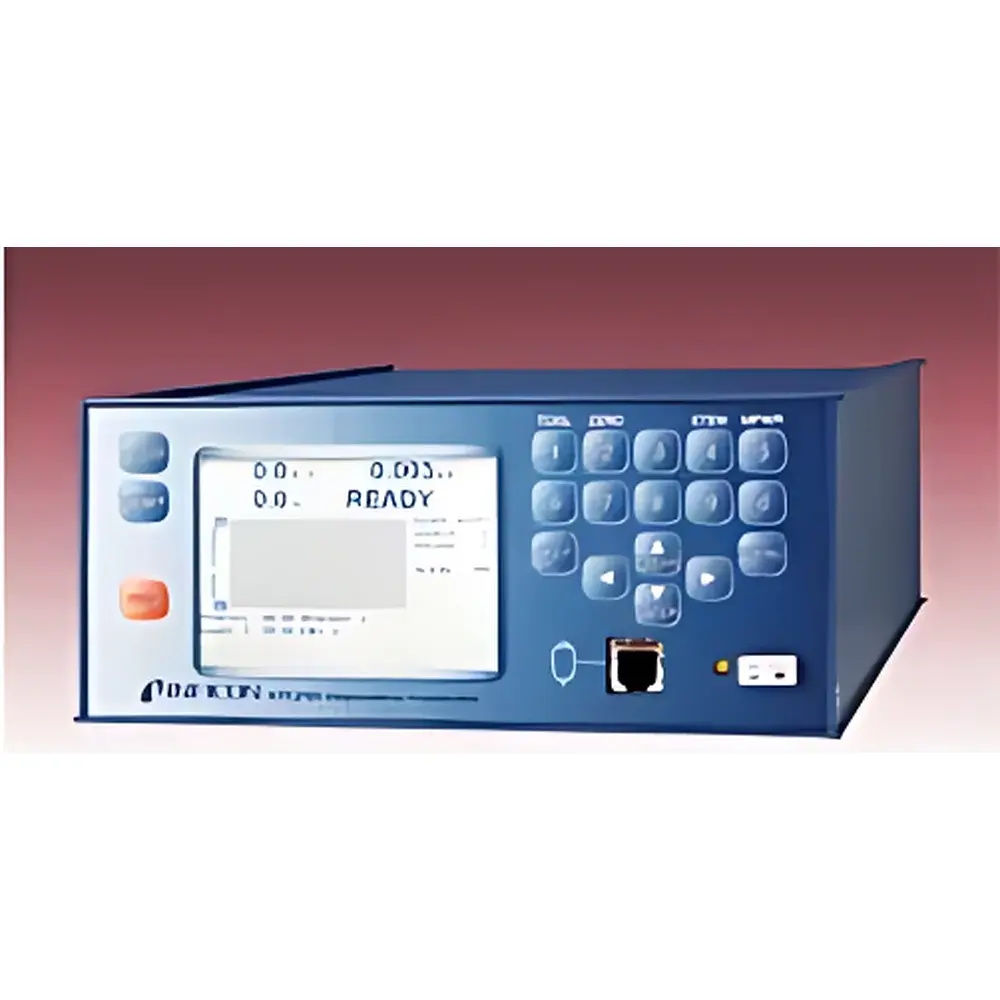
XTC/3 Thin Film Deposition Controller
| Origin | USA |
|---|---|
| Manufacturer Type | Authorized Distributor |
| Origin Category | Imported |
| Model | XTC/3 |
| Pricing | Upon Request |
Overview
The INFICON XTC/3 Thin Film Deposition Controller is a precision-engineered, real-time quartz crystal microbalance (QCM)-based process control instrument designed for high-reliability physical vapor deposition (PVD) environments. Operating on the fundamental principle of piezoelectric frequency shift—where mass accumulation on a resonant quartz crystal sensor induces a measurable decrease in its oscillation frequency—the XTC/3 delivers nanogram-level mass resolution and sub-angstrom thickness repeatability. It is purpose-built for both single-layer and multi-layer thin film fabrication processes, including thermal evaporation, electron-beam evaporation, sputtering, and reactive PVD. Unlike standalone rate meters, the XTC/3 integrates closed-loop feedback control of deposition rate and endpoint thickness, enabling deterministic process execution across diverse substrate geometries and material systems. Its architecture supports continuous operation in production-grade vacuum chambers (10⁻⁷ Torr and below), with EMI-hardened electronics and temperature-compensated crystal drive circuitry to maintain measurement integrity under dynamic thermal and pressure conditions.
Key Features
- ModeLock™ patented anti-mode-jump technology ensures stable frequency tracking during rapid deposition transients, eliminating erroneous thickness drift caused by harmonic mode ambiguity in QCM sensors.
- Native compatibility with INFICON Crystal 12™, CrystalSix® and dual-sensor auto-switching modules—enabling uninterrupted operation during sensor exhaustion or contamination events without process interruption.
- XTC/3M variant supports up to 99 distinct process recipes, 999 total layers, 32 individual coating steps, dual-source control, and two independent crystal sensors—ideal for complex optical stack fabrication and multilayer photovoltaic device manufacturing.
- XTC/3S variant provides streamlined control for single-layer applications, supporting up to 9 coating steps, dual-source coordination, and dual-sensor redundancy—optimized for R&D labs and small-batch optical filter production.
- High-contrast 320 × 240 TFT LCD graphical interface with intuitive icon-driven navigation; supports user-defined, alphanumeric process and layer names for unambiguous traceability in GLP/GMP-compliant environments.
- Standalone operation with embedded real-time OS—no external PC required; optional Windows®-based XTC Control Software (v5.x) enables remote monitoring, data logging, recipe management, and audit trail generation compliant with FDA 21 CFR Part 11 requirements.
- IEEE 802.3 Ethernet interface (10/100BASE-T) with TCP/IP stack for integration into factory automation networks, SCADA systems, and MES platforms via Modbus TCP or custom API protocols.
Sample Compatibility & Compliance
The XTC/3 interfaces exclusively with INFICON-certified quartz crystal sensors (QCS), including AT-cut fundamental-mode crystals (5–6 MHz) and overtone-enabled variants for enhanced sensitivity in low-rate depositions. It supports metallic (Al, Cr, Ni, Au, Ag), dielectric (SiO₂, TiO₂, Ta₂O₅, MgF₂), and organic (Alq₃, NPB, TPD) thin films deposited onto silicon wafers, glass substrates, flexible polymer foils, and curved optics. The controller meets IEC 61000-6-2 (EMC immunity) and IEC 61000-6-4 (EMC emissions) standards. Firmware and software architecture support electronic signature, user access levels, and time-stamped audit logs—fully aligned with ISO 9001, ISO 14001, and semiconductor industry-aligned quality frameworks such as SEMI E10 and E142.
Software & Data Management
The optional XTC Control Software (Windows® 10/11 compatible) provides full configuration, visualization, and archival capabilities. It records real-time deposition rate (Å/s), cumulative thickness (nm), crystal frequency (Hz), and sensor Q-factor at configurable intervals (10 ms–10 s). All datasets are saved in CSV and binary .xtc formats, with metadata including operator ID, chamber ID, recipe name, timestamp, and sensor serial number. The software implements role-based access control (RBAC), password-protected parameter editing, and exportable PDF reports—including statistical summaries (mean, std dev, Cp/Cpk) per layer—for internal QA review or regulatory submission. Raw data files are digitally signed and tamper-evident, satisfying long-term data integrity requirements per ALCOA+ principles.
Applications
- Semiconductor front-end manufacturing: precise control of gate oxides, metal interconnects, and hard masks in IC fabrication lines.
- Optical coating: multi-layer anti-reflection, high-reflection, and bandpass filters for laser systems, AR/VR waveguides, and astronomical instrumentation.
- Sputter-deposited transparent conductive oxides (TCOs) in thin-film solar cell production (e.g., ITO, AZO, FTO on glass or flexible substrates).
- OLED display manufacturing: sequential deposition of hole injection/transport, emissive, and electron transport layers with sub-nanometer thickness consistency across Gen 6+ substrates.
- Research & development: in-situ monitoring of nucleation kinetics, interfacial diffusion, and stress evolution during co-evaporation or reactive sputtering experiments.
FAQ
Does the XTC/3 require calibration against reference standards?
No—calibration is performed automatically during sensor initialization using built-in crystal characterization routines; however, periodic verification using certified thickness standards (e.g., NIST-traceable SiO₂ on Si wafers) is recommended per ISO/IEC 17025.
Can the XTC/3 operate in ultra-high vacuum (UHV) environments?
Yes—its electronics are rated for continuous operation at pressures down to 1×10⁻⁹ Torr; sensor feedthroughs comply with ConFlat® and KF40 vacuum flange standards.
Is firmware upgrade supported in the field?
Yes—updates are delivered via USB memory stick or Ethernet; all firmware versions maintain backward compatibility with existing XTC/2 configurations and recipes.
What safety certifications does the XTC/3 hold?
UL 61010-1, CE (EMC & LVD), and RoHS 3 compliant; no hazardous substance declarations required per EU Directive 2011/65/EU.



