
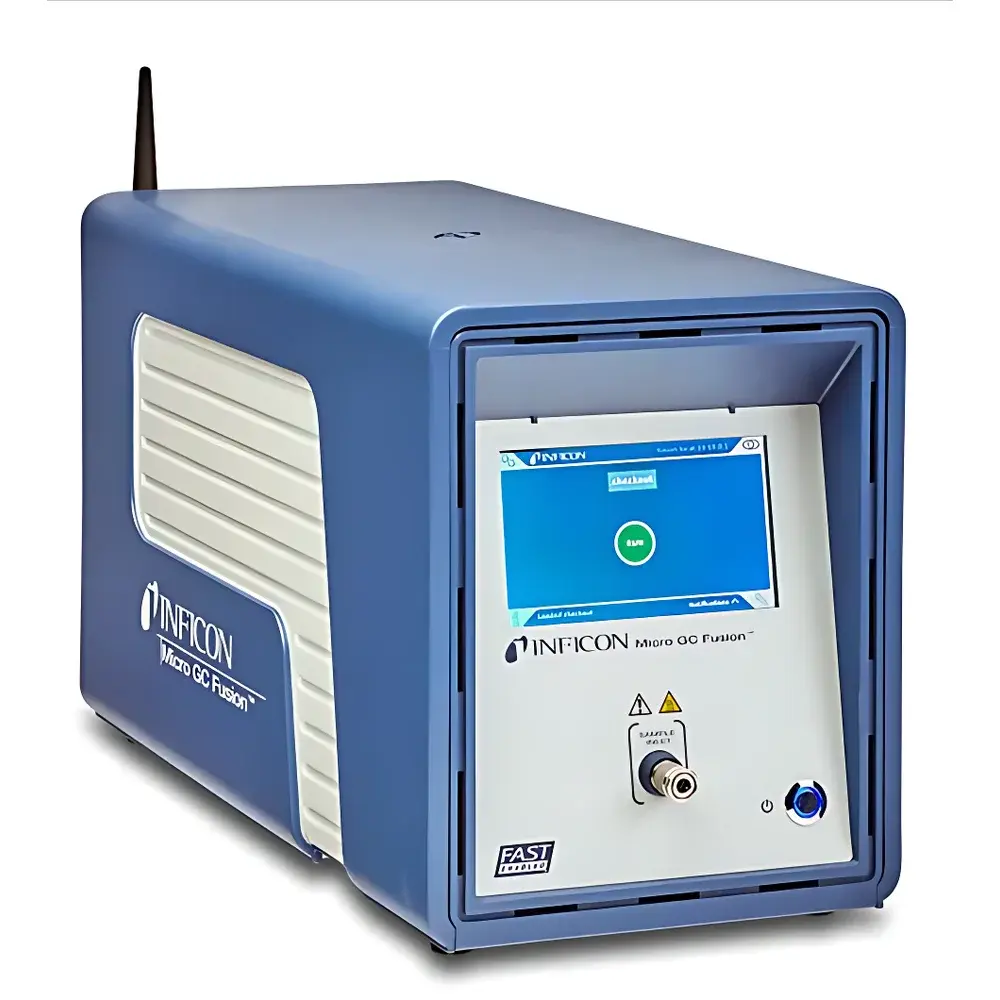
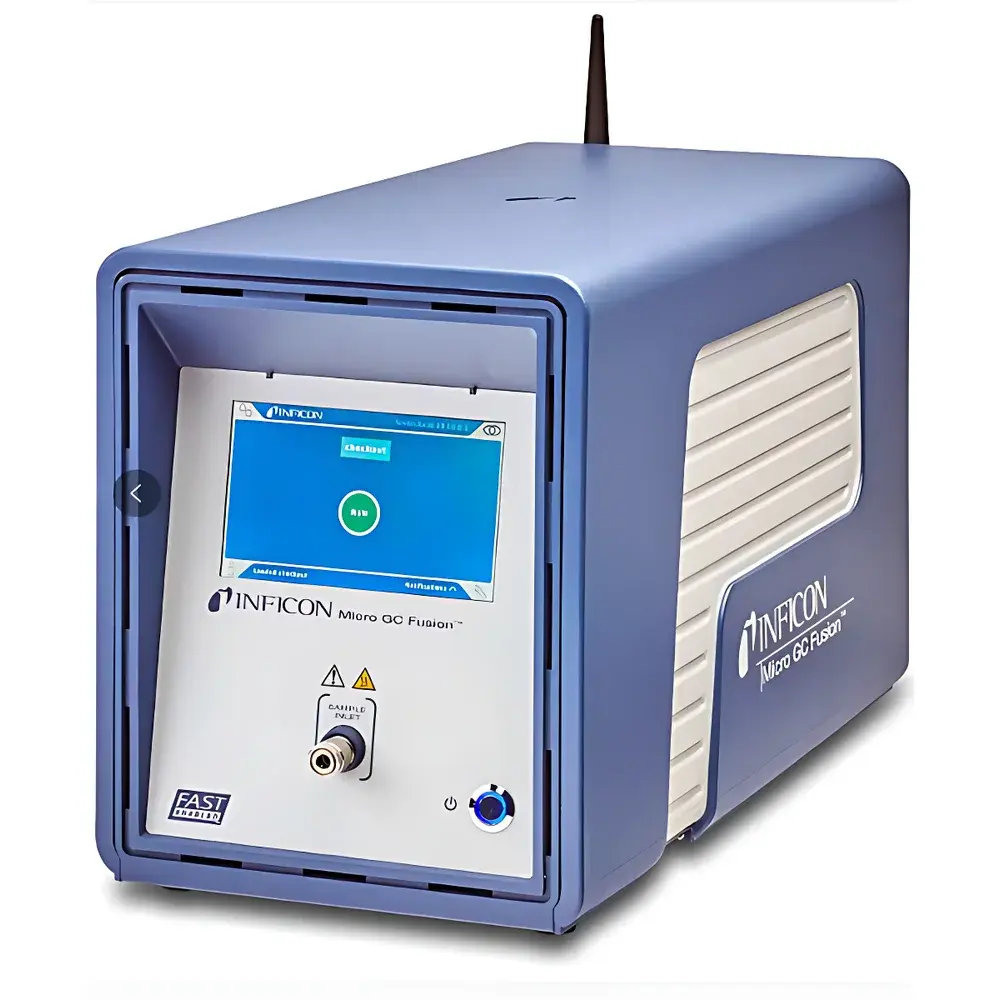
INFICON Fusion Micro Gas Chromatograph
| Brand | INFICON |
|---|---|
| Origin | USA |
| Model | Fusion |
| Instrument Type | Laboratory Micro Gas Chromatograph |
| Temperature Control Range | Ambient +5°C to 300°C |
| Maximum Ramp Rate | 300°C/min |
| Cooling Rate | 250°C to 50°C in <1 min |
| Carrier Gas Flow Range & Control | 3 mL/min |
| Carrier Gas Pressure Range & Control | 60 PSI |
| Injector Max Operating Temperature | 140°C |
| Injector Pressure Setting Range | 0–20 PSI |
| Injector Total Flow Setting Range | 0–10 mL/min |
Overview
The INFICON Fusion Micro Gas Chromatograph is a high-performance, benchtop- and field-deployable analytical platform engineered for rapid, reliable, and reproducible separation and quantification of permanent gases and volatile organic compounds (VOCs) in complex gas matrices. Based on microfabricated thermal conductivity detection (μTCD) and resistively heated capillary or PLOT columns, the Fusion employs true modular gas chromatography architecture—each independently programmable GC channel integrates a precision sample injector, a column oven with ultra-fast resistive heating, and a MEMS-based thermal conductivity detector. Unlike conventional GC systems reliant on convective oven heating, the Fusion’s column-integrated resistive heating enables ramp rates up to 300°C/min and sub-second thermal response, drastically reducing analysis cycle times while maintaining retention time stability (<0.1% RSD) and peak area repeatability (<1% RSD for concentrations ≥0.1%). The system operates on fundamental principles of differential thermal conductivity detection, where changes in thermal resistance across a micro-machined filament are correlated to analyte concentration in helium, hydrogen, nitrogen, or argon carrier streams.
Key Features
- Modular architecture supporting up to four independent, simultaneously operating GC channels—enabling parallel multi-method analysis without hardware reconfiguration
- Resistively heated capillary and PLOT columns (e.g., Rt®-Q-Bond, Rxi®-1ms, Rt®-Alumina BOND/Na₂SO₄, Rt®-Molecular Sieve 5A) with programmable temperature profiles up to 250°C (or column-phase limit, whichever is lower)
- Integrated Valco-type multi-port sampling valve for automated, unattended switching between up to eight gas sources—eliminating manual tubing changes and cross-contamination risk
- FAST (Fusion Automatic Sensing Technology): A proprietary signal-processing algorithm that dynamically adjusts detector gain and integration parameters in real time, enabling linear response across six orders of magnitude (ppm to % v/v) within a single run
- Web-native embedded control interface accessible via any modern browser—no software installation, licensing, or OS-specific drivers required; compatible with smartphones, tablets, and desktops over Wi-Fi or wired Ethernet (IEEE 802.11a/g/n and 10/100/1000BASE-T)
- Optional factory-installed heated pressure regulator for direct analysis of high-pressure samples up to 1000 psi—critical for upstream natural gas custody transfer and wellhead monitoring applications
Sample Compatibility & Compliance
The Fusion is validated for routine analysis of gaseous samples across energy, environmental, and industrial safety domains. It complies with ASTM D1945 (analysis of natural gas), ASTM D1946 (analysis of reformed gas), ISO 6974 (natural gas—determination of composition by GC), and USP (residual solvents). Its μTCD detection meets GLP/GMP data integrity requirements when paired with audit-trail-enabled third-party CDS platforms such as Thermo Fisher OpenLAB CDS or Agilent EZChrom. All firmware and web UI operations support full 21 CFR Part 11 compliance—including electronic signatures, user access controls, and immutable audit logs—when deployed in regulated pharmaceutical or petrochemical QA/QC laboratories. Sample introduction supports variable-volume, fixed-volume, large-volume, and back-flush injection modes, accommodating trace-level H₂S detection (LOD: 1 ppm in n-hexane on WCOT columns) through percent-level hydrocarbon quantification in raw syngas or landfill gas.
Software & Data Management
Fusion’s embedded firmware hosts a standards-compliant HTTP/HTTPS server delivering real-time chromatograms, method status, system diagnostics, and calibration history via responsive HTML5 pages. Raw chromatographic data (time-stamped peak tables, baseline-corrected signals, and metadata) are exported in vendor-neutral CSV and XML formats compatible with LIMS integration. For enterprise environments, the instrument supports OPC UA connectivity and RESTful API endpoints for remote scheduling, method push, and alarm notification. When interfaced with INFICON’s EZ IQ software or third-party chromatography data systems (CDS), the Fusion fully supports FDA 21 CFR Part 11 electronic record and signature workflows—including role-based permissions, electronic audit trails, and secure data archiving. No local client installation is required: all configuration, acquisition, and reporting occur through the browser-based interface, eliminating version conflicts and reducing IT overhead in multi-instrument labs.
Applications
- Natural gas and extended natural gas compositional analysis (C₁–C₆+, CO₂, N₂, H₂S, mercaptans)
- Refinery gas profiling (permanent gases, C₂–C₇ olefins and paraffins)
- Syngas, biogas, and landfill gas quality control (H₂, CO, CO₂, CH₄, O₂, N₂)
- Fuel cell feedstock purity verification (ppb-level CO detection in H₂ streams)
- VOC and solvent emissions monitoring per EPA Method 25A and ISO 11843
- Catalyst screening and reaction kinetics studies in alternative energy R&D
- Wellsite gas logging (mud gas analysis) and mine atmosphere surveillance (CH₄, CO, O₂, H₂)
- Specialty gas certification (electronic-grade N₂, Ar, He) and impurity profiling
FAQ
What carrier gases are supported?
Helium, hydrogen, nitrogen, and argon are fully supported. Hydrogen offers optimal speed-sensitivity trade-offs for fast permanent gas separations; helium remains preferred for high-resolution hydrocarbon analysis.
Can the Fusion operate unattended for extended periods?
Yes—its solid-state design, passive cooling architecture, and embedded watchdog timer enable continuous 24/7 operation. Scheduled methods, auto-calibration routines, and email/SNMP alerts for pressure loss or detector drift are configurable via the web UI.
Is method transfer possible from conventional GC systems?
Retention time indexing and relative polarity matching allow approximate method translation; however, due to fundamental differences in heating dynamics and column dimensions, full method validation per ICH Q2(R2) is required prior to regulatory use.
What is the maximum sample pressure the system can handle without external regulation?
With the optional integrated heated pressure regulator, inlet pressure up to 1000 psi is supported. Without this option, standard operation requires regulated input at ≤100 psi.
Does the Fusion support quantitative analysis per ISO/IEC 17025 requirements?
Yes—when operated with documented SOPs, calibrated standards, and audit-trail-enabled CDS integration, the Fusion satisfies measurement uncertainty estimation, traceability, and personnel competency requirements outlined in ISO/IEC 17025:2017 clause 7.7.




