
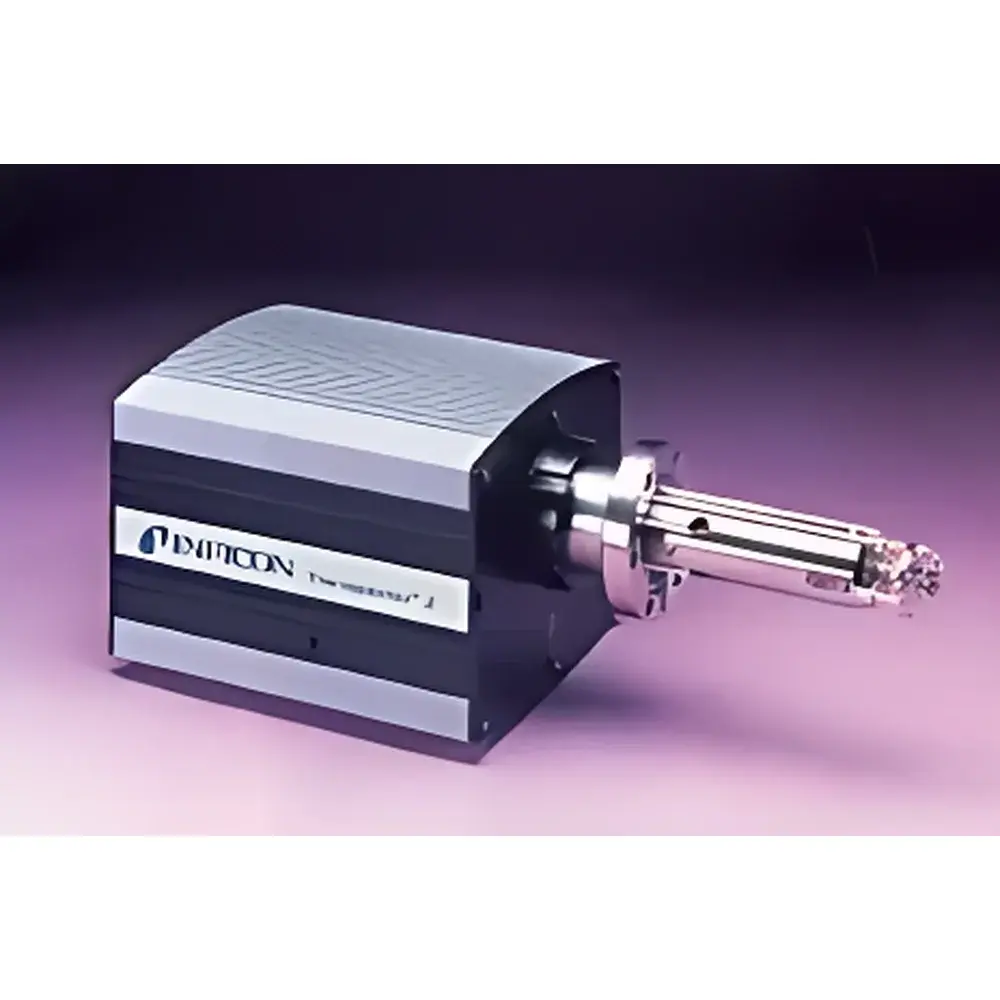
Transpector 2 Residual Gas Analyzer System
| Origin | USA |
|---|---|
| Manufacturer Type | Authorized Distributor |
| Origin Category | Imported |
| Model | Transpector 2 |
| Pricing | Available Upon Request |
Overview
The Transpector 2 Residual Gas Analyzer (RGA) is a high-performance quadrupole mass spectrometer engineered for precise, real-time compositional analysis of residual gases in ultra-high vacuum (UHV) and extreme-high vacuum (XHV) environments. Operating on the principle of mass-selective ion filtering via radiofrequency (RF) and direct-current (DC) voltage scanning across a quadrupole rod assembly, the system detects and quantifies partial pressures of gaseous species based on their mass-to-charge ratio (m/z). With mass ranges spanning 0–100, 0–200, or 0–300 atomic mass units (amu), the Transpector 2 supports dual detection configurations—either a Faraday cup for high-current stability or a hybrid Faraday/electron multiplier (EM) detector for enhanced sensitivity at low signal levels. Its design emphasizes long-term spectral fidelity, critical for applications requiring trace gas identification, leak localization, outgassing kinetics assessment, and process contamination monitoring.
Key Features
- Enhanced hydrogen (H₂) detection capability through optimized ion source geometry and reduced background contributions from surface recombination.
- Exceptional mass peak position stability (< ±0.01 amu over 24 hours) and intensity reproducibility (< ±1% RSD), achieved via temperature-stabilized electronics and precision-machined quadrupole rods.
- Signal-to-noise ratio improved by up to 10× relative to legacy Transpector platforms, enabling reliable detection of sub-picoamp ion currents.
- High-speed scanning mode with configurable dwell times down to 100 µs per mass unit, facilitating rapid transient event capture during pump-down or process excursions.
- Dynamic pressure measurement range spanning nine decades: from 1 × 10⁻⁴ Torr to 2 × 10⁻¹⁴ Torr—covering rough vacuum through XHV regimes.
- Modular detector architecture supporting field-replaceable Faraday cup or EM/Faraday hybrid assemblies without recalibration.
Sample Compatibility & Compliance
The Transpector 2 interfaces directly with standard ConFlat (CF) flanges (e.g., CF-63, CF-100) and integrates seamlessly into vacuum systems operating below 5 × 10⁻⁴ Torr. It complies with IEC 61000-6-3 (EMC emission standards) and meets mechanical safety requirements per ISO 14121-1 for industrial equipment. While not certified as a medical device or explosion-proof instrument, its operation aligns with vacuum safety best practices outlined in ASTM E1987 (Standard Guide for Residual Gas Analysis) and supports data integrity workflows consistent with GLP and GMP principles when paired with audit-trail-enabled software configurations.
Software & Data Management
The system is compatible with two licensed software suites: Single-Sensor Control (SSC) for standalone RGA operation and Multi-Sensor Network (MSN) for synchronized acquisition across distributed vacuum chambers. Both platforms provide real-time mass spectra display, time-resolved partial pressure trending, customizable alarm thresholds, and export functionality compliant with CSV, XML, and HDF5 formats. MSN supports OPC UA connectivity for integration into SCADA and MES environments. All software versions maintain full traceability—including user login logs, parameter change history, and raw spectrum metadata—to satisfy FDA 21 CFR Part 11 requirements where electronic records are subject to regulatory review.
Applications
- Leak detection and localization in UHV/XHV systems using helium or hydrogen tracer gas methods.
- Outgassing characterization during bake-out cycles in synchrotron beamlines, particle accelerator vacuum chambers, and space simulation facilities.
- Process gas purity verification in optical thin-film deposition, semiconductor etch/clean modules, and flat-panel display manufacturing.
- In-situ monitoring of chamber conditioning, plasma ignition byproducts, and precursor decomposition in ALD and PECVD tools.
- Surface science studies involving adsorption/desorption kinetics and reaction intermediate identification under controlled vacuum conditions.
- Contamination forensics in hard disk drive fabrication and photovoltaic cell coating lines.
FAQ
What vacuum compatibility does the Transpector 2 require for optimal performance?
The analyzer is specified for continuous operation at pressures ≤ 5 × 10⁻⁴ Torr; extended use above this threshold may reduce filament lifetime and compromise mass resolution.
Can the Transpector 2 be integrated into existing PLC-based vacuum control systems?
Yes—via optional analog I/O modules (0–10 V, 4–20 mA) or digital communication through RS-232/RS-485 and Ethernet/IP protocols.
Is calibration required before each use?
Factory calibration is stable for ≥12 months under typical operating conditions; annual verification using certified gas standards (e.g., NIST-traceable He/Ar/N₂ mixtures) is recommended.
Does the system support remote diagnostics and firmware updates?
Yes—through secure SSH-enabled network access and vendor-provided update packages validated for backward compatibility.
What is the typical warm-up time to achieve full spectral stability?
Under ambient conditions, thermal equilibrium and baseline stabilization are achieved within 30 minutes following power-on.







