
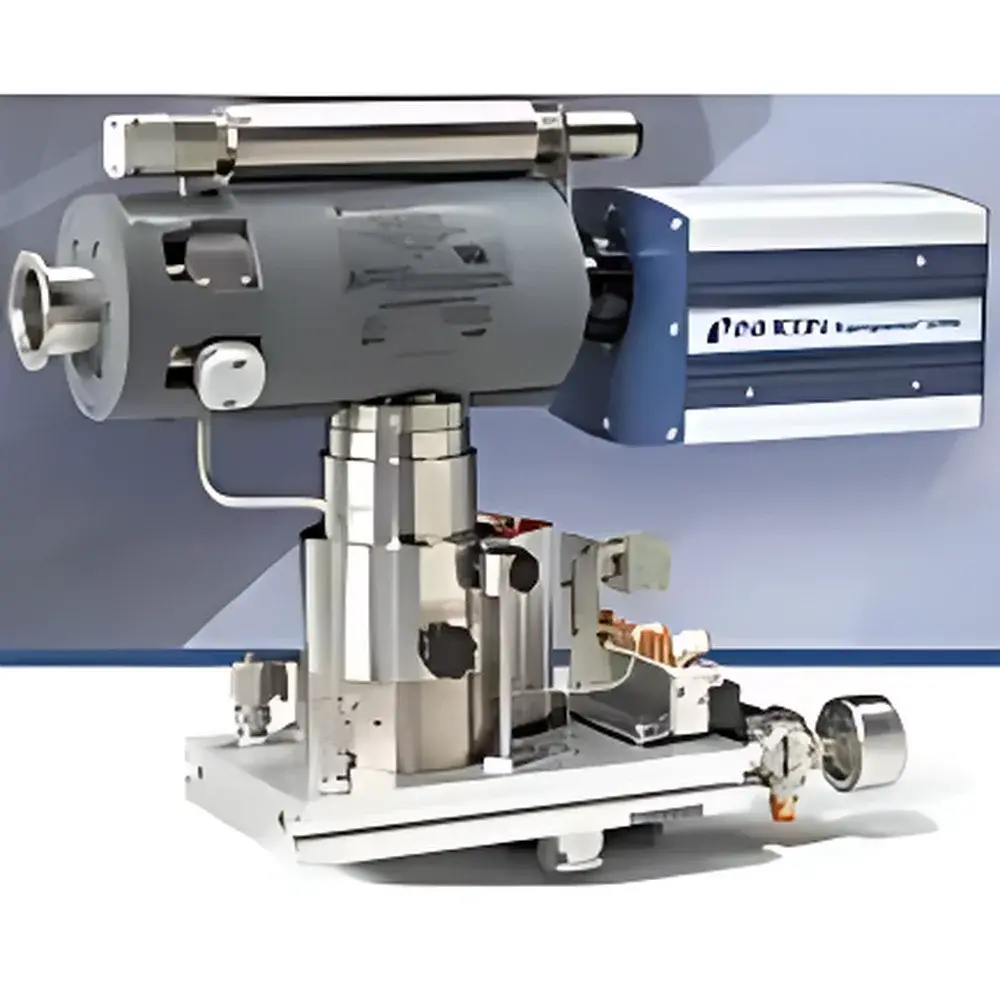
Transpector CPM Quadrupole Mass Spectrometer System
| Origin | USA |
|---|---|
| Manufacturer Type | Authorized Distributor |
| Origin Category | Imported |
| Model | Transpector CPM |
| Pricing | Upon Request |
Overview
The Transpector CPM Quadrupole Mass Spectrometer System is a purpose-engineered, compact in-line gas analysis platform designed for continuous, real-time monitoring of process gases in high-pressure vacuum environments (up to 2 bar absolute). Operating on the principle of quadrupole mass filtering—where ions are separated by their mass-to-charge ratio (m/z) under precisely controlled radiofrequency (RF) and direct current (DC) fields—the system delivers quantitative and qualitative compositional data across a selectable mass range of 0–100, 0–200, or 0–300 amu. Its architecture integrates directly into industrial vacuum tooling (e.g., PVD, CVD, and plasma etch chambers), enabling unattended 7×24 operation with high spectral reproducibility and long-term signal stability. Unlike benchtop laboratory mass spectrometers, the Transpector CPM is engineered for ruggedness, thermal resilience, and minimal maintenance in production-critical settings where uptime, repeatability, and trace-level detection are non-negotiable.
Key Features
- Compact, modular footprint optimized for integration into space-constrained high-pressure vacuum systems—including load locks, transfer chambers, and process modules.
- HexBlock™ sampling interface: A proprietary multi-port, heated, low-dead-volume inlet manifold that minimizes gas residence time, suppresses condensation, and ensures representative sampling across dynamic pressure gradients (10−6 mbar to 2 bar).
- Integrated capacitance manometer (CDG) with digital output: Provides simultaneous, calibrated process pressure measurement (±0.25% FS accuracy) and hardware-level interlock signaling for safety-critical chamber protection.
- Closed-source ionization design: Shields the filament and ion optics from reactive, corrosive, or polymerizing process chemistries (e.g., Cl2, NF3, SiH4, O2/CF4 plasmas), extending source lifetime and sustaining detection limits down to sub-ppm levels for key contaminants (H2O, O2, CO, CO2, hydrocarbons).
- Lightweight aluminum chassis (< 12 kg) with MIL-STD-810G compliant mounting options: Facilitates rapid deployment, repositioning, and field service without requiring structural reinforcement or custom support frames.
- Optional certified calibration gas modules: Pre-configured, NIST-traceable standard mixtures (e.g., 100 ppm Ar in N2, 1% O2 in He) for automated mass axis tuning, sensitivity verification, and quantitative response factor validation per ISO 17025-aligned procedures.
Sample Compatibility & Compliance
The Transpector CPM is validated for direct sampling of aggressive process streams encountered in semiconductor front-end-of-line (FEOL) and back-end-of-line (BEOL) fabrication, flat-panel display (FPD) thin-film deposition, and photovoltaic (PV) manufacturing. It maintains analytical integrity under exposure to halogen-based etchants, silane derivatives, metalorganic precursors, and oxidizing plasmas. The system complies with CE marking requirements (EMC Directive 2014/30/EU, Low Voltage Directive 2014/35/EU), meets UL 61010-1 safety standards for industrial instrumentation, and supports audit-ready documentation for GMP/GLP environments. Optional firmware configurations enable compliance with FDA 21 CFR Part 11 for electronic records and signatures when paired with validated host software.
Software & Data Management
Control and data acquisition are managed via the Transpector Control Suite—a Windows-based application supporting both local HMI and remote OPC UA server connectivity. The suite provides real-time spectral visualization, time-stamped peak tracking, customizable alarm thresholds (with email/SNMP notification), and export of raw .raw and processed .csv files. All spectral acquisitions include embedded metadata (timestamp, pressure reading, instrument status flags, operator ID), ensuring full traceability. Audit trails log user actions, method changes, and calibration events; data integrity is preserved through SHA-256 hashing and write-once archival modes compatible with enterprise LIMS and MES platforms.
Applications
- Leak detection and localization in high-pressure vacuum systems using helium or hydrogen tracer gases, with detection sensitivity < 1×10⁻⁹ mbar·L/s.
- Real-time gas purity verification for bulk and specialty gases (e.g., Ar, N2, He, NH3, BCl3) prior to delivery into critical process zones.
- In-situ contamination monitoring for moisture, oxygen, and hydrocarbon ingress during chamber pump-down and idle periods.
- Process endpoint detection in reactive ion etching (RIE) and deep reactive ion etching (DRIE) via transient species evolution (e.g., SiFx+, AlCl+, CFx+).
- Deposition rate correlation and stoichiometry verification in sputtering and ALD processes through precursor fragmentation pattern analysis.
FAQ
What mass ranges are supported, and how is range selection performed?
The system supports three factory-configurable mass ranges: 0–100 amu, 0–200 amu, and 0–300 amu. Range selection is performed at setup via firmware configuration—no hardware modification is required.
Is the Transpector CPM compatible with existing vacuum flange standards?
Yes—it ships with a standard DN40 CF (ConFlat) vacuum interface and optional adapters for ISO-KF, ISO-F, and NW flanges.
How frequently does the system require calibration or tuning?
Under stable operating conditions, mass calibration remains valid for ≥6 months; sensitivity drift is typically <5% per year. Quarterly verification using optional standard gas modules is recommended for quantitative applications.
Can the system operate autonomously without a host PC?
No—the Transpector CPM requires connection to a dedicated control PC or industrial controller running the Transpector Control Suite for operation, though it supports headless mode via remote desktop or VNC after initial setup.
Does the closed ion source require periodic cleaning or replacement?
The closed-source design significantly reduces maintenance frequency; routine filament replacement is recommended every 6–12 months depending on total ion dose, while source cleaning intervals exceed 12 months in typical semiconductor tooling environments.







