
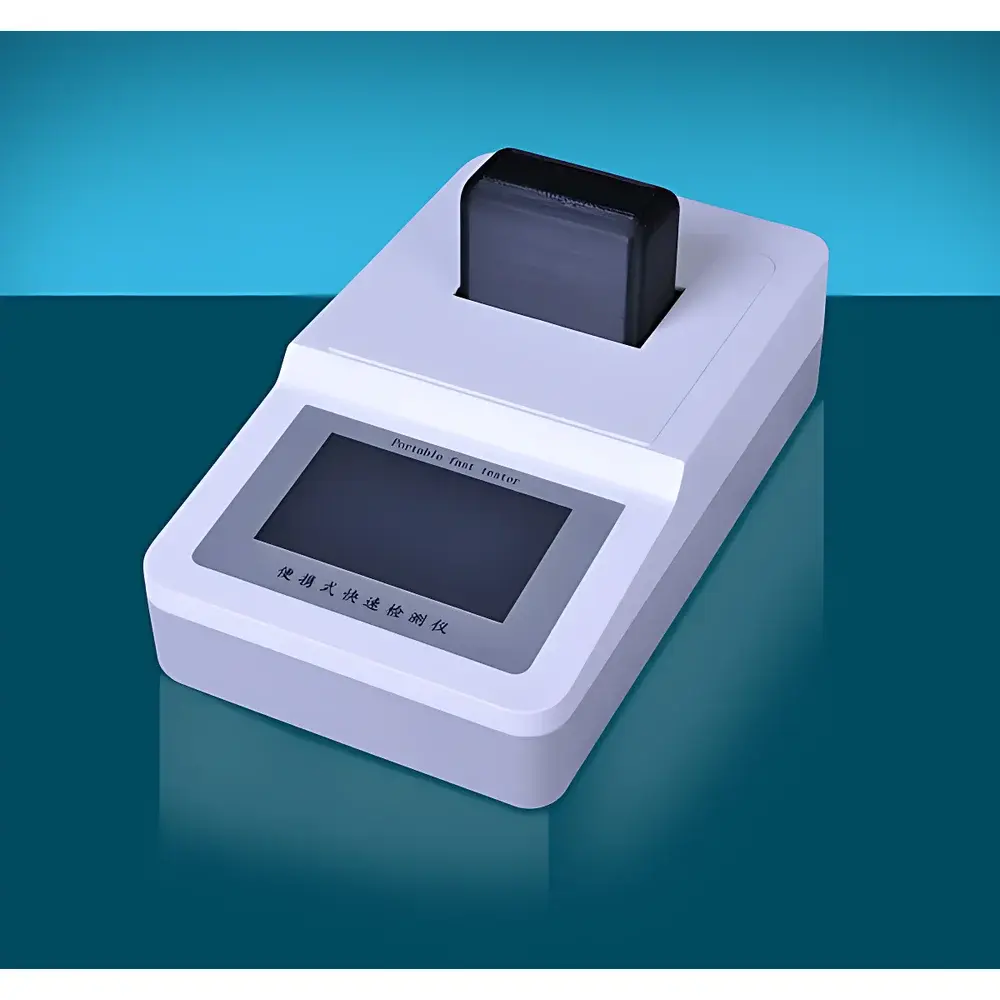
Ruixin SPb-I2 Portable Iodine Content Analyzer for Edible Salt
| Brand | Ruixin |
|---|---|
| Origin | Shanghai, China |
| Manufacturer Type | Authorized Distributor |
| Country of Manufacture | China |
| Model | SPb-I2 |
| Function Type | Single-Parameter Detection System |
| Sample Type | Dedicated to Edible Salt Samples |
| Wavelength Range | 400–680 nm |
| Detection Time | <2 min per sample |
| Repeatability (RSD) | <5% |
| Detection Channels | 1 |
| Absorbance Display Range | 0.000–4.000 |
| Transmittance Display Range | 0.00–100.00% |
| Transmittance Resolution | 0.01% |
| Absorbance Resolution | 0.001 |
| Photometric Accuracy (Transmittance) | ±2.0% |
| Photometric Repeatability (Transmittance) | ≤0.2% |
| Baseline Stability (3 min) | ≤0.3% |
| Limit of Detection (LOD) | 0.1 mg/kg |
| Quantification Range | 0–10 mg/kg |
| Communication Interfaces | RS232, USB |
| Power Options | Integrated Li-ion battery, AC 220 V, DC 5 V |
| Built-in Thermal Printer | Yes |
| Touchscreen | 4.3-inch HD color LCD with Chinese UI |
Overview
The Ruixin SPb-I2 Portable Iodine Content Analyzer is a dedicated spectrophotometric instrument engineered for rapid, on-site quantification of iodine concentration in edible salt—specifically targeting potassium iodate (KIO₃) or potassium iodide (KI) forms following standardized colorimetric reaction protocols (e.g., ceric ammonium sulfate or arsenious acid methods). Based on Beer–Lambert law principles, the analyzer measures absorbance at selected wavelengths within the visible spectrum (400–680 nm), where iodine-derived chromophores exhibit characteristic absorption peaks. Its optical architecture incorporates an integrated self-calibration system that automatically corrects baseline drift and photometric zero/100% transmittance upon power-on—eliminating manual calibration steps and enhancing measurement consistency across field deployments. Designed for compliance with national food safety standards including GB 14880–2012 (China’s Food Nutrient Fortification Standard) and GB/T 13025.7–2012 (Method for Determination of Iodine in Salt), the SPb-I2 delivers trace-level detection capability (LOD: 0.1 mg/kg) and linear quantification over 0–10 mg/kg—covering the regulatory range for iodized salt (typically 18–33 mg/kg KIO₃, equivalent to ~10–19 mg/kg elemental iodine).
Key Features
- Portable ruggedized design housed in an impact-resistant aluminum carrying case, enabling deployment in mobile food safety labs, county-level CDC units, market supervision vehicles, and rural inspection stations.
- Integrated rechargeable lithium-ion battery supporting ≥6 hours of continuous operation—ideal for off-grid or roadside testing without AC dependency.
- 4.3-inch high-resolution color touchscreen with full Chinese graphical user interface (GUI), supporting intuitive navigation, touch-based data entry, and real-time visualization of absorbance/transmittance values.
- Onboard thermal printer generates compliant test reports containing sample name (in Chinese), measured iodine concentration (mg/kg), test date/time, operator ID, and institutional stamp—meeting documentation requirements under China’s SAMR inspection guidelines.
- Dual-mode photometric display: simultaneous readout of absorbance (A) and percent transmittance (%T), facilitating method validation and cross-referencing with legacy UV-Vis protocols.
- Automated data management: internal memory stores ≥1,000 test records with timestamp, searchable by sample ID or date; supports export via USB or RS232 to LIMS or Excel-compatible formats.
- Optical self-diagnostic routine ensures wavelength accuracy and photometric linearity prior to each assay—reducing operator-induced variability and supporting GLP-aligned workflow integrity.
Sample Compatibility & Compliance
The SPb-I2 is validated exclusively for aqueous extracts of refined edible salt samples prepared according to GB/T 13025.7–2012. It is not intended for direct analysis of raw sea salt, iodized table salt with anti-caking agents requiring pre-filtration, or non-salt matrices without method adaptation and verification. While the instrument’s optical platform permits incidental use for other colorimetric assays (e.g., nitrite, formaldehyde), such applications fall outside factory validation and require independent method qualification per ISO/IEC 17025:2017. The device complies with electromagnetic compatibility (EMC) Class B limits per GB/T 18268.1–2010 and meets electrical safety requirements under GB 4793.1–2007. Documentation includes factory calibration certificates traceable to NIM (National Institute of Metrology, China).
Software & Data Management
Firmware supports audit-trail-free data logging compliant with basic food safety recordkeeping mandates. All measurements are time-stamped and stored with operator-assigned sample identifiers. USB mass storage mode enables drag-and-drop transfer of CSV-formatted datasets for external statistical analysis (e.g., Shewhart control charts, trend monitoring). RS232 serial output allows integration with centralized monitoring dashboards used by provincial food safety information platforms. No cloud connectivity or remote firmware updates are implemented—ensuring data sovereignty and alignment with China’s Cybersecurity Law requirements for sensitive food surveillance equipment.
Applications
- Routine monitoring of iodine fortification levels in commercial iodized salt batches at production facilities and distribution centers.
- Field verification during market surveillance campaigns conducted by municipal food and drug administration (CFDA/SAMR) teams.
- Capacity-building support for grassroots laboratories in western and rural regions lacking access to benchtop spectrophotometers.
- Educational use in food science curricula for demonstrating quantitative colorimetry and nutritional fortification analytics.
- Supplementary testing in emergency response scenarios (e.g., post-disaster salt supply screening) where laboratory infrastructure is compromised.
FAQ
Is the SPb-I2 compliant with international iodine testing standards such as Codex Alimentarius or AOAC?
The instrument implements methodology aligned with GB/T 13025.7–2012, which is technically harmonized with ISO 15278:1999 (now withdrawn) and retains equivalence to core principles in Codex STAN 235–2003. However, formal AOAC Performance Tested Method (PTM) certification has not been obtained.
Can the device be used for iodine testing in dairy or seafood products?
No. The SPb-I2 is factory-validated only for salt matrixes. Analysis of complex biological matrices requires extraction optimization, interference correction, and independent method validation per ISO 5725 series.
Does the built-in printer support English-language reporting?
The current firmware version supports Chinese-only print output. English localization requires custom firmware revision and is not available under standard warranty terms.
What maintenance is required to sustain photometric accuracy?
Monthly verification using supplied neutral density filters and annual optical path cleaning with lint-free swabs and isopropanol are recommended. No lamp replacement is needed—the LED light source has >10,000-hour operational lifetime.
Is PC software provided for data aggregation and report generation?
A Windows-compatible desktop utility is included on USB drive for batch export, basic statistics (mean, SD, CV%), and PDF report templating—no installation or license required.





