
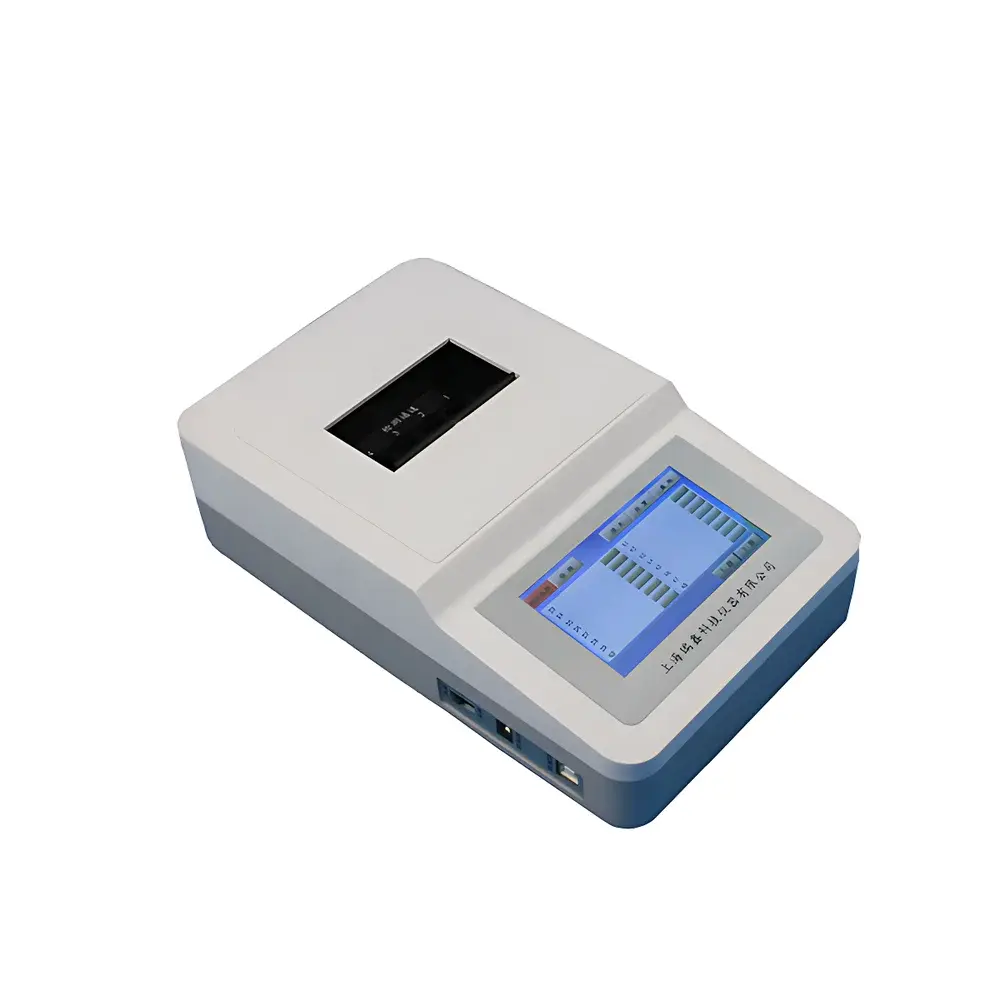
Ruixin SPb-GB2 Benzoyl Peroxide Rapid Detection Analyzer
| Brand | Ruixin |
|---|---|
| Origin | Shanghai, China |
| Manufacturer Type | Authorized Distributor |
| Regional Category | Domestic (China) |
| Model | SPb-GB2 |
| Price Range | USD 4,200 – 7,000 (FOB Shanghai) |
| Functionality | Single-Analyte Dedicated Instrument |
| Sample Format | Single-Sample Mode |
| Optical Wavelength | 540 nm |
| Assay Time | ≤ 180 seconds |
| Photometric Repeatability | ≤ 0.2% (Transmittance) |
| Detection Channels | 1 |
Overview
The Ruixin SPb-GB2 Benzoyl Peroxide Rapid Detection Analyzer is a portable, single-wavelength photometric analyzer engineered for quantitative determination of benzoyl peroxide (BPO) in flour, wheat products, and related food matrices. It operates on the principle of visible-spectrum absorbance measurement at 540 nm, where BPO—after reaction with a chromogenic reagent (typically potassium iodide under acidic conditions)—generates a yellow-colored triiodide complex proportional to analyte concentration. This method aligns with standard colorimetric protocols referenced in GB/T 22388–2008 (Chinese National Standard for Benzoyl Peroxide in Flour) and supports rapid screening workflows compliant with routine food safety surveillance requirements. Designed for field-deployable operation, the SPb-GB2 integrates an embedded optical calibration system that performs automatic zero and full-scale self-adjustment upon startup—eliminating manual photometric alignment and reducing operator dependency. Its compact form factor, combined with internal rechargeable lithium battery power, enables uninterrupted use in mobile inspection units, regulatory field labs, and point-of-entry checkpoints without external AC infrastructure.
Key Features
- Portable architecture with integrated 4.3-inch high-resolution TFT color touchscreen—fully localized Chinese UI with intuitive icon-driven navigation and tactile feedback.
- On-device intelligent Chinese input via virtual keyboard and stylus support—enabling direct entry of sample IDs, operator names, and institutional metadata into assay records.
- Dedicated thermal printer module producing traceable hard-copy reports per test channel; output includes quantitative result (mg/kg), sample name (Chinese), date/time stamp, analyst ID, and testing institution.
- Automated photometric calibration sequence: self-zeroing and auto-span correction at power-on—ensuring consistent baseline stability across environmental fluctuations.
- Dual-mode display capability: simultaneous real-time readout of absorbance (0.000–4.000 AU) and transmittance (0.00–100.00%), supporting method validation and cross-platform data correlation.
- Embedded data management: automatic timestamped storage of ≥1,000 test results with recall-by-date, sample ID, or operator filter; no external memory card required.
- Multi-source power compatibility: internal Li-ion battery (≥6 h continuous operation), AC 220 V adapter, and DC 5 V USB input—enabling flexible deployment in vehicles, temporary labs, or remote sites.
Sample Compatibility & Compliance
The SPb-GB2 is validated for use with homogenized flour samples prepared according to standardized extraction and derivatization procedures specified in GB/T 22388–2008. It accommodates liquid-phase reaction mixtures in standard 10-mm pathlength cuvettes and delivers reliable quantification within the linear dynamic range of 0–300 mg/kg, with a limit of detection (LOD) of 20.0 mg/kg (S/N ≥ 3). While not certified to ISO/IEC 17025 as a standalone instrument, its operational protocol supports GLP-aligned documentation practices—including audit-ready printed reports with unique identifiers, operator authentication fields, and immutable timestamps. Data export via RS232 or USB facilitates integration into centralized food safety monitoring platforms compliant with China’s Food Safety Information Traceability System (FSITS) architecture.
Software & Data Management
No external PC software is required for basic operation. All firmware logic—including calibration algorithms, concentration interpolation (via pre-loaded calibration curve), and report generation—is executed onboard. Result archives are stored in non-volatile memory with write-protection against accidental overwrites. Exported datasets (CSV format) retain full metadata: absorbance value, calculated concentration, detection wavelength, operator ID, and UTC timestamp. Communication interfaces comply with standard serial command sets (ASCII-based) and USB CDC class protocols—enabling interoperability with third-party LIMS or regional food safety dashboards. Audit trail functionality meets minimum requirements for regulatory review under China’s Administrative Measures for Food Safety Sampling and Inspection (Order No. 15 of SAMR).
Applications
- Routine surveillance testing of wheat flour and bakery raw materials by municipal market supervision bureaus.
- On-site verification during unannounced inspections at milling facilities, wholesale distribution centers, and retail supply chains.
- Complementary analysis in mobile food safety laboratories mounted on inspection vehicles (e.g., “Food Safety Patrol Cars” deployed by provincial CDCs).
- Pre-screening prior to confirmatory analysis by HPLC or GC-MS in central reference labs—reducing analytical workload and accelerating decision cycles.
- Training and capacity-building for frontline inspectors in county-level health and quality supervision agencies.
FAQ
What regulatory standards does the SPb-GB2 support?
It is designed to implement the methodology outlined in GB/T 22388–2008 and supports documentation practices aligned with SAMR Order No. 15 and China’s national food traceability framework.
Can the instrument be used outside China?
Yes—though method validation must be performed locally to verify matrix interference and recovery rates in non-Chinese flour varieties and regulatory contexts.
Is user calibration required before each test?
No—automatic photometric self-calibration occurs at startup; only routine cuvette cleaning and reagent lot verification are recommended between batches.
Does the device meet FDA or EU food safety requirements?
It is not CE-marked or FDA-listed; however, its photometric performance parameters (e.g., repeatability ≤0.2%, stability ≤0.3%/3 min) fall within typical acceptance criteria for rapid screening devices used in preliminary hazard assessment.
How is data integrity ensured during transmission?
RS232 and USB exports generate tamper-evident CSV files containing digital signatures of acquisition time and operator ID—supporting basic data governance requirements for internal QA reviews.




