
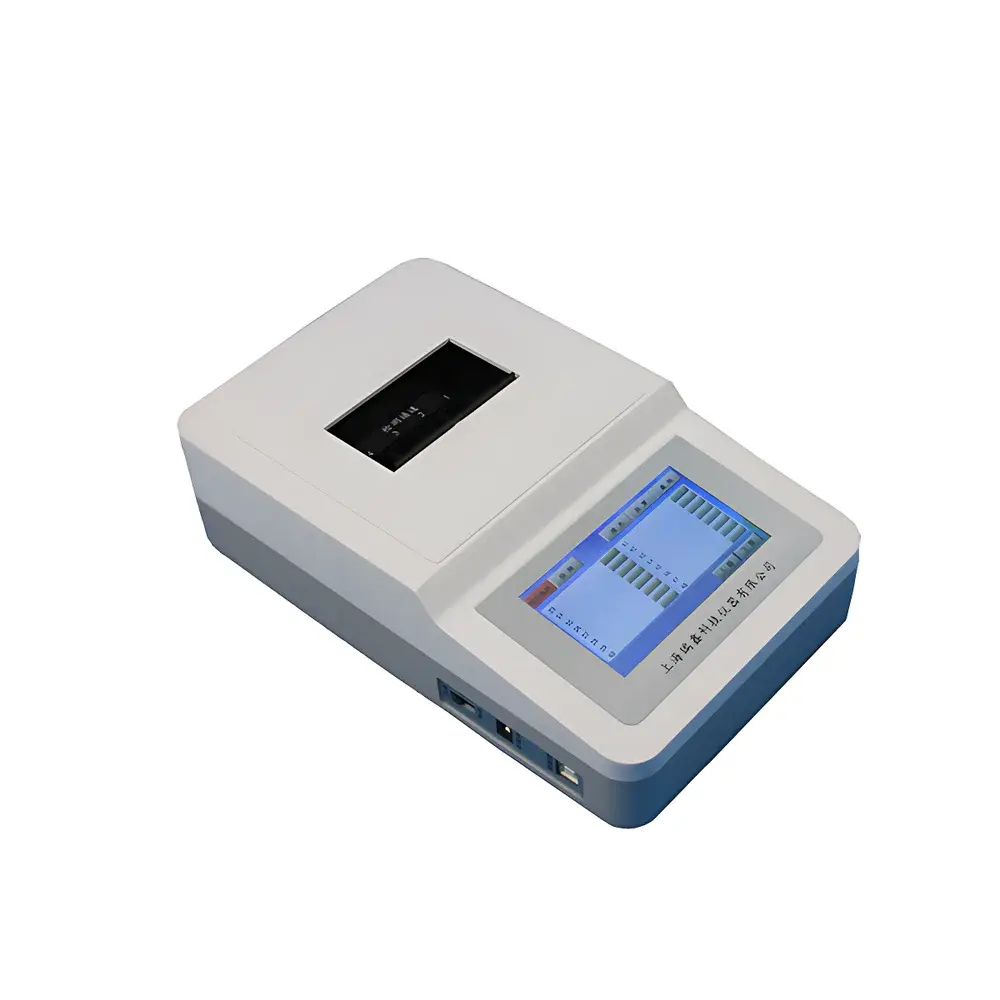
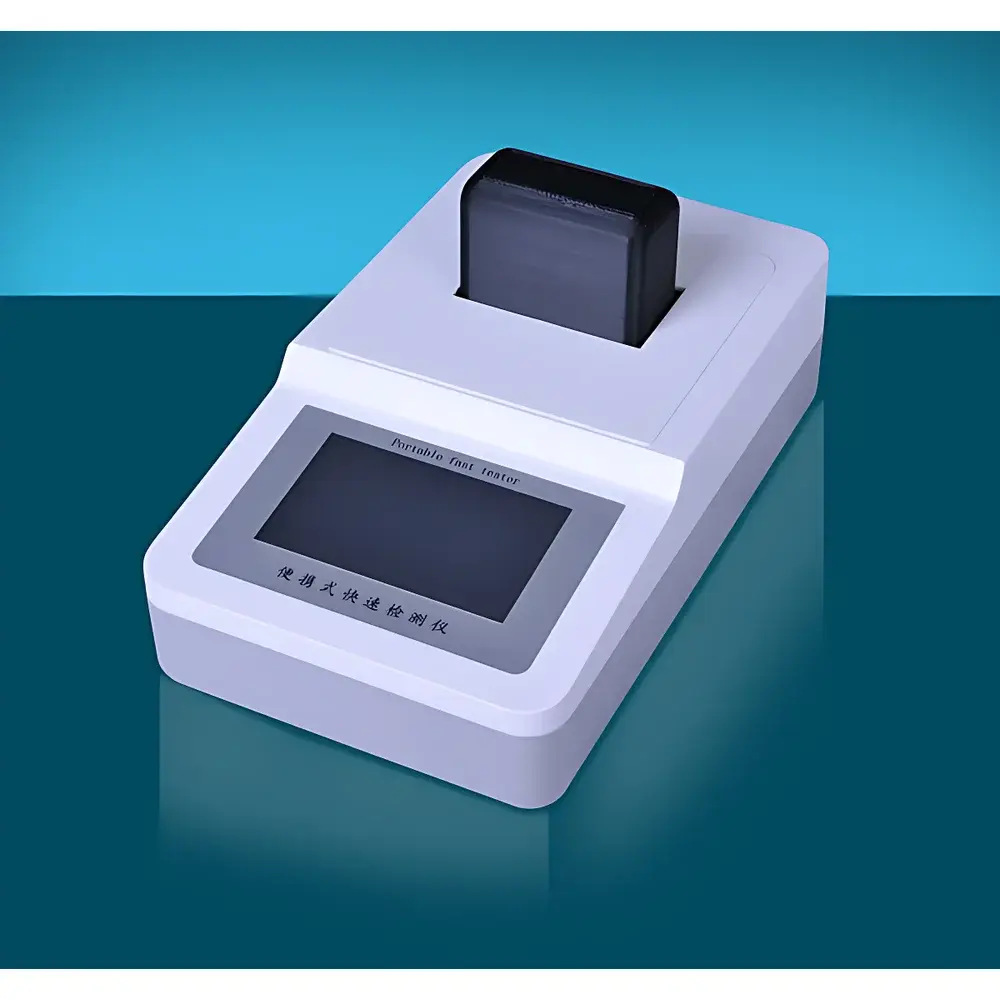
Ruixin SZ-FH2 Fluoride Ion Analyzer
| Brand | Ruixin |
|---|---|
| Origin | Shanghai, China |
| Manufacturer Type | Authorized Distributor |
| Country of Manufacture | China |
| Model | SZ-FH2 |
| Price | USD 540 (approx.) |
| Functionality | Single-Analyte Quantitative Detection |
| Sample Format | Single-Sample Mode |
| Wavelength Range | 380–630 nm |
| Analysis Time | ≤ 180 s |
| Photometric Repeatability | ≤ 0.2% |
| Optical Channels | 1 |
| Absorbance Range | 0.000–4.000 AU |
| Transmittance Range | 0.00–100.00% |
| Transmittance Resolution | 0.01% |
| Absorbance Resolution | 0.001 AU |
| Photometric Accuracy (Transmittance) | ±2.0% |
| Baseline Stability (3 min) | ≤ 0.3% |
| Fluoride Measurement Range | 0.01–1.00 mg/L F⁻ |
| Communication Interfaces | RS-232, USB |
| Power Options | AC 220 V / DC 5 V / Rechargeable Li-ion Battery |
| Display | 4.5-inch TFT color touchscreen (full Chinese UI) |
| Data Output | Embedded thermal printer, on-device storage, real-time data export |
Overview
The Ruixin SZ-FH2 Fluoride Ion Analyzer is a portable, single-parameter spectrophotometric instrument engineered for rapid, field-deployable quantification of fluoride ion (F⁻) in aqueous matrices. It operates on the principle of colorimetric analysis using the SPADNS (sodium 2-(p-sulfophenylazo)-1,8-dihydroxy-3,6-naphthalenedisulfonate) method or analogous chromogenic reagent systems compliant with standard fluorometric protocols (e.g., APHA Standard Method 4500-F B and ISO 10304-1). The instrument integrates a fixed-wavelength optical path within the visible spectrum (380–630 nm), optimized for high signal-to-noise ratio detection of the magenta-colored complex formed between fluoride and zirconium–SPADNS under controlled pH conditions. Designed for operational flexibility, the SZ-FH2 supports both on-site environmental screening and routine laboratory use—meeting the functional requirements of water quality monitoring programs, municipal drinking water compliance checks, and industrial effluent verification per national regulatory frameworks.
Key Features
- Compact aluminum alloy chassis with ergonomic handling and IP54-rated dust/moisture resistance for reliable field operation.
- 4.5-inch high-resolution TFT color touchscreen with full Chinese graphical user interface (GUI), enabling intuitive navigation without external peripherals.
- Integrated intelligent Chinese input system supporting touch-pen and on-screen keyboard entry for sample ID, operator name, location tags, and contextual notes—ensuring traceable, auditable recordkeeping.
- Preloaded calibration curves for multiple concentration ranges (0.01–0.20 mg/L, 0.10–0.50 mg/L, 0.30–1.00 mg/L), eliminating manual curve construction during routine analysis.
- Embedded thermal printer delivering immediate hard-copy reports including date/time stamp, measured absorbance/transmittance values, calculated F⁻ concentration (mg/L), and operator ID.
- Onboard data storage (≥1000 test records) with timestamp, result, and calibration status metadata; accessible via menu-driven query function.
- Dual power architecture: operable from AC mains (220 V), universal DC adapter (5 V), or internal rechargeable lithium-ion battery (≥8 h continuous use).
Sample Compatibility & Compliance
The SZ-FH2 is validated for direct analysis of clarified, low-turbidity aqueous samples—including surface water, groundwater, treated drinking water, and pre-filtered industrial wastewater—without dilution or pretreatment when fluoride concentrations fall within 0.01–1.00 mg/L. Interference mitigation protocols (e.g., masking with citrate or EDTA for Fe³⁺/Al³⁺) are supported via configurable method steps in the instrument’s assay library. While not certified to ISO/IEC 17025 or accredited per GLP, the analyzer conforms to core performance criteria referenced in China’s HJ 488-2009 (Environmental Monitoring Technical Specification for Fluoride in Water) and aligns with measurement principles cited in US EPA Method 300.0 and ASTM D3869-21. Its photometric repeatability (≤0.2%) and stability (≤0.3% over 3 min) meet minimum requirements for Class II field instruments under ISO 7027-1:2016.
Software & Data Management
Data acquisition and reporting are managed through embedded firmware with non-volatile memory retention. All measurements are automatically time-stamped and stored with full context: sample ID, calibration ID, reagent lot (manually entered), and operator annotation. Export is supported via USB mass-storage mode (CSV format) or RS-232 serial transmission to external PCs or LIMS platforms. No proprietary software installation is required; exported files are compatible with Excel, LabArchives, and common ELN systems. Audit trail functionality includes automatic logging of calibration events, zero-point adjustments, and firmware updates—supporting basic 21 CFR Part 11 readiness when deployed in regulated environments with supplementary procedural controls.
Applications
- Routine surveillance of fluoride levels in community water supply systems to verify compliance with WHO guideline value (1.5 mg/L) and national standards (e.g., GB 5749-2022: 1.0 mg/L max).
- Field-based assessment of geogenic fluoride contamination in rural groundwater sources across endemic regions.
- Quality control testing of fluoride-containing dental products, pharmaceutical excipients, and industrial etchants prior to discharge.
- Educational use in university environmental science laboratories for teaching colorimetric assay fundamentals and water quality parameter interrelationships.
- Emergency response screening following suspected industrial spills involving hydrofluoric acid or fluorosilicates.
FAQ
What reagents are required for fluoride measurement with the SZ-FH2?
The instrument requires commercially available fluoride test kits based on the zirconium–SPADNS method (e.g., Hach 8014 or equivalent). Reagents must be stored desiccated and protected from light; shelf life is typically 12 months unopened.
Can the SZ-FH2 be used for seawater or high-salinity samples?
No. High chloride and sulfate concentrations cause significant interference; samples with TDS > 500 mg/L require dilution and matrix-matched calibration or alternative methods (e.g., ion-selective electrode).
Is firmware upgrade supported?
Yes—updates are distributed as .bin files via USB drive and installed through the “System Maintenance” menu. Version history and release notes are provided in English and Chinese.





