
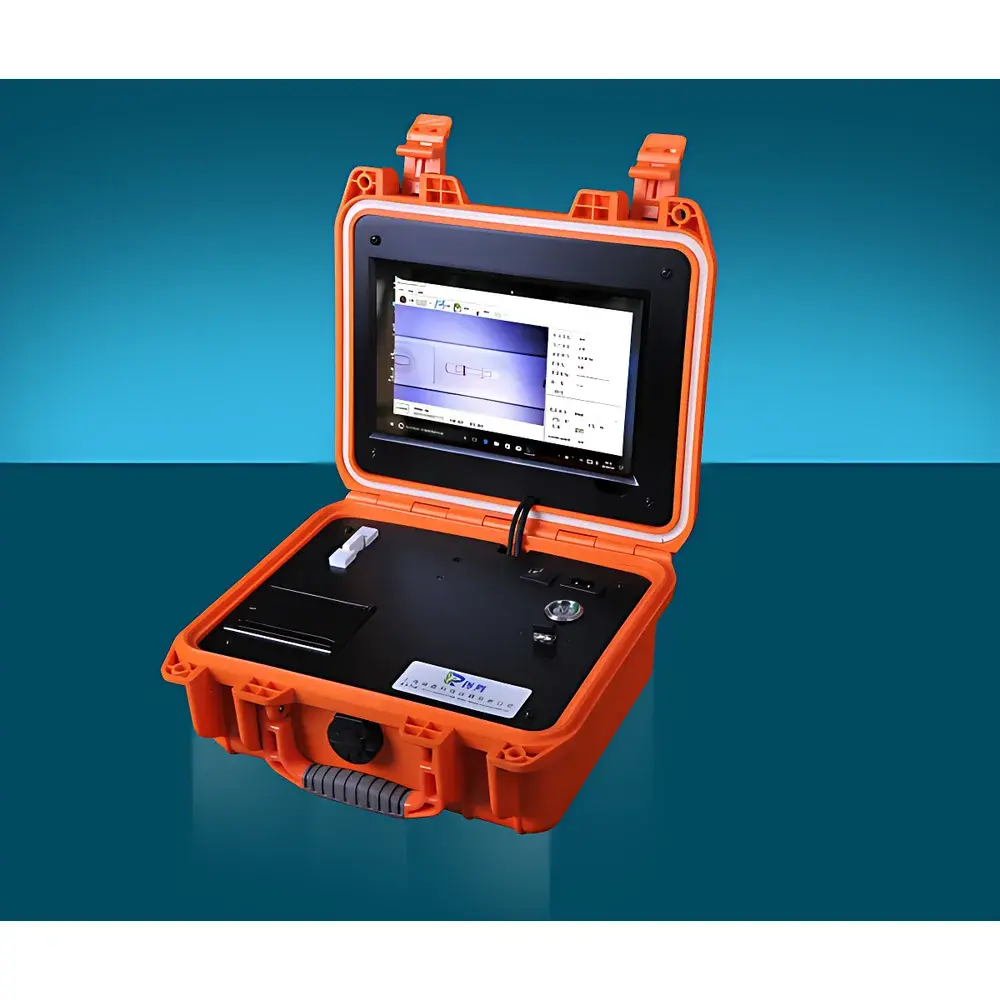
Ruixin JT-102JD Egg Antibiotic Residue Rapid Detection Analyzer
| Brand | Ruixin |
|---|---|
| Origin | Shanghai, China |
| Manufacturer Type | Authorized Distributor |
| Regional Classification | Domestic (PRC) |
| Model | JT-102JD |
| Function Type | Single-Analyte Rapid Immunoassay Platform |
| Sample Type | Egg and Duck Egg Matrix Only |
| Wavelength Range | 380–680 nm |
| Detection Time | ≤ 180 s per test |
| Repeatability (CV) | ≤ 0.3% |
| Detection Channels | 1 |
| Measurement Speed | < 0.5 s per image capture |
| Optical Precision | CV < 1% (certified control strips), Inter-batch Variation < 3% |
| Sensitivity Threshold | < 0.001 ng/mL (matrix-dependent, per validated analyte) |
| Data Storage | 16 GB internal (expandable to 32 GB), ≥ 100,000 test records with full-image archiving |
| Power Supply | AC 220 V / 5 V DC / Internal Li-ion battery (≥24 h standby) |
| Power Consumption | < 10 W |
| Connectivity | USB 2.0, Wi-Fi 802.11 b/g/n, Bluetooth 4.2, Optional 3G/4G module |
| Output Formats | C/T line intensity ratio, colorimetric quantification, CT value, digital chromatographic profile export (CSV, PDF, XML) |
| Regulatory Alignment | Designed for compliance with GB/T 22286–2008, NY/T 761–2008, and supports audit-trail-ready data handling per GLP principles |
Overview
The Ruixin JT-102JD Egg Antibiotic Residue Rapid Detection Analyzer is a dedicated lateral flow immunoassay (LFIA) reader engineered for quantitative interpretation of colloidal gold-based test strips in avian egg matrices. It operates on reflectance spectroscopy within the visible spectrum (380–680 nm), capturing high-resolution digital images of test and control lines using a calibrated CCD sensor. Unlike qualitative visual assessment, the JT-102JD applies pixel-intensity normalization, background subtraction, and multi-point curve fitting (including logistic 4PL and linear regression models) to convert optical density into concentration estimates—enabling trace-level quantification of over 100 veterinary drug residues, including fluoroquinolones (enrofloxacin, ofloxacin), nitrofurans (furazolidone, furaltadone), chloramphenicol, sulfonamides, tetracyclines, β-lactams, macrolides, aminoglycosides, and melamine. The system bridges rapid screening and semi-quantitative decision-making in farm-to-market food safety workflows, supporting risk-based triage prior to confirmatory LC-MS/MS analysis.
Key Features
- High-fidelity 10.1-inch capacitive touchscreen interface running Windows OS with Intel quad-core 1.3 GHz processor, enabling real-time image processing and on-device data visualization.
- Auto-alignment algorithm corrects strip positioning errors (lateral shift, rotation, tilt) and discriminates valid test cartridges from expired or damaged units via embedded QR/barcode validation.
- Full-spectrum reflectance measurement with integrated white-light LED illumination and spectral response compensation for batch-to-batch photometric consistency.
- Onboard storage (16 GB standard, expandable) retains raw TIFF images, processed CT ratios, calibration logs, operator IDs, timestamps, GPS geotags, and audit trails—meeting GLP documentation requirements.
- Multi-protocol wireless connectivity (Wi-Fi, Bluetooth 4.2, optional 3G/4G) enables encrypted TLS 1.2 transmission to centralized food safety monitoring platforms, regional regulatory dashboards, or cloud-hosted LIMS.
- Open-source software architecture allows third-party integration, custom assay method deployment, and regulatory-compliant firmware updates without vendor lock-in.
- Integrated thermal printer supports immediate generation of ISO/IEC 17025-aligned reports with QR-coded result verification and digital signature fields.
Sample Compatibility & Compliance
The JT-102JD is validated exclusively for homogenized, centrifuged, and filtered extracts from chicken and duck eggs. It accepts standardized colloidal gold immunochromatographic strips conforming to GB/T 22286–2008 (determination of chloramphenicol in animal-derived foods) and NY/T 761–2008 (residue detection in agricultural products). While not a primary reference method, its output serves as an evidentiary screening tool under China’s Food Safety Law (Article 112) and aligns with FAO/WHO Codex Alimentarius principles for rapid analytical methods. All data handling—including user authentication, version-controlled software execution, and immutable record timestamps—supports traceability required for GMP/GLP audits and FDA 21 CFR Part 11 readiness when deployed with appropriate procedural controls.
Software & Data Management
The embedded Ruixin Analytical Suite provides role-based access control (administrator, technician, auditor), configurable test templates, and built-in calibration management with NIST-traceable reference strip libraries. Raw image metadata includes EXIF tags (exposure time, gain, lens distortion correction coefficients), enabling retrospective reprocessing. Export formats include CSV (for statistical analysis in R or Python), PDF/A-2 (archival), and XML (compatible with national food safety surveillance systems such as China’s “Food Safety Traceability Platform”). Audit logs record every action—method selection, result override, calibration event, or user logout—with SHA-256 hashing for integrity verification. Firmware updates are digitally signed and applied over secure OTA channels.
Applications
- On-farm and hatchery-level screening of laying hen flocks for antibiotic non-compliance prior to egg collection.
- Quality control in egg processing facilities performing lot-release testing per HACCP plans.
- Regulatory field inspections by municipal market supervision bureaus conducting random sampling at wholesale markets.
- Contract laboratories providing rapid-turnaround pre-screening services to exporters requiring CNAS-accredited documentation.
- Academic research on residue depletion kinetics in avian tissues, where high-throughput semi-quantitative trends supplement confirmatory analytics.
FAQ
Is the JT-102JD suitable for detecting antibiotics in liquid milk or meat tissue?
No. It is strictly validated for egg and duck egg homogenates. Cross-matrix use voids calibration validity and violates GB/T 22286–2008 scope limitations.
Does the instrument require daily recalibration with reference standards?
Yes. A certified control strip must be scanned before each testing session to validate optical baseline and linearity; calibration logs are auto-archived.
Can raw image files be exported for independent reanalysis?
Yes. TIFF files with embedded metadata (including pixel-intensity matrices and illumination profiles) are accessible via USB or network share.
What cybersecurity protocols govern wireless data transmission?
All Wi-Fi and cellular transmissions use AES-256 encryption and mutual TLS authentication; certificate pinning prevents man-in-the-middle interception.
Is the software compliant with FDA 21 CFR Part 11 for electronic records?
The system supports Part 11 elements (electronic signatures, audit trails, record retention) but requires site-specific validation per Annex 11 and organizational SOPs to achieve full compliance.





