
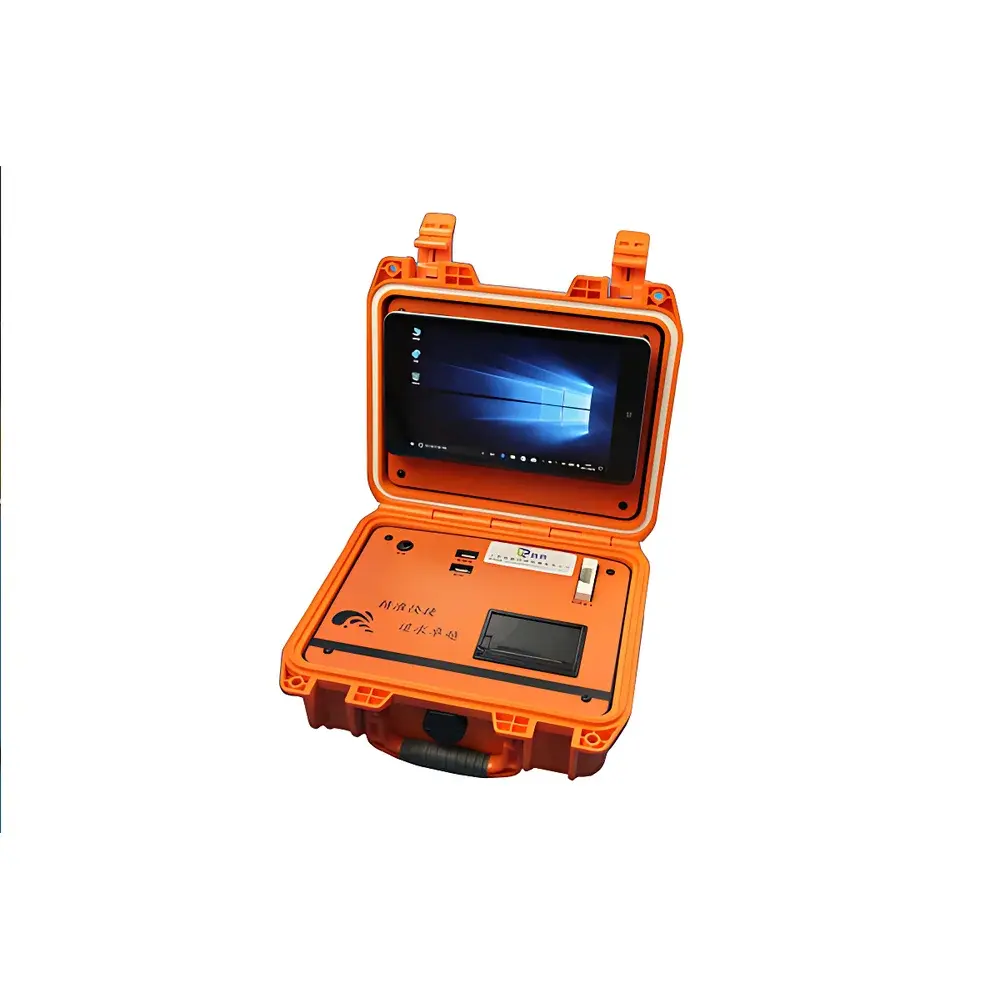
Ruixin JT-102B Colloidal Gold Immunoassay Reader
| Brand | Ruixin |
|---|---|
| Origin | Shanghai, China |
| Manufacturer Type | Authorized Distributor |
| Regional Classification | Domestic (PRC) |
| Model | JT-102B |
| Price Range | USD 1,400–2,800 |
| Function Type | Multi-analyte Quantitative Immunoassay Reader |
| Sample Format | Single-strip Lateral Flow Assay (LFA) Cartridge |
| Wavelengths | 410 nm, 510 nm, 630 nm |
| Detection Time | ≤ 180 s per strip |
| Repeatability (CV) | ≤ 0.3% |
| Detection Channels | 1 |
Overview
The Ruixin JT-102B Colloidal Gold Immunoassay Reader is a dedicated optical quantification instrument engineered for rapid, objective, and traceable interpretation of lateral flow immunoassays (LFIA) based on colloidal gold nanoparticle labeling. It operates on reflectance photometry principles—capturing high-resolution digital images of test (T) and control (C) lines under precisely controlled illumination at three discrete wavelengths (410 nm, 510 nm, 630 nm), enabling spectral discrimination of line intensity, color saturation, and spatial morphology. Unlike subjective visual assessment, the JT-102B converts analog strip signals into quantitative metrics—including T/C ratio, optical density (OD), hue-saturation-value (HSV)-based colorimetric values, and line width/area parameters—supporting semi-quantitative and quantitative analysis of analytes such as β-agonists (e.g., clenbuterol), veterinary antibiotics (e.g., chloramphenicol, enrofloxacin), mycotoxins (e.g., aflatoxin B1, ochratoxin A), pesticide residues (e.g., organophosphates), and unauthorized food additives (e.g., melamine, Sudan dyes). Designed for field-deployable operation in food safety inspection stations, cold-chain logistics hubs, and regulatory sampling sites, it complies with core functional requirements outlined in GB/T 27404–2008 (Guidelines for Laboratory Quality Control in Food Microbiology and Chemistry Testing) and supports audit-ready data workflows aligned with GLP principles.
Key Features
- High-fidelity CCD imaging system with auto-focus and ambient light compensation—ensures consistent capture of LFIA strips regardless of batch variation or environmental lighting conditions.
- Integrated 8-inch capacitive touchscreen (1280 × 800 resolution), powered by Intel-based ARM processor, 2 GB RAM, 32 GB internal eMMC storage—enabling real-time image processing and local database management.
- Multi-wavelength reflectance measurement at 410 nm (optimized for blue-shifted gold conjugates), 510 nm (green reference), and 630 nm (red-dominant T-line peak)—enhancing specificity in complex matrix interference scenarios.
- Automated strip validation: distinguishes valid assay cards from expired, damaged, or improperly hydrated strips using C-line morphology and background uniformity algorithms.
- On-device quantitative output: T/C ratio, CT ratio, absolute OD at each wavelength, hue angle deviation, and binary pass/fail classification—all stored with timestamp, operator ID, and GPS metadata (when enabled).
- Low-power architecture: 6 hours continuous use on integrated lithium-ion battery (72 h standby), suitable for unpowered field environments.
Sample Compatibility & Compliance
The JT-102B accepts standard single-use lateral flow test cassettes and dipstick formats (up to 5 mm width × 80 mm length) without mechanical loading—enabling “plug-and-read” operation. It is validated for use with commercially available colloidal gold–based rapid kits certified under CNAS-accredited methods (e.g., SN/T 1944–2007 for ractopamine in pork; GB/T 23077–2008 for aflatoxin M1 in dairy). Instrument firmware embeds calibration traceability via NIST-traceable reflectance standards (certified ceramic tiles, 10–90% reflectance range), and raw image archives retain EXIF metadata compliant with ISO/IEC 17025:2017 clause 7.7 (result reporting integrity). All data export functions support CSV, PDF, and encrypted SQLite formats—facilitating integration into regional food safety surveillance platforms (e.g., China’s NIFDC Food Safety Information System).
Software & Data Management
The embedded Android 9.0 OS hosts a purpose-built application with role-based access control (admin/operator modes), configurable user profiles, and built-in audit trail logging (per ISO/IEC 17025:2017 clause 8.9). Data synchronization occurs via dual-mode connectivity: Wi-Fi (IEEE 802.11 b/g/n), Bluetooth 5.0 (for peripheral pairing), and optional 4G LTE (via external USB dongle). Cloud transmission uses TLS 1.2–encrypted HTTPS POST to RESTful APIs, supporting automatic upload of results, annotated images, and QC logs to centralized dashboards. Local storage retains ≥100,000 assay records with full image thumbnails and metadata indexing. Firmware updates are delivered over-the-air (OTA) with SHA-256 signature verification, ensuring version control and cybersecurity compliance per GB/T 22239–2019 (Information Security Technology – Basic Requirements for Cybersecurity Level Protection).
Applications
- Routine screening of meat and aquatic products for β-agonist residues at slaughterhouses and import inspection points.
- On-site verification of mycotoxin contamination in grain silos and feed mills—reducing reliance on off-site ELISA or HPLC confirmation.
- Surveillance testing of fresh produce for organophosphate and carbamate pesticide exposure during harvest and wholesale distribution.
- Verification of dairy product authenticity and adulteration (e.g., hydrolyzed protein fraud) using targeted antibody strips.
- Regulatory compliance audits requiring documented, non-subjective evidence of rapid test performance—meeting documentation thresholds under China’s Food Safety Law (Article 87) and SAMR’s 2023 Rapid Test Kit Evaluation Guidelines.
FAQ
Does the JT-102B require calibration before each use?
No—factory calibration is retained across power cycles. Users perform quarterly verification using included reflectance reference cards; full recalibration is performed only after hardware service.
Can the device read QR codes printed on test cassettes?
Yes—integrated 2D barcode scanner decodes manufacturer-specific lot numbers, expiration dates, and assay parameters, auto-populating test configuration fields.
Is raw image data export supported for third-party reanalysis?
Yes—uncompressed TIFF and PNG exports include embedded EXIF tags (exposure time, gain, white balance), enabling independent algorithmic validation or machine learning model training.
What network security protocols does the cloud upload function support?
HTTPS with TLS 1.2 encryption, client certificate authentication (optional), and AES-256 encryption of locally cached data prior to transmission.
How is instrument performance verified for regulatory submissions?
The device generates IQ/OQ documentation templates compliant with GB/T 27404–2008 Annex C, including linearity assessment (5-point dilution series), repeatability (n=10 replicates), and intermediate precision (inter-operator/inter-day CV analysis).






