
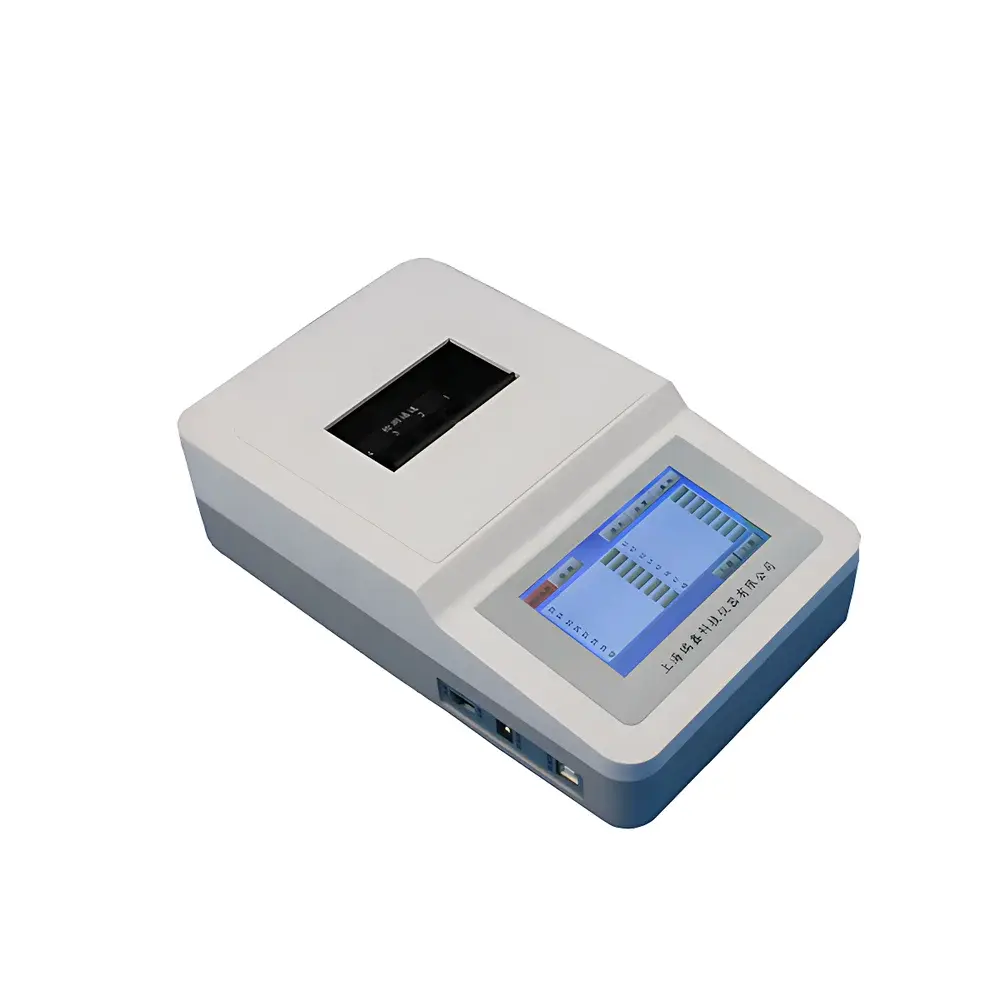
Ruixin SPb-CX2 Erythrosine Detection Analyzer
| Brand | Ruixin |
|---|---|
| Origin | Shanghai, China |
| Manufacturer Type | Authorized Distributor |
| Country of Origin | China |
| Model | SPb-CX2 |
| Price Range | USD 4,200 – 7,000 (FOB Shanghai) |
| Functionality | Single-Analyte Quantitative Detection |
| Sample Format | Dedicated Single-Sample Cartridge/Tube |
| Optical Wavelength | 540 nm |
| Assay Time | ≤ 180 seconds per sample |
| Photometric Repeatability | ≤ 0.2% RSD |
| Detection Channels | 1 |
Overview
The Ruixin SPb-CX2 Erythrosine Detection Analyzer is a dedicated, portable photometric analyzer engineered for rapid, field-deployable quantification of erythrosine (FD&C Red No. 3) in food matrices. It operates on the principle of fixed-wavelength visible absorption spectroscopy at 540 nm — the characteristic λmax of erythrosine in acidic aqueous solution — enabling selective and interference-minimized detection without chromatographic separation. Designed for regulatory compliance workflows, the SPb-CX2 delivers trace-level quantitation in accordance with standard spectrophotometric methods referenced in GB 5009.35–2023 (National Food Safety Standard for Determination of Synthetic Colorants in Foods) and aligned with AOAC Official Method 995.05 principles for colorant screening. Its compact form factor, integrated rechargeable Li-ion battery, and ruggedized housing support continuous operation in mobile inspection units, roadside checkpoints, or decentralized laboratory environments where infrastructure stability is limited.
Key Features
- Portable architecture with integrated 4.3-inch high-resolution color TFT touchscreen — fully localized Chinese UI with tactile responsiveness and on-screen virtual keyboard for direct Chinese sample annotation.
- Self-calibrating optical path system: automatic zero and reference (100% T) initialization upon power-on; eliminates manual calibration steps and reduces operator dependency.
- Dual-mode photometric display: simultaneous real-time readout of absorbance (0.000–4.000 AU, 0.001 AU resolution) and transmittance (0.00–100.00%, 0.01% resolution), supporting method flexibility beyond erythrosine assays.
- Embedded thermal printer: generates compliant hard-copy reports including analyte concentration (mg/kg), Chinese-labeled sample ID, date/time stamp, operator name, and testing institution — traceable per GLP documentation requirements.
- On-device data management: automatic storage of ≥1,000 test records with timestamped metadata; searchable by sample ID, date range, or concentration threshold.
- Multi-source power compatibility: operates via internal Li-ion battery (≥6 h continuous use), AC 220 V adapter, or USB 5 V DC input — optimized for vehicle-mounted deployment or benchtop use.
Sample Compatibility & Compliance
The SPb-CX2 is validated for use with pre-extracted aqueous or ethanol-water extracts from common food categories including candied fruits, maraschino cherries, confectionery coatings, dairy-based desserts, and processed meat products. Sample preparation follows standardized extraction protocols (e.g., solid-phase extraction or liquid-liquid partitioning per GB/T 5009.35). Instrument performance meets critical metrological criteria: photometric repeatability ≤0.2% RSD (n=10), baseline stability ≤0.3% drift over 3 minutes, and erythrosine detection limit of 100.0 mg/kg in solid matrix — consistent with national surveillance sensitivity thresholds. While not certified to ISO/IEC 17025 as a standalone instrument, its operational parameters are traceable to NIST-traceable photometric standards, and data integrity supports audit readiness under China’s SAMR-mandated food safety inspection frameworks.
Software & Data Management
Data export and remote monitoring are enabled via dual physical interfaces: RS-232 serial port (for legacy lab network integration) and USB 2.0 (for mass storage mode or PC synchronization). The device supports CSV-formatted result export compatible with LIMS platforms and national food safety surveillance systems (e.g., China’s National Food Safety Risk Monitoring Information System). Audit trail functionality includes immutable timestamps for each measurement event, user login identification (via optional password-protected access), and tamper-evident local storage — fulfilling foundational requirements for data integrity under GB/T 27404–2019 (Guidelines for Laboratory Quality Control in Food Testing). Firmware updates are delivered via USB flash drive with version-controlled checksum verification.
Applications
- Routine screening of erythrosine adulteration in fruit preserves, jellies, and soft drinks during market surveillance campaigns.
- On-site verification at border inspection posts and wholesale distribution centers to enforce GB 2760–2024 maximum residue limits (MRLs).
- Quality assurance checks in contract manufacturing facilities producing red-colored food products.
- Training and capacity-building in provincial CDC laboratories and municipal food safety centers requiring low-cost, high-throughput colorant verification tools.
- Supplemental verification tool in tandem with HPLC confirmation workflows — reducing instrument time for presumptive positives.
FAQ
What is the measurement principle used by the SPb-CX2?
It employs fixed-wavelength visible absorption photometry at 540 nm, calibrated specifically for erythrosine’s spectral peak in standardized extraction media.
Does the instrument require external calibration standards before each use?
No — the built-in optical self-correction system performs automatic zero and 100% transmittance calibration at startup, eliminating daily standardization steps.
Can the SPb-CX2 quantify other synthetic colorants?
No — it is a single-analyte platform optimized exclusively for erythrosine. Cross-reactivity with other dyes (e.g., Allura Red AC, Ponceau 4R) has not been validated and is not supported.
Is the device compliant with FDA or EU regulatory requirements?
The SPb-CX2 is designed and verified against Chinese national standards (GB series). While its photometric performance aligns with general AOAC and ISO 750–1994 principles, formal CE marking or FDA 510(k) clearance is not held.
How is data security ensured during wireless transmission?
The SPb-CX2 does not support Wi-Fi or Bluetooth. All data transfer occurs via physically connected RS-232 or USB interfaces, ensuring air-gapped integrity unless interfaced with an externally secured network gateway.




