
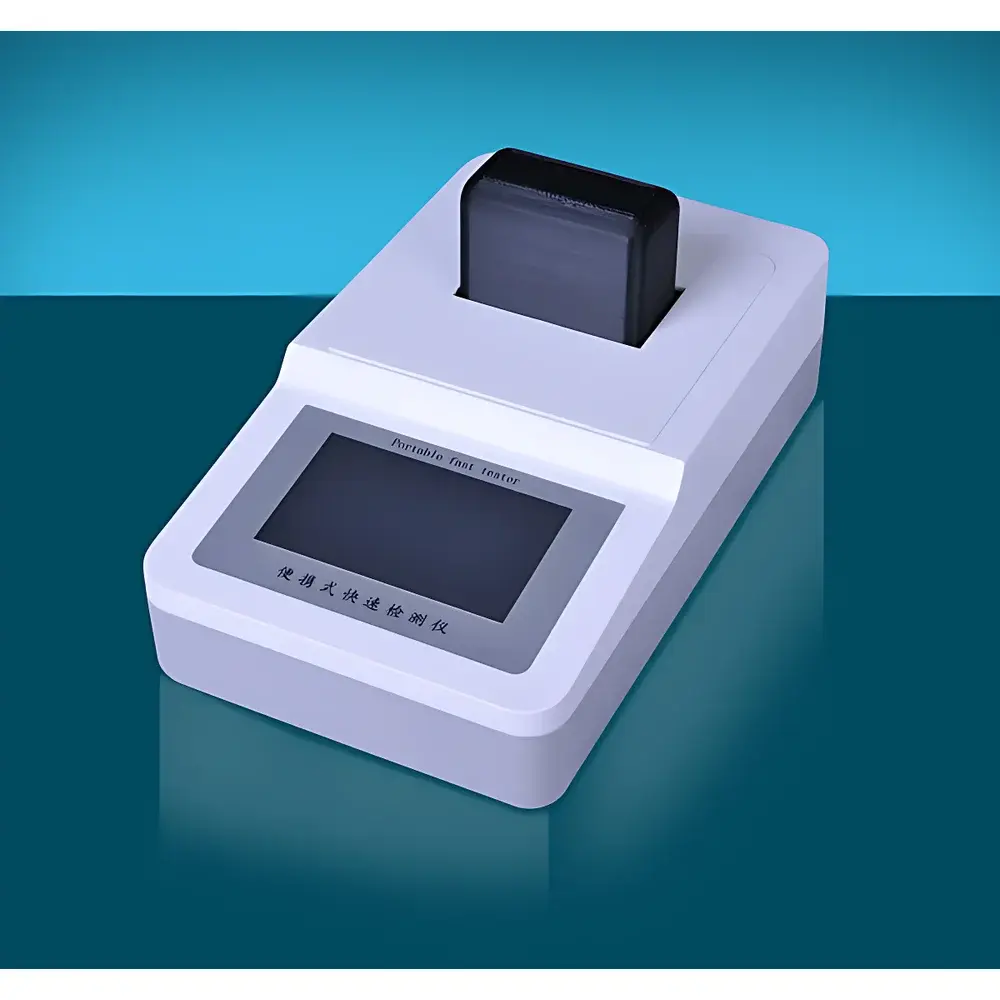
Ruixin SP-NH2 Nitrate Analyzer for Food Safety Testing
| Brand | Ruixin |
|---|---|
| Origin | Shanghai, China |
| Manufacturer Type | Authorized Distributor |
| Country of Origin | China |
| Model | SP-NH2 |
| Price | USD 780 (FOB Shanghai) |
| Functionality | Single-Analyte Detection System |
| Sample Format | Single-sample cuvette-based assay |
| Wavelength Range | 400–680 nm |
| Analysis Time | <120 s per sample |
| Relative Standard Deviation (RSD) | <5% |
| Detection Channels | 1 |
| Detection Limit | 200.0 mg/kg |
| Quantification Range | 0–15,000 mg/kg |
| Photometric Accuracy (Transmittance) | ±2.0% |
| Photometric Repeatability | ≤1.0% |
| Dark Current Drift | ≤0.5% over 3 min |
| Power Supply | AC 220 V / DC 12 V (with rechargeable 12 V Li-ion battery) |
Overview
The Ruixin SP-NH2 Nitrate Analyzer is a dedicated photometric instrument engineered for rapid, field-deployable quantification of nitrate (NO₃⁻) in food matrices—primarily fresh produce including leafy vegetables, root crops, and processed fruit products. It operates on the principle of visible-light spectrophotometry, utilizing the Griess reaction-derived chromophore formation under acidic conditions, where nitrate is first reduced to nitrite and then coupled with sulfanilamide and N-(1-naphthyl)ethylenediamine dihydrochloride to yield a stable pink azo dye measurable at wavelengths between 400 nm and 680 nm. Designed for compliance with standard food safety screening protocols—including those aligned with GB 5009.33–2023 (China National Food Safety Standard for Nitrate and Nitrite Determination) and AOAC Official Method 2005.02—the SP-NH2 delivers laboratory-grade reproducibility in non-laboratory environments such as mobile inspection units, agro-market checkpoints, and municipal food surveillance vehicles.
Key Features
- Integrated 128×64 monochrome LCD with intuitive Chinese-language interface and step-by-step guided operation—no external PC required for routine use.
- Preloaded calibration curves optimized for common food matrices (e.g., spinach, lettuce, celery), plus support for user-defined curve generation using up to 10-point standard series.
- Dual operational modes: standalone instrument mode with onboard data storage (up to 500 test records), and PC-controlled mode via RS-232 serial interface for centralized method deployment and audit trail logging.
- Onboard thermal micro-printer enables immediate hardcopy output of results—including sample ID, timestamp, concentration (mg/kg), and pass/fail flag relative to regulatory thresholds (e.g., EU Regulation (EC) No 1881/2006 limits).
- Modular optical path design with stabilized tungsten-halogen light source and precision interference filter ensures long-term photometric stability; dark current drift remains ≤0.5% over 3 minutes, supporting extended field use without recalibration.
- Triple power configuration: mains-powered (220 V AC), DC adapter (12 V), or integrated rechargeable lithium-ion battery (12 V, 4,400 mAh), enabling >8 hours of continuous operation in off-grid settings.
Sample Compatibility & Compliance
The SP-NH2 is validated for homogenized aqueous extracts prepared from solid food samples according to standardized extraction protocols (e.g., AOAC 973.32 or GB/T 5009.33). Compatible sample types include raw and cooked leafy greens, tubers, cured meats (after desalting), dairy powders, and drinking water. All assays comply with GLP-aligned data integrity requirements: each result is time-stamped, uniquely indexed, and stored with full metadata (operator ID, curve ID, dilution factor, raw absorbance). The system supports traceability per ISO/IEC 17025:2017 Clause 7.7 and facilitates alignment with FDA 21 CFR Part 11 when used with validated third-party LIMS integration via RS-232.
Software & Data Management
The included Ruixin Food Analysis Management Software (v3.2, Windows-compatible) provides secure local database management, statistical summary reports (mean, SD, CV%), outlier detection, and export to CSV/PDF. Audit logs record all parameter modifications, curve edits, and result deletions. Data synchronization supports batch upload to regional food safety monitoring platforms compliant with China’s National Food Safety Risk Monitoring Information System (NFMRIS) architecture. No cloud storage or remote telemetry is embedded—data sovereignty is maintained on-premise unless explicitly configured by the end user.
Applications
- Routine surveillance of nitrate accumulation in hydroponic and greenhouse-grown vegetables during pre-harvest and post-harvest stages.
- Verification of compliance with maximum residue limits (MRLs) in imported/exported produce shipments at port-of-entry laboratories.
- Field-based assessment of fertilizer impact on crop nitrate load in agricultural extension programs.
- Quality assurance screening in food processing facilities handling baby foods, juices, and ready-to-eat salads.
- Training and proficiency testing in vocational food safety labs where cost-effective, low-maintenance instrumentation is prioritized.
FAQ
What extraction method is recommended prior to analysis?
Standard aqueous extraction per GB 5009.33–2023: homogenize 5 g sample with 45 mL deionized water, centrifuge at 4,000 × g for 10 min, filter through 0.45 µm membrane.
Can the instrument measure nitrite concurrently?
No—the SP-NH2 is calibrated exclusively for nitrate via cadmium column reduction; nitrite must be determined separately using a dedicated nitrite module or orthogonal method.
Is third-party calibration verification supported?
Yes—absorbance accuracy can be verified using NIST-traceable neutral density filters (OD 0.5, 1.0, 2.0) at 540 nm; factory calibration certificates are provided with each unit.
How often does the optical system require maintenance?
No routine optical alignment is needed; cleaning of the cuvette holder and light path aperture is recommended after every 100 tests or when ambient dust exposure is high.
Does the software meet FDA 21 CFR Part 11 requirements?
The standalone software does not include electronic signature or role-based access control out-of-the-box; however, it exports structured data compatible with Part 11-compliant LIMS platforms when deployed in regulated QA/QC environments.






