
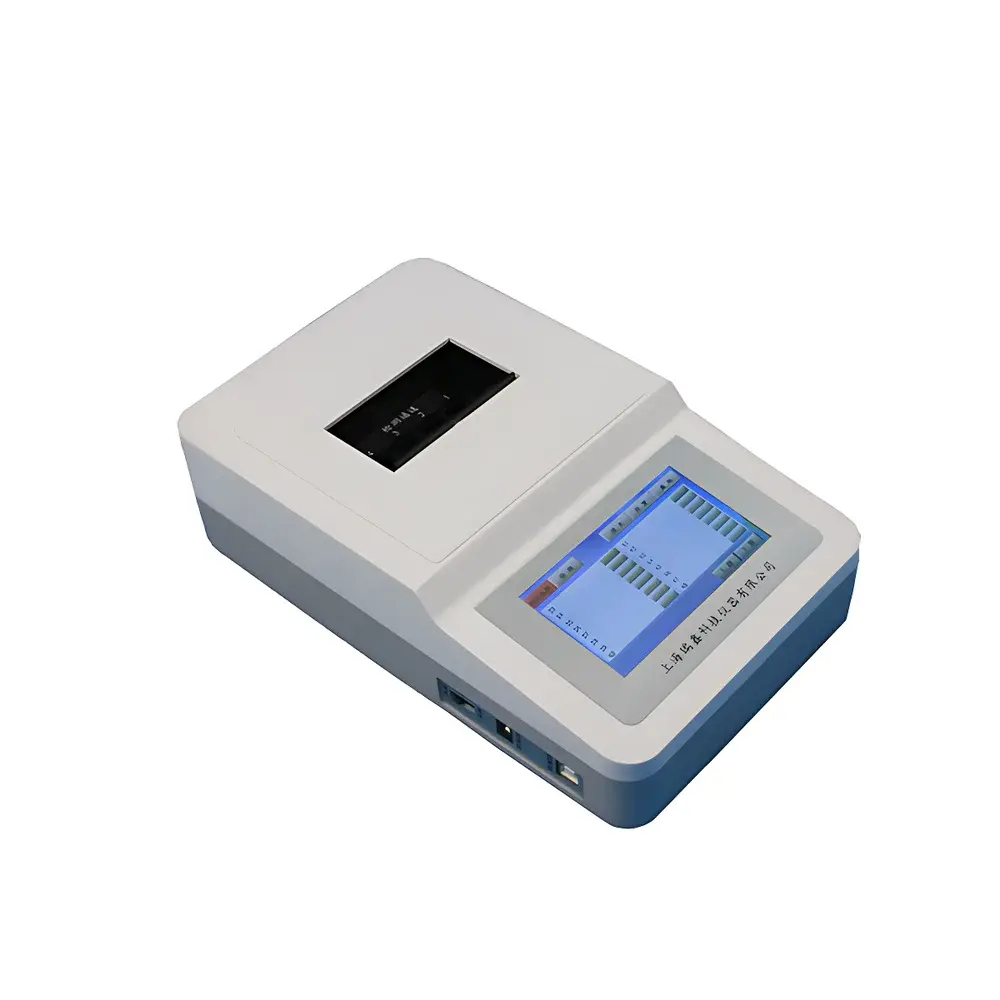
Ruixin SPb-JQ2 Formaldehyde Detection Analyzer
| Brand | Ruixin |
|---|---|
| Origin | Shanghai, China |
| Manufacturer Type | Authorized Distributor |
| Country of Origin | China |
| Model | SPb-JQ2 |
| Price | USD 1,380 (FOB Shanghai) |
| Functionality | Single-Analyte Quantitative Detection |
| Sample Format | Single-Sample Dedicated System |
| Optical Wavelength | 410 nm |
| Detection Time | ≤ 180 s |
| Photometric Repeatability | ≤ 0.2% |
| Detection Channels | 1 |
Overview
The Ruixin SPb-JQ2 Formaldehyde Detection Analyzer is a portable, single-channel photometric analyzer engineered for rapid, field-deployable quantification of formaldehyde in food matrices. It operates on the principle of colorimetric reaction coupled with fixed-wavelength absorbance measurement at 410 nm — aligned with the analytical methodology specified in China’s agricultural standard NY5172–2002, “Determination of Formaldehyde in Foods.” The instrument implements a standardized chromogenic assay where formaldehyde reacts with acetylacetone and ammonium acetate under acidic heating to form a yellow dihydropyridine derivative, whose absorbance intensity at 410 nm is directly proportional to formaldehyde concentration. Designed for regulatory compliance workflows, the SPb-JQ2 delivers trace-level detection (LOD: 1.0 mg/kg) across a linear dynamic range of 0–200 mg/kg, supporting quantitative analysis without dilution or pre-concentration for most food samples including aquatic products, tofu, noodles, and preserved vegetables.
Key Features
- Integrated optical self-calibration system: eliminates manual zero/100% transmittance adjustment; automatic baseline correction upon power-on.
- 4.3-inch high-resolution TFT color touchscreen with full Chinese GUI — supports direct Chinese character input via virtual keyboard and stylus for sample labeling and report annotation.
- Dedicated embedded thermal printer: generates compliant test reports containing analyte concentration (mg/kg), Chinese sample name, test date/time, operator ID, and testing unit — all in a single printout.
- Triple-power architecture: rechargeable Li-ion battery (≥6 h continuous operation), AC 220 V adapter, and DC 5 V external supply — optimized for mobile labs, inspection vehicles, and on-site market supervision.
- Dual photometric display mode: simultaneous real-time readout of absorbance (0.000–4.000 AU) and transmittance (0.00–100.00%), enabling method flexibility and cross-validation with legacy protocols.
- Data integrity safeguards: automatic timestamped result storage (≥1,000 records), recall-by-date/operator/sample ID, and audit-ready session logs.
Sample Compatibility & Compliance
The SPb-JQ2 is validated for use with homogenized liquid or extract-based food samples prepared per NY5172–2002, including but not limited to fish paste, dried seafood, bean curd sheets, wheat gluten, and pickled vegetables. Sample pretreatment requires centrifugation and filtration (0.45 µm) prior to derivatization. While not certified to ISO/IEC 17025 or AOAC Official Methods, its optical performance meets key photometric criteria referenced in ISO 7027 (turbidity) and USP (spectrophotometric system suitability), with transmittance accuracy ±2.0% and 3-minute photometric stability ≤0.3%. The device supports GLP-aligned documentation practices through printed reports and exportable data logs — suitable for internal quality audits and routine food safety screening under China’s GB 2760–2024 and GB 5009.49–2023 frameworks.
Software & Data Management
No PC software installation is required; all operations are executed via embedded firmware. Data export is supported via RS232 serial interface (for legacy lab printers or LIMS integration) and USB 2.0 (mass storage mode for CSV file transfer). Each stored record includes unique session metadata: test ID, calibration status flag, raw absorbance value, calculated concentration, operator code, and UTC timestamp. Optional firmware updates are delivered via USB stick. The system does not implement FDA 21 CFR Part 11 electronic signature or audit trail features, but maintains chronological event logging (power-on, test start/end, print trigger, battery level warnings) accessible via menu navigation.
Applications
- Routine surveillance testing by municipal market regulation bureaus during routine inspections and unannounced sampling campaigns.
- On-vehicle food safety screening in mobile inspection units deployed at wholesale markets, cold-chain logistics hubs, and rural distribution centers.
- Pre-screening in QC laboratories prior to confirmatory LC-MS/MS analysis — reducing instrument time and consumable costs.
- Training and capacity-building for frontline inspectors due to intuitive workflow design and minimal reagent handling requirements.
- Compliance verification for HACCP prerequisite programs addressing chemical adulteration risks in high-risk food categories.
FAQ
What is the formaldehyde detection limit and linear range of the SPb-JQ2?
The instrument achieves a limit of detection (LOD) of 1.0 mg/kg and provides quantitative linearity from 0 to 200 mg/kg in food extracts.
Does the SPb-JQ2 require external calibration standards before each test?
No — the integrated optical self-calibration system performs automatic zero and reference adjustment at startup; only one-point calibration using a supplied 10 mg/kg standard is recommended weekly or after transport-induced shock.
Can the SPb-JQ2 be used for non-food matrices such as wood adhesives or indoor air samples?
It is not validated for those applications; sample matrix effects, interferences (e.g., acetaldehyde, formic acid), and extraction efficiency differ significantly — use only with food samples processed per NY5172–2002.
Is the thermal printer compatible with third-party label formats or network printing?
No — it is a fixed-format embedded thermal printer generating standardized A7-size reports; no driver or PCL support is provided.
What maintenance is required for long-term photometric stability?
Clean the cuvette chamber weekly with lint-free tissue and ethanol; replace the LED light source every 10,000 hours (approx. 3 years at 10 tests/day); recalibrate optics annually using factory-certified reference filters.




