
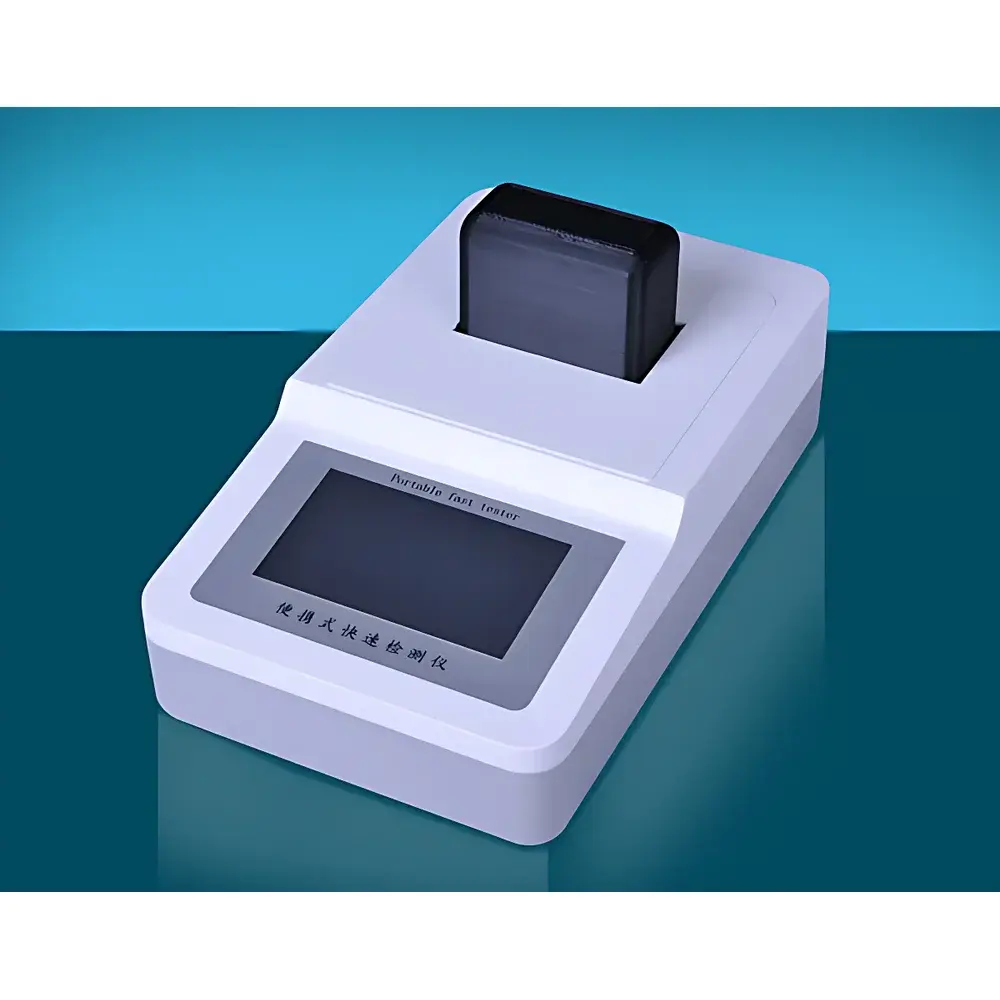
Shanghai Ruixin SZ-HCL Portable Residual and Total Chlorine Analyzer
| Brand | Ruixin |
|---|---|
| Origin | Shanghai, China |
| Model | SZ-HCL |
| Instrument Type | Portable |
| Measurement Principle | Colorimetric (DPD Method) |
| Measured Parameters | Residual Chlorine, Total Chlorine |
| Range | 0–10 mg/L |
| Accuracy | ±5% |
| Repeatability | ≤2% |
| Resolution | 0.01 mg/L |
| Detection Limit | 0.02 mg/L |
| Absorbance Range | 0.000–4.000 |
| Absorbance Resolution | 0.001 |
| Transmittance Accuracy | ±2.0% |
| Transmittance Repeatability | ≤0.2% |
| Stability | ≤0.5% (3 min) |
| Display | 4.3″ TFT color touchscreen |
| Data Output | Embedded thermal printer, USB interface |
| Power Supply | AC 220 V / Rechargeable Li-ion battery |
| Compliance | Designed for field-deployable water quality testing per standard methods including APHA 4500-Cl G (DPD), ISO 7393-2, and EPA Method 334.0 |
Overview
The Shanghai Ruixin SZ-HCL Portable Residual and Total Chlorine Analyzer is a field-deployable photometric instrument engineered for rapid, on-site quantification of free residual chlorine and total chlorine in drinking water, municipal wastewater, and healthcare facility effluents. It operates on the standardized N,N-diethyl-p-phenylenediamine (DPD) colorimetric method—recognized by APHA Standard Methods 4500-Cl G, ISO 7393-2, and U.S. EPA Method 334.0—as a robust alternative to benchtop spectrophotometers where portability, operational simplicity, and regulatory traceability are critical. The device integrates a stable LED light source, precision optical path design, and temperature-compensated photodetector to deliver reproducible absorbance measurements across the 0.000–4.000 AU range. Its compact form factor, combined with an integrated rechargeable lithium-ion battery, enables uninterrupted operation during extended field campaigns without reliance on mains power.
Key Features
- 4.3-inch high-resolution TFT color touchscreen with full Chinese GUI—designed for intuitive navigation and real-time concentration display without external software.
- On-device intelligent Chinese input via virtual keyboard and stylus support—enabling direct annotation of sample IDs, operator names, and site metadata into test records.
- Built-in calibration curve library with multiple preloaded DPD-based calibration functions optimized for low-, mid-, and high-range chlorine concentrations (0–0.5 mg/L, 0.5–5 mg/L, 5–10 mg/L).
- Embedded thermal printer delivering immediate hard-copy reports with timestamp, measured value, unit, and operator ID—fully compliant with GLP documentation requirements.
- Automated data logging: up to 1,000 test results stored internally with date/time stamp, absorbance reading, and calculated concentration; searchable by parameter or time window.
- Dual-power architecture supporting AC 220 V operation and ≥8 hours of continuous field use on a single Li-ion battery charge.
Sample Compatibility & Compliance
The SZ-HCL analyzer is validated for aqueous matrices including potable water, chlorinated secondary effluent, cooling tower water, swimming pool circulation systems, and sterilization rinse solutions from hospitals and pharmaceutical cleanrooms. Sample volume requirement is 10 mL per test using standardized DPD reagent tablets or liquid kits (not included). All measurement protocols adhere to internationally accepted colorimetric performance criteria: transmittance accuracy ±2.0%, repeatability ≤0.2%, and baseline stability ≤0.5% over 3 minutes—meeting minimum instrumentation specifications outlined in ISO/IEC 17025 for routine environmental testing laboratories. While not certified to FDA 21 CFR Part 11, the device supports audit-ready data export via USB for integration into LIMS or QA/QC workflows requiring electronic record retention.
Software & Data Management
No proprietary PC software is required for basic operation. All calibration, measurement, and reporting functions execute natively on the embedded ARM-based controller. Test results—including raw absorbance values, concentration outputs, and user-entered metadata—are stored in a non-volatile internal database with automatic timestamping. USB 2.0 interface permits direct file transfer of CSV-formatted logs to Windows/macOS systems for further statistical analysis or regulatory submission. Firmware updates are delivered via USB flash drive and include version-controlled changelogs aligned with evolving regional water quality directives (e.g., China’s GB/T 5750.11–2023, EU Directive 98/83/EC Annex II).
Applications
- Routine disinfection validation at water treatment plant distribution points and booster stations.
- Emergency response monitoring following pipeline breaks or cross-connection incidents.
- Compliance verification for healthcare facilities under local health department mandates for medical wastewater chlorine residuals.
- QA/QC screening of membrane bioreactor (MBR) effluent prior to UV or ozone tertiary treatment.
- Educational use in environmental engineering labs for teaching standardized chlorine assay methodology.
FAQ
What reagents are required for operation?
DPD No. 1 (for free chlorine) and DPD No. 3 (for total chlorine) reagents—available as stabilized tablets or liquid formulations compatible with standard 10 mL sample vials.
Is calibration traceable to NIST standards?
While the instrument itself is not NIST-certified, calibration verification can be performed using NIST-traceable potassium permanganate or chlorine standard solutions (e.g., AccuStandard® CL-1000-1000).
Can the device measure chlorine dioxide simultaneously?
No—the SZ-HCL is optimized exclusively for residual and total chlorine via DPD chemistry; separate instrumentation is required for ClO₂ quantification per Standard Methods 4500-ClO₂.
Does it support multi-language firmware beyond Chinese?
Firmware is currently localized for Simplified Chinese only; English-language UI is not available in this hardware revision.
How often must the optical system be cleaned or serviced?
The LED light source and silicon photodiode require no routine maintenance; users should wipe the cuvette chamber and lens surface with lint-free tissue after each field day to prevent residue buildup.
Related Products







