
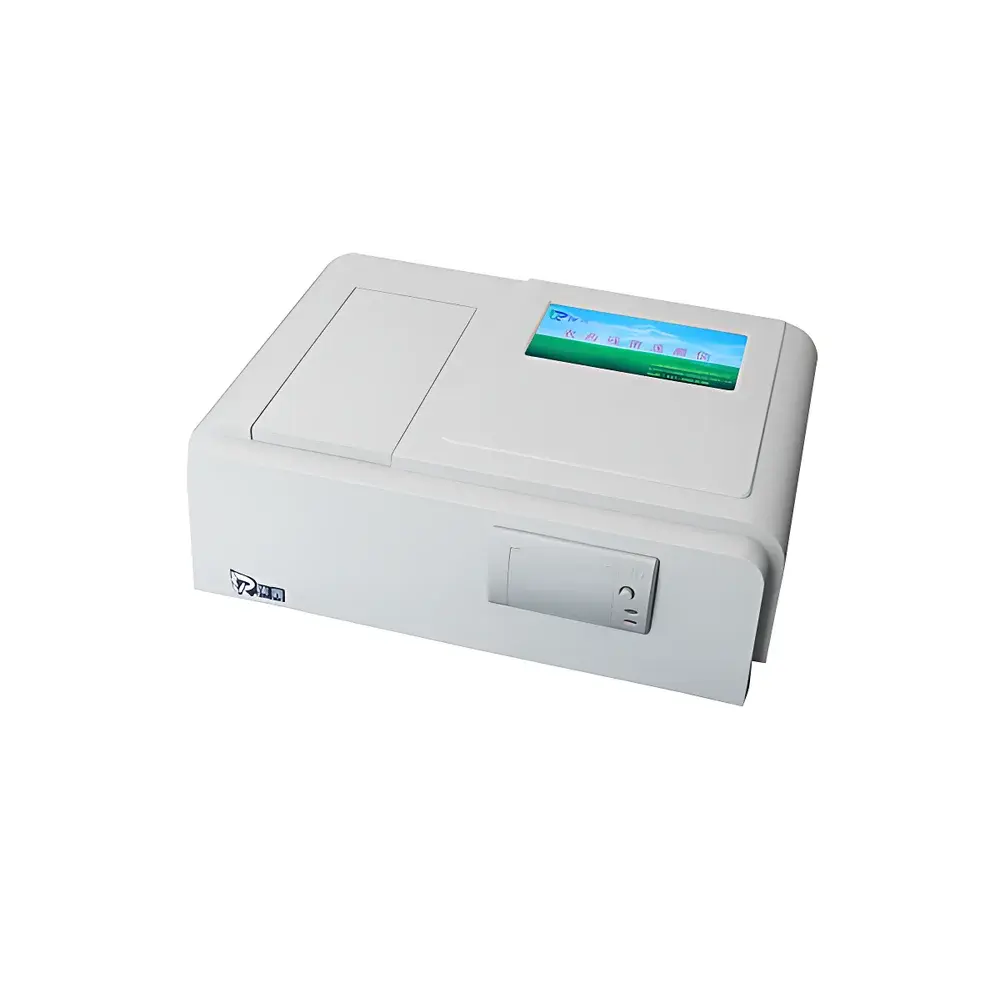
Ruixin SP-801SC Aquatic Food Safety Analyzer
| Brand | Ruixin |
|---|---|
| Origin | Shanghai, China |
| Manufacturer Type | Authorized Distributor |
| Regional Classification | Domestic (PRC) |
| Model | SP-801SC |
| Price Range | USD 4,200 – 7,000 |
| Function Type | Multi-analyte Rapid Detection System |
| Sample Format | Single-sample per test cycle |
| Wavelengths | 410 nm, 510 nm, 630 nm |
| Assay Time | ≤ 180 s per sample |
| Photometric Repeatability | ≤ 0.2% (Transmittance), ≤ 0.3% (Absorbance) |
| Detection Channels | 8 parallel optical paths |
Overview
The Ruixin SP-801SC Aquatic Food Safety Analyzer is a dedicated benchtop photometric analyzer engineered for rapid, quantitative detection of six critical chemical contaminants and spoilage indicators in aquatic food products—including fresh, chilled, frozen, and processed seafood. It operates on the principle of fixed-wavelength visible-light absorption spectrophotometry (410 nm, 510 nm, and 630 nm), calibrated to standardized colorimetric assay protocols aligned with GB/T 5009, NY/T 1379, and SN/T 2008 series methods. Designed for regulatory compliance environments, the instrument delivers trace-level quantification of histamine, total volatile basic nitrogen (TVB-N), formaldehyde, sulfur dioxide (SO₂), hydrogen peroxide (H₂O₂), and nitrite (NO₂⁻)—all key markers of microbial degradation, illegal adulteration, or preservative misuse. Its architecture supports both laboratory-based routine surveillance and mobile deployment in food safety inspection vehicles, meeting operational requirements for GLP-aligned data integrity and field-deployable robustness.
Key Features
- 8-channel independent optical detection system enabling simultaneous analysis of up to eight samples per run—significantly improving throughput for batch screening.
- 7.0-inch high-resolution TFT-LCD capacitive touchscreen with full Chinese GUI, supporting direct Chinese character input via on-screen keyboard or stylus for unambiguous sample labeling and report annotation.
- Integrated self-calibrating optical path: automatic zero and 100% transmittance initialization at power-on eliminates manual calibration steps and reduces operator dependency.
- Dual-mode photometric display: real-time readout of both absorbance (0.000–4.000 AU, resolution 0.001) and transmittance (0.00–100.00%, resolution 0.01%), facilitating method validation and cross-platform protocol alignment.
- Built-in thermal line printer: generates audit-ready hardcopy reports per channel, including channel ID, analyte concentration, Chinese sample name, date/time stamp, analyst ID, and institutional header.
- Photometric performance validated to ≤0.2% transmittance repeatability and ≤0.3% absorbance repeatability (n = 10, same sample, same cuvette), with baseline stability ≤0.2% over 3 minutes.
- RS232 and USB 2.0 interfaces support bidirectional communication with LIMS, ELN, or third-party data aggregation platforms; compatible with FDA 21 CFR Part 11–compliant software extensions upon integration.
Sample Compatibility & Compliance
The SP-801SC accepts standard 10-mm pathlength glass or plastic cuvettes and is optimized for aqueous extracts prepared from homogenized fish, shrimp, squid, mollusks, and processed aquatic products. All six target analytes are measured using AOAC- and China National Standard–validated colorimetric chemistries requiring minimal sample pretreatment (e.g., extraction, centrifugation, filtration). The system conforms to national food safety monitoring frameworks including China’s “National Supervision and Sampling Plan for Aquatic Products” (2023 Edition) and supports documentation traceability required under GB 14881–2013 (General Hygienic Practice for Food Production). While not certified to ISO/IEC 17025 as a standalone testing lab, its hardware design and data output structure align with ISO/IEC 17025 Clause 7.7 (Reporting of Results) when operated within an accredited quality management system.
Software & Data Management
Embedded firmware includes a local database capable of storing ≥10,000 test records with searchable metadata (sample ID, analyte, concentration, operator, timestamp, instrument serial number). Data export is supported in CSV and PDF formats via USB drive. Optional Ruixin DataLink™ PC software (Windows 10/11) enables centralized fleet management, statistical trend analysis (e.g., Shewhart X-bar/R charts), automated PDF report generation, and secure network upload to cloud-based dashboards. Audit trail functionality logs all user actions—including method edits, result deletions, and calibration events—with time-stamped, non-erasable entries—meeting minimum ALCOA+ principles for regulated environments.
Applications
- Routine surveillance of histamine levels in tuna, mackerel, and sardines to prevent scombroid poisoning outbreaks.
- Quantitative verification of SO₂ residuals in dried seafood (e.g., cuttlefish, shrimp) against GB 2760–2024 maximum limits.
- Detection of illicit formaldehyde adulteration in jellyfish and shark fin products.
- Monitoring TVB-N accumulation in chilled fish fillets during cold-chain logistics audits.
- Field verification of H₂O₂ residues in live bivalve depuration systems.
- Screening for nitrite in cured aquatic products such as salted roe and fermented fish paste.
FAQ
What regulatory standards does the SP-801SC support for official reporting?
It implements analytical procedures referenced in GB/T 5009.45–2003 (formaldehyde), GB 5009.34–2022 (SO₂), GB 5009.33–2016 (nitrite), and NY/T 1379–2007 (TVB-N), enabling use in statutory food safety supervision programs.
Can the instrument be integrated into an existing LIMS?
Yes—via RS232 or USB CDC mode using ASCII-based command protocol; Ruixin provides documented API specifications and sample Python/Node.js drivers for custom integration.
Is reagent compatibility limited to Ruixin-branded kits?
No—the optical path and timing logic are compatible with any third-party colorimetric reagents matching the specified wavelengths and reaction kinetics, provided they meet GB/T 27404–2008 validation criteria.
Does the device require annual factory recalibration?
No scheduled factory recalibration is mandated; however, users must perform daily photometric verification using NIST-traceable neutral density filters and document results per internal QA procedure.
What is the expected lifetime of the LED light sources?
The 410/510/630 nm LEDs are rated for ≥50,000 hours of operation under typical usage conditions (≤8 hrs/day), with no measurable wavelength drift over 3 years per manufacturer accelerated aging tests.





