
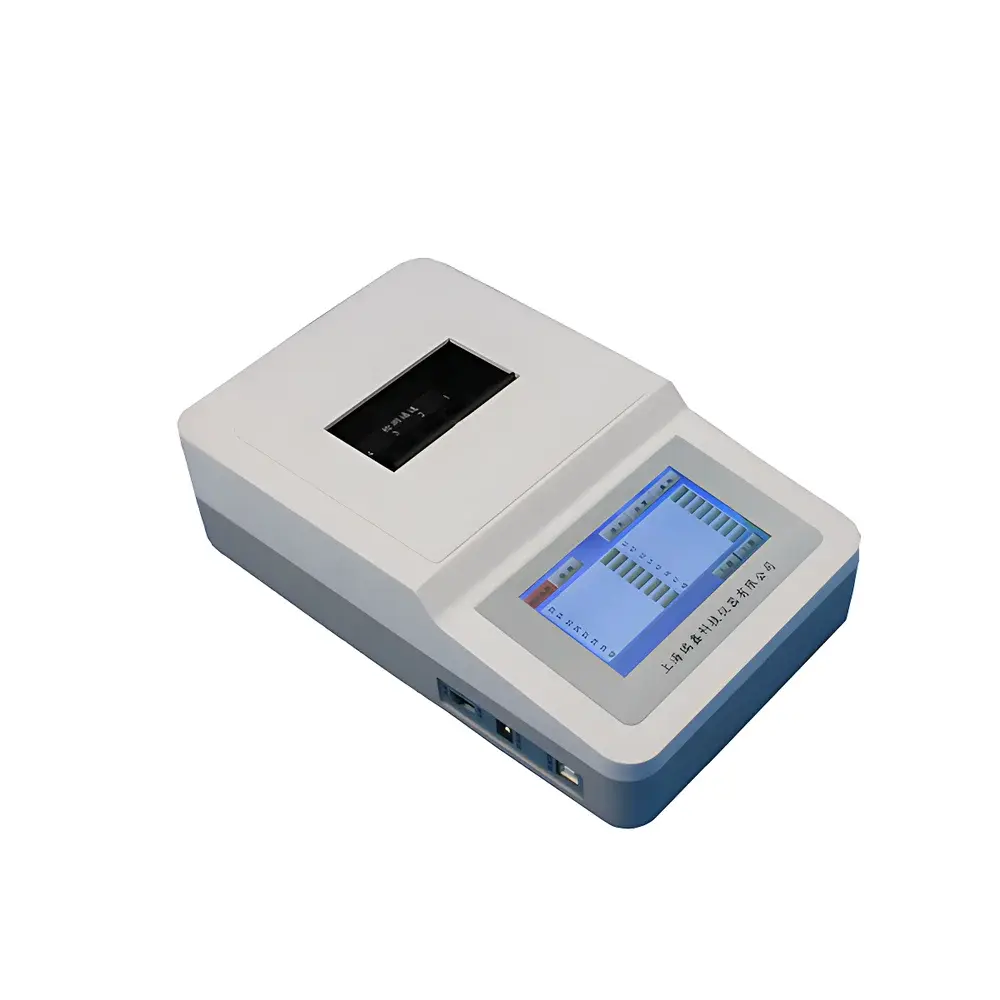
Ruixin SPb-YS2 Nitrite Rapid Detection Analyzer
| Brand | Ruixin |
|---|---|
| Origin | Shanghai, China |
| Manufacturer Type | Authorized Distributor |
| Origin Category | Domestic (China) |
| Model | SPb-YS2 |
| Price | USD 1,380 (FOB Shanghai) |
| Function Type | Single-Analyte Detection |
| Sample Type | Single-Sample Dedicated |
| Wavelength | 540 nm |
| Detection Time | ≤ 3 min |
| Repeatability | ≤ 0.2% |
| Detection Channels | 1 |
| Absorbance Range | 0.000–4.000 |
| Transmittance Range | 0.00–100.00% |
| Transmittance Resolution | 0.01% |
| Absorbance Resolution | 0.001 |
| Photometric Accuracy (Transmittance) | ±2.0% |
| Stability (3-min drift) | ≤0.3% |
| LOD (Nitrite) | 2.0 mg/kg |
| Measurement Range (Nitrite) | 0–200 mg/kg |
| Communication Interfaces | RS232, USB |
| Power Supply | Integrated Li-ion Battery, AC 220 V, DC 5 V |
Overview
The Ruixin SPb-YS2 Nitrite Rapid Detection Analyzer is a dedicated photometric instrument engineered for quantitative determination of nitrite (NO₂⁻) in food matrices—primarily fresh produce, processed meats, dairy products, and aquatic commodities. It operates on the principle of diazotization-coupling spectrophotometry, aligned with the methodology specified in China’s national standard GB 5009.33–2016 (revised edition of GB 5009.33–2003), which is harmonized with internationally recognized colorimetric protocols such as AOAC Official Method 973.33 and ISO 20036:2016. The system employs a fixed-wavelength optical path centered at 540 nm—the optimal absorption peak for the stable azo dye formed during nitrite reaction with sulfanilamide and N-(1-naphthyl)ethylenediamine dihydrochloride (NED). Designed for field-deployable and laboratory-based screening, the SPb-YS2 delivers trace-level quantification within regulatory thresholds relevant to Codex Alimentarius, EU Commission Regulation (EC) No 1333/2008, and China’s GB 2760–2024.
Key Features
- Integrated self-calibrating optical system: automatic zero and full-scale alignment at power-on eliminates manual baseline adjustment and ensures long-term photometric stability.
- 4.3-inch high-resolution color TFT touchscreen with full Chinese GUI: supports direct stylus or on-screen keyboard input for sample ID, operator name, and testing unit—enabling fully traceable, auditable recordkeeping.
- Dual-parameter display: simultaneous real-time readout of absorbance (A) and transmittance (%T), facilitating method development and cross-validation with legacy spectrophotometric workflows.
- Embedded thermal printer: generates compliant test reports containing analyte concentration (mg/kg), sample description (in Chinese), date/time stamp, analyst ID, and institutional header—fully traceable per GLP documentation requirements.
- Multi-mode power architecture: operational autonomy via rechargeable Li-ion battery (≥6 h continuous use), supplemented by AC 220 V and universal DC 5 V inputs—optimized for mobile labs, market surveillance units, and roadside inspection vehicles.
- Onboard data management: automatic storage of ≥1,000 test records with timestamped metadata; recallable via chronological or sample-name search.
Sample Compatibility & Compliance
The SPb-YS2 is validated for homogenized aqueous extracts prepared from solid food samples following standardized extraction protocols (e.g., 0.02 M ammonium acetate buffer, centrifugation, filtration). It accommodates liquid samples (e.g., brines, sauces, drinking water) with minimal pretreatment. All hardware and firmware comply with IEC 61010-1:2010 safety standards for electrical equipment used in laboratory environments. While not certified under FDA 21 CFR Part 11, its audit-ready reporting structure—including immutable timestamps, operator identifiers, and uneditable result logs—supports internal validation for GMP-aligned quality control laboratories. Data export via RS232/USB enables integration into LIMS platforms compliant with ISO/IEC 17025:2017 documentation controls.
Software & Data Management
The embedded firmware provides standalone operation without external PC dependency. Test results are stored locally with ISO 8601-formatted timestamps and hierarchical indexing. USB mass-storage mode allows direct file transfer of CSV-formatted datasets for statistical analysis (e.g., Excel, JMP, R). RS232 serial output supports real-time telemetry to central monitoring dashboards or supervisory SCADA systems in regulatory enforcement fleets. Firmware updates are delivered via USB stick—no internet connectivity required—ensuring air-gapped security in sensitive inspection environments.
Applications
- Routine screening of nitrite residues in leafy vegetables (e.g., spinach, lettuce), cured meats (bacon, ham), fermented foods (kimchi, sauerkraut), and infant formula raw materials.
- Field verification during agricultural supply chain audits, wholesale market inspections, and border control phytosanitary checks.
- QC/QA release testing in food manufacturing facilities operating under HACCP or ISO 22000 frameworks.
- Educational use in food science laboratories for teaching quantitative colorimetry, calibration curve construction, and LOD/LOQ determination.
FAQ
What regulatory standards does the SPb-YS2 align with?
It implements the analytical procedure defined in GB 5009.33–2016, which is technically equivalent to AOAC 973.33 and ISO 20036:2016 for nitrite in food.
Can the instrument be calibrated using NIST-traceable standards?
Yes—users may perform verification using certified nitrite reference solutions (e.g., NIST SRM 3248) to confirm linearity and accuracy across the 0–200 mg/kg range.
Is method validation documentation provided?
A comprehensive user manual includes validation parameters: LOD (2.0 mg/kg), LOQ (6.7 mg/kg), linearity (R² ≥ 0.999 over 0–200 mg/kg), and inter-day precision (CV ≤ 2.1%, n = 5 days).
Does the device support multi-analyte expansion?
No—the SPb-YS2 is purpose-built for nitrite only. For broader panel testing (e.g., nitrate, formaldehyde, sulfite), Ruixin offers modular multi-channel platforms (e.g., SPb-MultiScan series).
What maintenance is required?
Routine cleaning of the cuvette chamber and optical window with lint-free tissue and ethanol; annual verification of photometric accuracy using neutral density filters recommended.





