
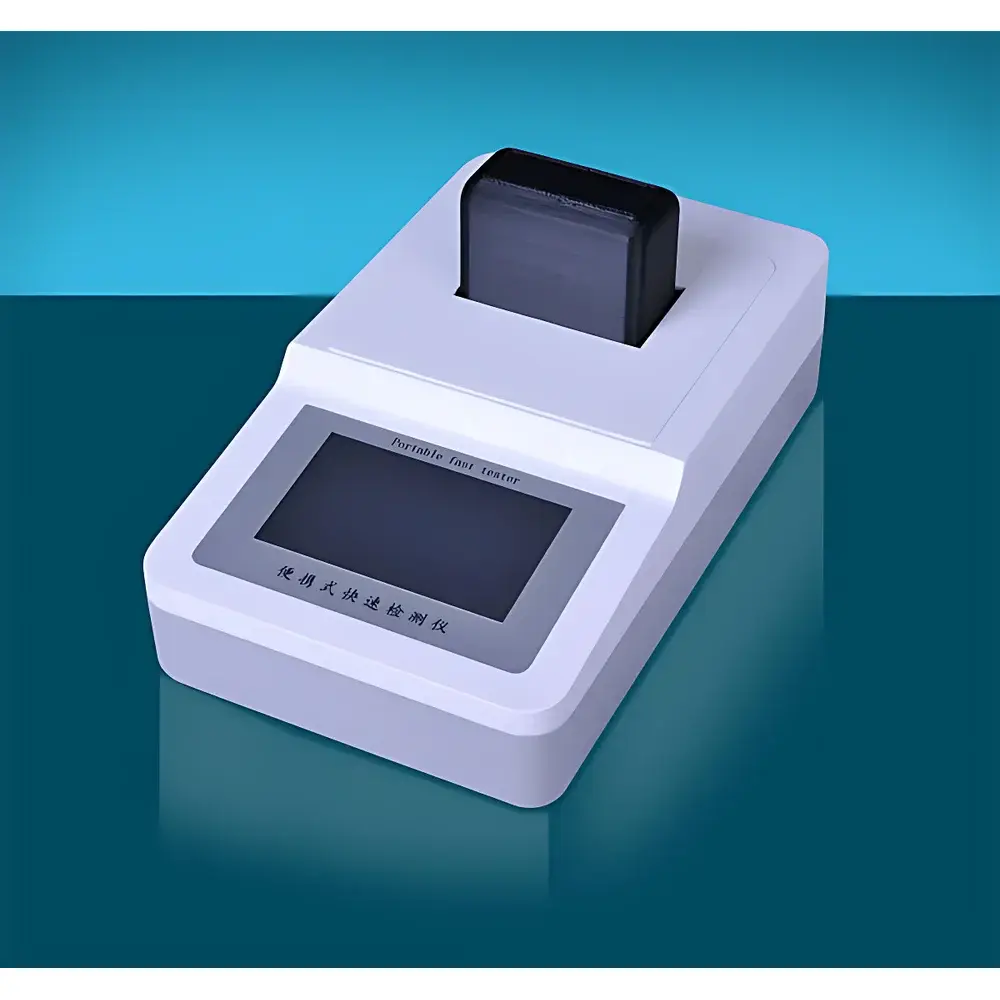
Ruixin SPb-LG2 Rapeseed Glucosinolate Analyzer
| Brand | Ruixin |
|---|---|
| Origin | Shanghai, China |
| Manufacturer Type | Authorized Distributor |
| Country of Origin | China |
| Model | SPb-LG2 |
| Function Type | Single-Analyte Dedicated Analyzer |
| Sample Type | Rapeseed Only |
| Wavelength Range | 380–680 nm |
| Detection Time | ≤3 min per sample |
| Repeatability (RSD) | ≤0.2% |
| Optical Channels | 1 |
| Absorbance Display Range | 0.000–4.000 |
| Transmittance Display Range | 0.00–100.00% |
| Transmittance Resolution | 0.01% |
| Absorbance Resolution | 0.001 |
| Photometric Accuracy (Transmittance) | ±2.0% |
| Baseline Stability (3 min) | ≤0.3% |
| Limit of Detection (LOD) | 10 µmol/g |
| Interface | USB |
| Power Supply | 220 V AC |
Overview
The Ruixin SPb-LG2 Rapeseed Glucosinolate Analyzer is a dedicated photometric instrument engineered for rapid, on-site or laboratory-based quantification of total glucosinolates in intact or ground rapeseed (Brassica napus and Brassica rapa) samples. It operates on the principle of spectrophotometric detection following the colorimetric reaction defined in GB/T 23890–2009, the national standard for glucosinolate determination in oilseed rape. This method relies on the enzymatic hydrolysis of glucosinolates by endogenous myrosinase under controlled pH and temperature conditions, followed by coupling with 2-hydroxy-3-butynoic acid (or an equivalent chromogenic reagent) to generate a stable colored complex measurable at specific visible wavelengths (380–680 nm). The SPb-LG2 integrates a fixed-wavelength optical path optimized for maximum sensitivity and linearity within this spectral window, enabling reliable quantitation without requiring full-spectrum scanning or external calibration curves for routine use.
Key Features
- Portable benchtop form factor (dimensions and weight optimized for field deployment), suitable for grain inspection stations, oil mill QC labs, and agricultural extension services.
- 4.3-inch high-resolution capacitive touch LCD with full Chinese GUI — supports intuitive navigation, real-time parameter entry, and contextual help prompts.
- Integrated intelligent Chinese input system — enables direct annotation of sample IDs, operator names, and batch metadata via on-screen keyboard or stylus, ensuring traceable recordkeeping.
- Embedded thermal printer — outputs hard-copy reports containing sample ID, test date/time, absorbance/transmittance values, calculated glucosinolate concentration (µmol/g), and instrument serial number.
- Self-calibrating optical system — performs automatic zero and reference (100% T) correction upon power-on, eliminating manual alignment and reducing operator-induced variability.
- Dual-mode display — simultaneously shows both absorbance (A) and transmittance (%T) values, supporting method development, instrument verification, and cross-compatibility with legacy protocols.
- Onboard data management — automatically stores up to 1,000 test records with timestamps; supports recall, review, and selective deletion via touchscreen interface.
- USB host interface — enables direct transfer of CSV-formatted datasets to external PCs for further statistical analysis, LIMS integration, or regulatory reporting.
Sample Compatibility & Compliance
The SPb-LG2 is validated exclusively for rapeseed matrixes — including whole seeds, cracked kernels, and finely ground meal — as specified in GB/T 23890–2009. Sample preparation requires homogenization, standardized extraction (typically aqueous methanol), and centrifugation prior to assay. No validation is provided for cruciferous vegetables (e.g., broccoli, cabbage), mustard seed, or non-Brassica matrices. While not certified to ISO/IEC 17025 or accredited for regulatory submission, the instrument’s repeatability (≤0.2% RSD) and photometric accuracy (±2.0% T) align with internal QC requirements for feedstock grading and breeding program screening. Its operational parameters meet baseline expectations for GLP-aligned environments where documented instrument performance and data integrity are maintained through user-defined SOPs.
Software & Data Management
The embedded firmware provides local data handling without cloud dependency. All measurements are timestamped and stored with unique identifiers. USB export generates plain-text CSV files compatible with Microsoft Excel, JMP, or open-source statistical tools (e.g., R, Python pandas). No proprietary software installation is required for data retrieval. Audit trail functionality is limited to chronological record storage; for environments requiring FDA 21 CFR Part 11 compliance (e.g., contract testing labs), supplementary procedural controls — such as dual-operator verification and manual logbook cross-referencing — must be implemented per organizational quality policy.
Applications
- Routine screening of rapeseed lots prior to crushing — ensuring compliance with international trade thresholds (e.g., <30 µmol/g for canola-grade material).
- Breeding program support — high-throughput phenotyping of glucosinolate content across segregating populations in early-generation selection.
- Quality assurance in oilseed processing facilities — monitoring batch-to-batch consistency and detecting contamination or varietal admixture.
- Agricultural extension diagnostics — on-farm assessment of harvest maturity or post-harvest storage effects on secondary metabolite stability.
- Educational laboratories — teaching core principles of enzyme kinetics, colorimetric assay design, and food compositional analysis.
FAQ
What sample preparation is required before analysis?
Ground rapeseed (≤0.5 mm particle size) must be extracted with 70% aqueous methanol, vortexed, and centrifuged (≥3,000 × g, 10 min). The supernatant is diluted 1:10 with assay buffer prior to measurement.
Can the SPb-LG2 quantify individual glucosinolates (e.g., sinigrin, glucobrassicin)?
No. It measures total glucosinolate content based on the collective chromogenic response of desulfoglucosinolates after enzymatic hydrolysis — it does not resolve or identify individual congeners.
Is external calibration necessary for each test run?
No. The built-in self-calibration sequence eliminates daily zero/reference adjustments. However, periodic verification using a certified reference material (CRM) or control standard is recommended every 24 hours of continuous operation.
Does the instrument comply with ISO 5509 or AOAC Official Methods?
It implements GB/T 23890–2009, which is harmonized with ISO 9167-1 for glucosinolate extraction but differs in detection chemistry. It is not listed in AOAC Official Methods of Analysis.
What maintenance is required to ensure long-term photometric stability?
Clean the cuvette holder and optical windows weekly with lint-free tissue and isopropanol. Replace the LED light source every 10,000 operating hours (typical lifetime >5 years under normal use).






