
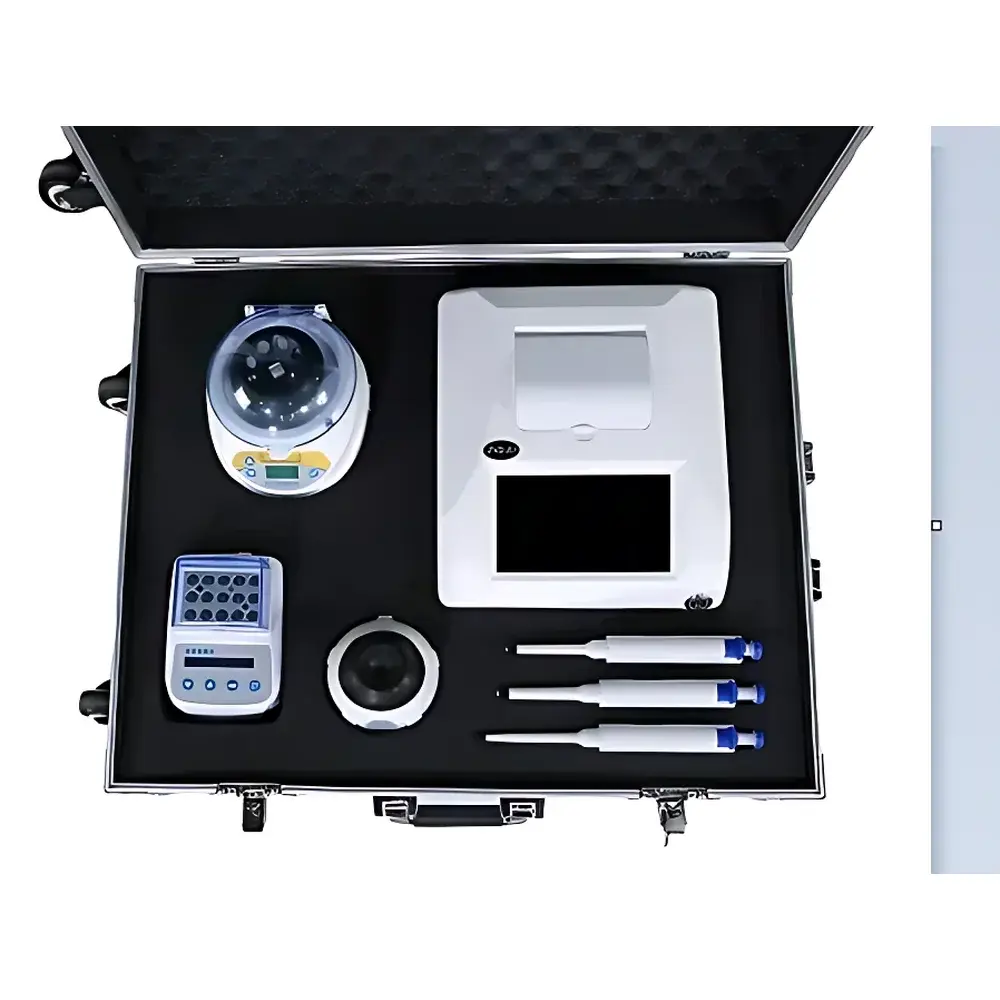
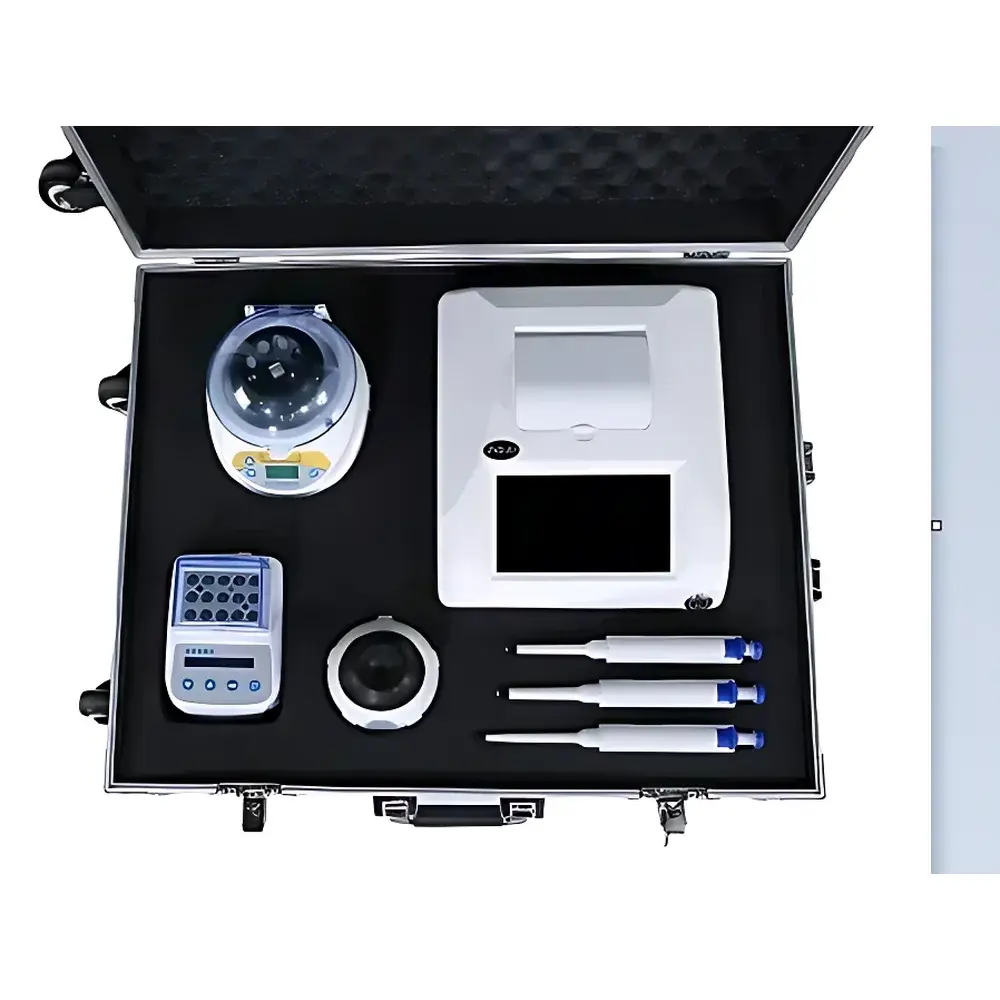
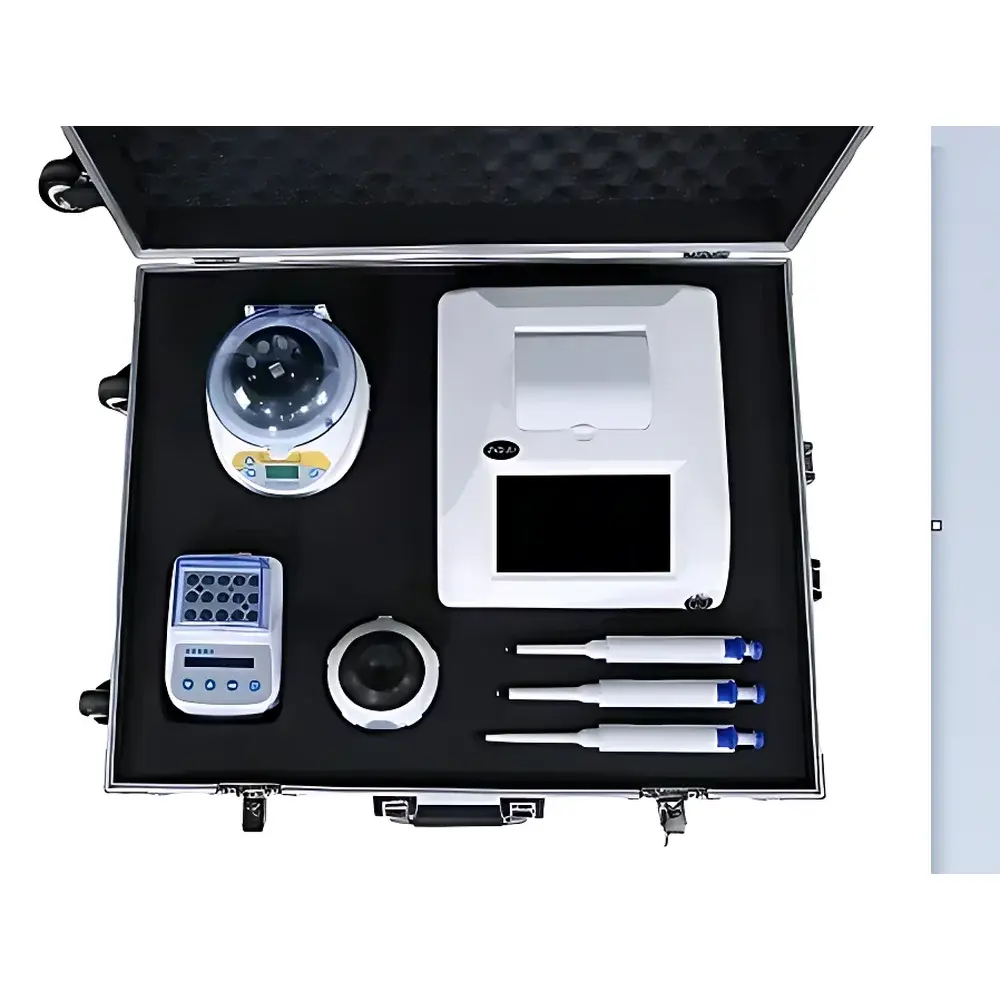
Ruixin HYG-16YB 16-Channel Integrated Rapid Detection System for African Swine Fever Virus (ASFV)
| Brand | Ruixin |
|---|---|
| Origin | Shanghai, China |
| Manufacturer Type | Authorized Distributor |
| Product Origin | Domestic (China) |
| Model | HYG-16YB |
| Price | USD 16,500 (approx.) |
| Function Type | Multi-analyte Detection Platform |
| Sample Compatibility | Universal for Animal Tissues, Blood, Oral Fluids, Swabs, and Processed Food Matrices (e.g., Dumpling Fillings) |
| Wavelength Range | 380–680 nm |
| Detection Time | ≤60 min (including nucleic acid extraction and amplification) |
| Repeatability | CV ≤0.2% |
| Detection Channels | 16 independent optical channels |
Overview
The Ruixin HYG-16YB is a CE-compliant, benchtop integrated rapid detection system engineered for field-deployable and laboratory-based molecular screening of African Swine Fever Virus (ASFV) in compliance with OIE (WOAH) diagnostic guidelines. It combines real-time isothermal amplification (LAMP and fluorescence-based constant-temperature methods) with integrated optical detection across 16 parallel reaction channels. Unlike conventional qPCR platforms requiring thermal cycling, the HYG-16YB utilizes a precisely controlled metal-block heating module (±0.3°C uniformity) to maintain optimal isothermal conditions (60–65°C), enabling direct detection of ASFV genomic DNA without RNA reverse transcription. The system operates on the principle of target-specific primer-initiated strand displacement amplification, with fluorescent signal generation via intercalating dyes (e.g., CMR dye) or probe-based chemistries—measured continuously at excitation/emission wavelengths within the 380–680 nm range. Designed for biosafety Level 2 (BSL-2) environments, it supports decentralized surveillance in veterinary diagnostic labs, slaughterhouse QC units, and regional animal health centers where infrastructure for high-end PCR infrastructure is limited.
Key Features
- 16-channel independent detection architecture enabling parallel processing of up to 16 samples per run—optimized for batch testing in outbreak response scenarios.
- Integrated temperature control system with Peltier-based metal bath (range: 37–95°C; accuracy: ±0.3°C) eliminating need for external heating blocks or water baths.
- Optical detection module featuring dual-wavelength LED excitation and photodiode-based emission collection—calibrated for high-sensitivity fluorescence quantification down to 10² copies/μL ASFV DNA.
- Onboard data acquisition and real-time amplification curve visualization via embedded Linux OS and 7-inch capacitive touchscreen interface.
- No requirement for cold-chain transport of reagents: all assay kits (LAMP and恒温荧光 formats) are lyophilized or formulated for ambient stability up to 30 days post-reconstitution.
- Compliance-ready design supporting audit trails: timestamped run logs, operator ID tagging, and exportable .csv/.xlsx reports compatible with LIMS integration.
Sample Compatibility & Compliance
The HYG-16YB accepts diverse sample matrices without modification to core assay protocols—including porcine serum, EDTA-anticoagulated whole blood, oral fluids, tonsillar swabs, spleen/kidney homogenates, and processed food items such as dumpling fillings (validated per GB/T 32559–2016). All sample preparation workflows align with ISO/IEC 17025:2017 requirements for method validation and precision control. The system meets Chinese national standard NY/T 3385–2018 for ASFV detection and supports harmonized interpretation under OIE Terrestrial Manual Chapter 3.8.1. For regulatory submissions, raw Ct values, amplification efficiency curves, and negative/positive control performance metrics are automatically archived per run. Instrument calibration and verification procedures follow internal SOPs traceable to NIM (National Institute of Metrology, China) reference standards.
Software & Data Management
The embedded firmware (v3.2+) provides full assay lifecycle management: from protocol selection (ASFV-LAMP, ASFV-Fluorescent Isothermal) to automatic baseline correction, threshold setting, and endpoint classification. Each run generates a PDF report containing sample IDs, Ct values, amplification plots, QC status flags (per OIE-defined criteria), and pass/fail determinations based on user-configurable thresholds (default: Ct ≤60 for positivity; Ct >60 or no curve = negative). Data export supports USB flash drive transfer or Ethernet-based upload to centralized servers. Audit trail functionality records all parameter changes, user logins, and result modifications—meeting GLP documentation expectations and providing foundational support for FDA 21 CFR Part 11 compliance when deployed in GMP-aligned facilities.
Applications
The HYG-16YB serves three primary operational tiers: (1) Frontline surveillance—enabling same-day ASFV confirmation at border checkpoints or live-animal markets using swab or blood samples; (2) Slaughterhouse quality assurance—rapid screening of lymph nodes or spleen tissue from suspect carcasses prior to release; (3) Feed and processed meat safety monitoring—detection of ASFV contamination in pork-derived ingredients (e.g., dumpling fillings, sausages) per GB 4789.43–2016. Its portability (<12 kg), low power consumption (24 V DC input), and battery-backup option make it suitable for mobile veterinary units. Validation studies conducted by provincial CDCs confirm ≥98.7% diagnostic sensitivity and 100% specificity against non-ASFV porcine pathogens (CSFV, PRV, PCV2).
FAQ
Does the HYG-16YB require RNA extraction for ASFV detection?
No. ASFV is a double-stranded DNA virus; the system detects genomic DNA directly using DNA-specific LAMP primers—no reverse transcription step is needed.
Can the instrument be used for other swine pathogens beyond ASFV?
Yes. With validated assay kits (e.g., CSFV, PEDV, PRRSV), the platform supports multiplexed panel development under RUO (Research Use Only) designation.
What is the minimum required biosafety level for operation?
BSL-2 practices are mandatory during sample handling and nucleic acid extraction; the HYG-16YB itself operates as a closed-system detector and does not generate aerosols during amplification.
Is software update capability available remotely?
Firmware updates are delivered via encrypted USB media only—no internet connectivity is enabled to preserve data integrity and cybersecurity compliance.
How is instrument performance verified between runs?
Each assay kit includes built-in positive/negative controls; additionally, daily optical calibration is performed using certified fluorescence reference standards traceable to NIST SRM 2241.





