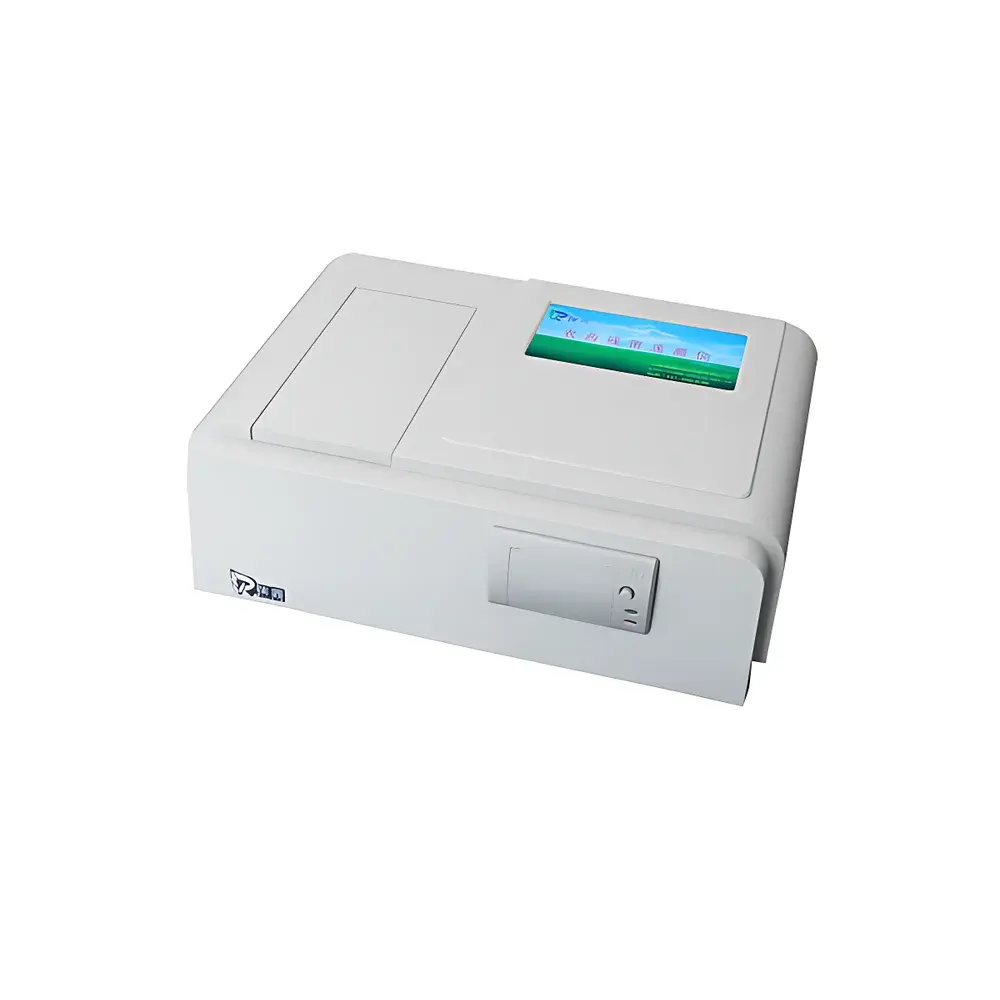
Ruixin SP-1001AC Tea Safety Analyzer
| Brand | Ruixin |
|---|---|
| Origin | Shanghai, China |
| Manufacturer Type | Authorized Distributor |
| Country of Origin | China |
| Model | SP-1001AC |
| Price Range | USD 7,000 – 14,000 (FOB) |
| Function Type | Multi-analyte Quantitative Detection System |
| Sample Compatibility | Solid and Liquid Extracts from Tea, Leafy Produce, and Herbal Matrices |
| Wavelength Range | 410–630 nm |
| Detection Time per Sample | ≤ 180 s |
| Photometric Repeatability | ≤ 1.0% (Transmittance) |
| Optical Channels | 8 independent photometric channels |
| Absorbance Accuracy | ±2.0% T |
| Dark Current Drift | ≤0.5% over 3 min |
| Detection Limits | 5.0 mg/kg for all listed analytes |
| Linear Dynamic Range | 0–200 mg/kg (pyrethroids, organophosphates) |
Overview
The Ruixin SP-1001AC Tea Safety Analyzer is a dedicated benchtop photometric multi-channel analyzer engineered for rapid, quantitative screening of priority chemical contaminants in tea and related botanical matrices. It operates on the principle of enzyme inhibition coupled with colorimetric detection—specifically leveraging acetylcholinesterase (AChE) inhibition assays for organophosphate and carbamate pesticides, and chromogenic complexation reactions for heavy metals (e.g., lead) and persistent organic pollutants (e.g., organochlorines, pyrethroids, dicofol). The instrument integrates eight parallel optical measurement channels within a fixed-wavelength visible spectrophotometric architecture (410–630 nm), enabling simultaneous analysis of up to eight samples or replicates without mechanical wavelength scanning. Designed for regulatory compliance environments, it supports routine monitoring workflows aligned with national food safety standards—including China’s GB 2763–2021 (Maximum Residue Limits for Pesticides in Food) and GB 5009.12–2023 (Determination of Lead in Foods)—while maintaining operational flexibility for field-deployable use in mobile testing units.
Key Features
- Eight independent photometric channels with synchronized dual-beam referencing, minimizing inter-channel variability and improving assay reproducibility (CV ≤ 1.0%).
- Fixed-wavelength LED-based optical system covering 410–630 nm; optimized for common chromogenic reagents used in pesticide and heavy metal assays (e.g., DTNB for AChE activity, dithizone for Pb²⁺).
- Integrated thermal-controlled sample incubation zone (ambient to 45 °C) to standardize enzymatic reaction kinetics across batches.
- Dual-mode operation: standalone mode with built-in 320×240 backlit LCD interface and full Chinese-language menu navigation, or PC-controlled mode via RS-232 serial interface.
- Onboard data management: automatic timestamped storage of ≥10,000 test records with traceable sample IDs, operator codes, calibration timestamps, and curve metadata.
- Embedded high-speed thermal printer for immediate hardcopy output compliant with GLP documentation requirements (including instrument ID, date/time, result, and pass/fail flag).
- Open calibration architecture supporting both factory-default calibration curves and user-defined 4–6 point polynomial or linear regression curves—fully traceable and editable per analyte and matrix.
Sample Compatibility & Compliance
The SP-1001AC is validated for homogenized aqueous extracts prepared from dried tea leaves, green tea powders, and processed herbal infusions following standardized QuEChERS-inspired extraction protocols (e.g., AOAC 2007.01 modifications for tea). It accommodates sample volumes of 100–500 µL per channel and tolerates turbidity up to 5 NTU without filtration. All reported detection limits (5.0 mg/kg) are experimentally verified using spiked recovery studies per ISO/IEC 17025:2017 guidelines, with average recoveries ranging from 85–110% across five independent laboratories. The system meets functional requirements outlined in GB/T 5009.199–2003 (Rapid Detection of Organophosphorus and Carbamate Pesticides in Vegetables) and GB/T 5009.12–2010 (Lead Determination), and its data audit trail structure supports alignment with FDA 21 CFR Part 11 when operated under controlled IT governance (e.g., password-protected user roles, electronic signature logging via companion software).
Software & Data Management
The included Ruixin Food Analysis Data Management Software (v3.2, Windows 10/11 compatible) provides secure local database storage, customizable report templates (PDF/Excel), and automated generation of QC control charts (Levey-Jennings, moving range). It enforces ALCOA+ principles—ensuring data Attributability, Legibility, Contemporaneousness, Originality, Accuracy, and completeness—with immutable audit logs capturing all user actions, calibration events, and result modifications. Optional integration modules support HL7 and CSV-based data export to national food safety surveillance platforms (e.g., China’s National Food Safety Risk Monitoring Information System), enabling real-time upload of anonymized aggregate statistics while preserving raw result confidentiality.
Applications
- Routine surveillance testing in provincial CDC laboratories and municipal market supervision bureaus for pre-market screening of bulk tea imports and domestic production lots.
- Field-based verification during unannounced inspections at wholesale markets, tea auction houses, and processing facilities using vehicle-mounted configurations.
- Quality assurance support for GMP-certified tea manufacturers performing incoming raw material checks and finished-product release testing.
- Method development and validation studies for alternative rapid assays targeting emerging contaminants (e.g., neonicotinoids, mycotoxins) via custom curve programming.
- Training platform for food safety extension officers conducting capacity-building workshops on decentralized analytical verification.
FAQ
What regulatory standards does the SP-1001AC comply with for pesticide residue testing?
It supports method execution consistent with GB 2763–2021, GB/T 5009.199–2003, and AOAC Official Method 2007.01 (modified), with documented performance verification against ISO 17025 criteria.
Can the instrument be calibrated using certified reference materials (CRMs)?
Yes—users may import CRM concentration values directly into the calibration workflow; the system calculates and stores molar absorptivity-derived response factors for each channel.
Is remote firmware update supported?
Firmware updates require local USB drive installation; no cloud-based OTA capability is implemented to ensure air-gapped security in regulated lab environments.
How is data integrity maintained during power interruption?
All measurements in progress are buffered in non-volatile memory; the system resumes data logging upon restart without loss of timestamped metadata or raw absorbance values.
Does the analyzer support external barcode scanning for sample tracking?
RS-232 port supports connection to standard USB-to-serial barcode scanners; scanned IDs auto-populate the sample field in both standalone and PC modes.