
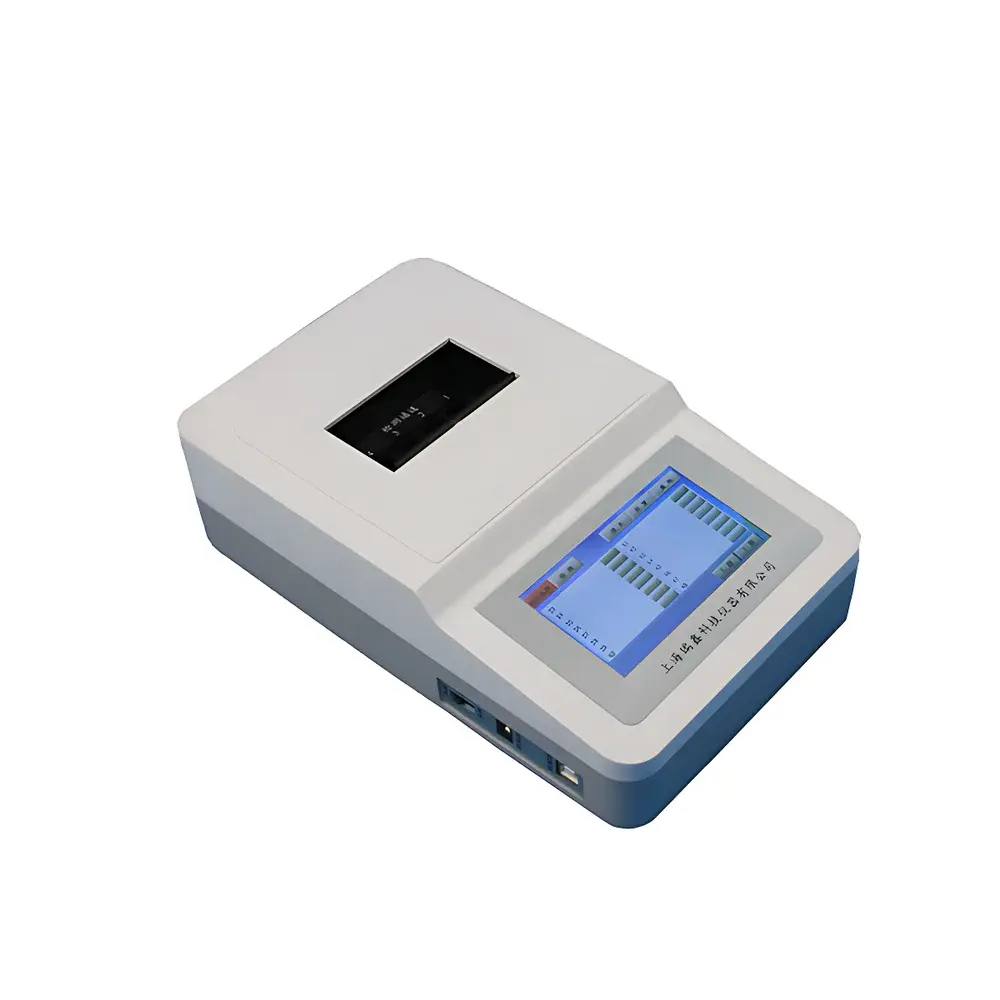
Ruixin SPb-JHg2 Mercury (Hg) Rapid Detection Analyzer
| Brand | Ruixin |
|---|---|
| Origin | Shanghai, China |
| Manufacturer Type | Authorized Distributor |
| Country of Origin | China |
| Model | SPb-JHg2 |
| Price Range | USD 4,200 – 7,000 |
| Functionality | Single-Analyte Detection (Mercury Only) |
| Sample Format | Single-Sample Dedicated Use |
| Wavelength | 540 nm |
| Detection Time | ≤ 3 min |
| Repeatability | ≤ 0.2% |
| Detection Channels | 1 |
Overview
The Ruixin SPb-JHg2 Mercury (Hg) Rapid Detection Analyzer is a portable, single-channel spectrophotometric instrument engineered for quantitative determination of total mercury in solid and liquid food matrices—including grains, vegetables, dairy products, seafood, and processed foods. It operates on the principle of colorimetric analysis based on the dithizone-mercury complex formation, with optical measurement at a fixed wavelength of 540 nm. The system integrates a stabilized LED light source, precision optical path alignment, and embedded photometric calibration to ensure high reproducibility under field or laboratory conditions. Designed for regulatory compliance workflows, the SPb-JHg2 delivers rapid, on-site screening results aligned with national food safety standards (e.g., GB 5009.17–2021 for mercury in food), supporting preliminary risk assessment prior to confirmatory testing via ICP-MS or CV-AAS.
Key Features
- Portable architecture with integrated rechargeable lithium battery (up to 8 hours continuous operation), enabling deployment in mobile food inspection vehicles, market surveillance units, or remote sampling sites.
- 4.3-inch high-resolution color TFT touchscreen with full Chinese GUI—supports intuitive navigation, real-time parameter adjustment, and bilingual (Chinese/English) firmware switching for cross-regional use.
- On-device intelligent Chinese input via virtual keyboard and stylus—facilitates direct entry of sample names, operator IDs, and institutional metadata without external peripherals.
- Embedded thermal printer outputs traceable, audit-ready reports per test channel, including numeric concentration (mg/kg), sample description in native language, date/time stamp, analyst ID, and accredited lab identifier.
- Self-calibrating optical system performs automatic zero and reference (100% T) correction at power-on—eliminating manual baseline adjustment and reducing operator-dependent variability.
- Dual-mode photometric display: simultaneous readout of absorbance (0.000–4.000 AU, resolution 0.001) and transmittance (0.00–100.00%, resolution 0.01%), supporting method development and secondary validation experiments.
- Instrument stability ≤ 0.3% over 3 minutes (drift test per ISO 7027-1:2016 Annex B), ensuring reliable performance during extended batch analysis.
Sample Compatibility & Compliance
The SPb-JHg2 is validated for use with homogenized, acid-digested, or extraction-prepared samples conforming to standard pretreatment protocols outlined in GB/T 5009.17 and AOAC Official Method 999.10. It accommodates liquid extracts (aqueous HCl or thiourea-HCl media) and clarified supernatants from solid food digests. While not intended for direct solid-phase analysis, it supports GLP-aligned documentation when paired with certified reference materials (CRMs) such as NIST SRM 1566b (Oyster Tissue) or ERM-BB184 (Rice Flour). Data integrity meets basic requirements for regulatory triage: each result carries embedded timestamps, operator tags, and instrument serial logging. Though not 21 CFR Part 11-compliant out-of-the-box, audit trails are exportable via USB for integration into LIMS environments supporting FDA-mandated record retention.
Software & Data Management
The analyzer runs embedded firmware v3.2 with local storage capacity for ≥10,000 test records (including raw absorbance values, calculated concentrations, and user annotations). All data are timestamped and indexed by channel ID. RS232 and USB 2.0 interfaces enable bidirectional communication with external PCs or centralized food safety monitoring platforms. Export formats include CSV and XML—structured to align with China’s National Food Safety Risk Monitoring Information System (NFMRIS) schema. Firmware updates are delivered via encrypted USB key; no cloud dependency ensures data sovereignty and network isolation in sensitive inspection environments.
Applications
- Routine screening of mercury contamination in rice, wheat flour, edible oils, and infant formula during routine market surveillance.
- Field verification of supplier compliance with maximum residue limits (MRLs) specified in GB 2762–2022 (Contaminants in Food).
- Triage testing in foodborne illness investigations where rapid heavy metal exposure assessment is required.
- Quality assurance checks at processing facilities prior to release—especially for seafood importers subject to customs clearance timelines.
- Training and capacity building for provincial CDC laboratories and third-party certification bodies operating under CNAS accreditation (ISO/IEC 17025).
FAQ
What is the detection limit and linear range for mercury using this instrument?
The method detection limit (MDL) is 5 mg/kg in solid food matrices following standardized digestion; the quantification range spans 0–50 mg/kg with R² ≥ 0.995 across five-point calibration curves.
Does the instrument require external calibration standards before each use?
No—optical self-calibration occurs automatically at startup; however, daily verification using a certified control standard (e.g., 10 mg/kg Hg CRM) is recommended per GB/T 27404–2008 guidelines.
Can the SPb-JHg2 be used for other heavy metals besides mercury?
No—it is configured exclusively for mercury detection via the dithizone reaction pathway; separate analyzers are required for lead, cadmium, or arsenic.
Is technical support available in English for international users?
Yes—Ruixin provides multilingual documentation (EN/CN), remote firmware diagnostics, and application engineering consultation through authorized regional distributors.
How is data security handled during USB transfer?
All exported files are write-protected and contain SHA-256 checksums; no executable code or configuration parameters are exposed in data exports.





