
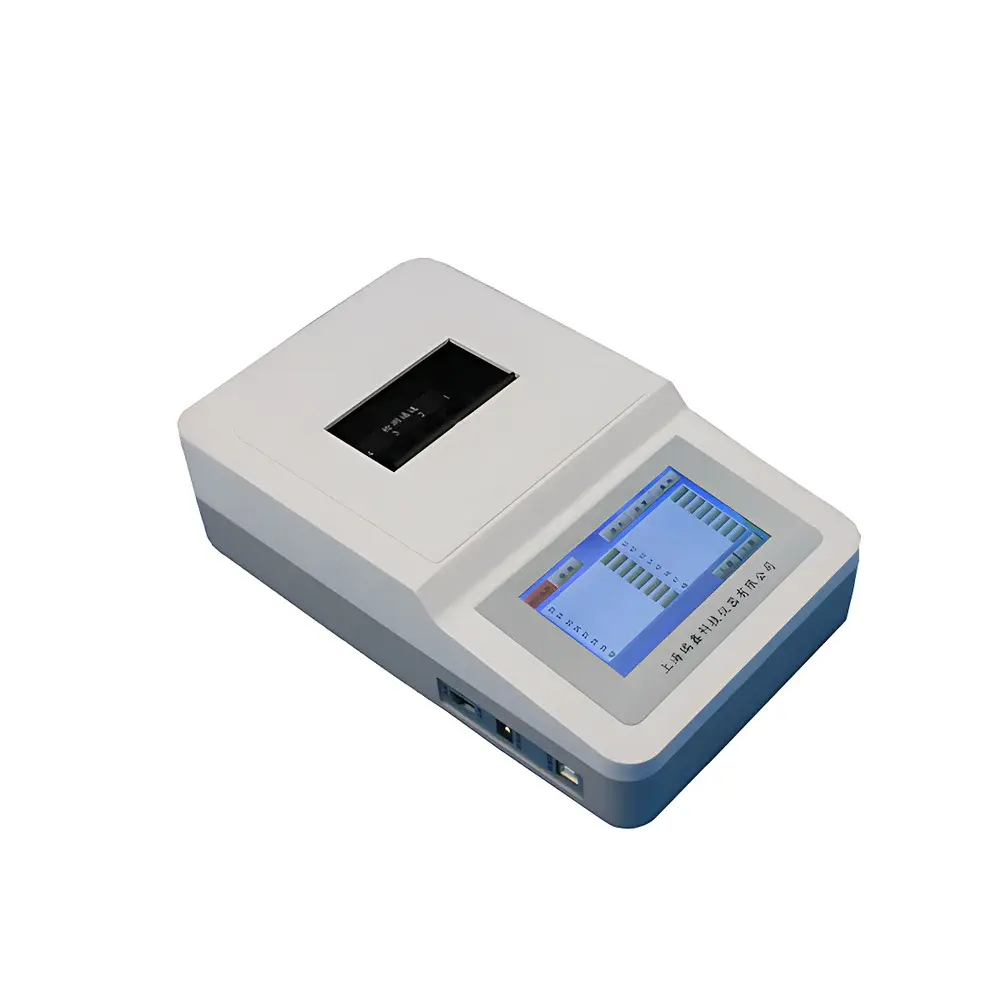
Ruixin SPb-DY2 Iodine Content Analyzer for Edible Salt
| Brand | Ruixin |
|---|---|
| Origin | Shanghai, China |
| Manufacturer Type | Authorized Distributor |
| Country of Origin | China |
| Model | SPb-DY2 |
| Price Range | USD 2,800–4,200 (FOB Shanghai) |
| Functionality | Single-analyte, dedicated assay |
| Sample Type | Solid edible salt samples only |
| Wavelength | 540 nm |
| Assay Time | ≤3 min per sample |
| Photometric Repeatability | ≤0.2% (transmittance) |
| Optical Channels | 1 |
| Absorbance Range | 0.000–4.000 |
| Transmittance Range | 0.00–100.00% |
| Transmittance Resolution | 0.01% |
| Absorbance Resolution | 0.001 |
| Photometric Accuracy | ±2.0% (transmittance) |
| Baseline Stability | ≤0.3% over 3 min |
| LOD | 2.0 mg/kg |
| Quantitation Range | 0–80 mg/kg |
| Communication Interfaces | RS-232, USB |
| Power Supply | Rechargeable Li-ion battery (7.4 V, 4400 mAh), AC 220 V ±10%, DC 5 V input |
Overview
The Ruixin SPb-DY2 Iodine Content Analyzer is a dedicated photometric instrument engineered for rapid, field-deployable quantification of iodine concentration in refined edible salt—strictly aligned with the methodology specified in GB/T 13025.7–2012 (“Determination of iodine content in salt — Spectrophotometric method using arsenic cerium catalytic reaction”) and consistent with Codex Alimentarius Standard CXS 150–1985 (Standard for Iodized Salt). It operates on the principle of catalytic kinetic spectrophotometry: under acidic conditions, iodide ions catalyze the oxidation of arsenious acid by ceric ammonium sulfate; the rate of color development (measured at 540 nm) correlates directly with iodide concentration. This fixed-wavelength, single-channel system delivers trace-level sensitivity (LOD: 2.0 mg/kg) and high reproducibility (≤0.2% transmittance repeatability), enabling compliance verification within national regulatory thresholds (e.g., 18–33 mg/kg for iodized salt in China per GB 26878–2011).
Key Features
- Integrated 4.3-inch high-resolution color TFT touchscreen with full Chinese GUI—enabling intuitive navigation, real-time data visualization, and on-device annotation via stylus or predictive Chinese input.
- Self-calibrating optical path architecture: automatic zero and 100% T initialization at power-on eliminates manual calibration steps and reduces operator dependency.
- Dual photometric display mode: simultaneous numeric readout of absorbance (A) and transmittance (%T), supporting both regulatory reporting and method development flexibility.
- Onboard thermal printer (embedded micro-printer): generates compliant test reports containing iodine concentration (mg/kg), sample name (user-defined Chinese text), date/time stamp, analyst ID, and testing unit—formatted to support internal QA documentation.
- Triple-power operation: rechargeable lithium-ion battery (7.4 V, 4400 mAh) enables ≥8 hours of continuous field use; also compatible with AC 220 V mains and external 5 V DC sources for lab or mobile deployment.
- Robust data integrity controls: automatic timestamped result storage (≥1000 records), recall-by-date/sample-ID search, and audit-ready export via RS-232 or USB to LIMS or Excel-compatible spreadsheets.
Sample Compatibility & Compliance
The SPb-DY2 is validated exclusively for homogenized, dry, non-iodized or iodized sodium chloride matrices (particle size < 0.5 mm). It does not support liquid brines, fortified seasonings, or multi-component food matrices. All assays require pre-extraction per GB/T 13025.7–2012: dissolution in deionized water, centrifugation, and filtration prior to analysis. The instrument meets essential metrological requirements for routine QC in salt production, distribution, and regulatory inspection settings—including alignment with ISO/IEC 17025:2017 clause 7.2.2 (method validation) and supporting GLP-aligned recordkeeping (timestamped results, operator ID, environmental temperature logging). While not FDA 21 CFR Part 11-certified out-of-box, its data export architecture permits integration into Part 11-compliant review workflows.
Software & Data Management
No proprietary PC software is required. Data transfer occurs via standard serial (RS-232) or mass-storage-class USB protocols—enabling direct import into laboratory information management systems (LIMS), Microsoft Excel, or statistical packages (e.g., JMP, Minitab). Each stored record includes embedded metadata: assay start time, measured A/%T values, calculated iodine concentration, user-entered sample descriptor, and instrument serial number. Internal memory retains full traceability without cloud dependency. Firmware updates are delivered via USB stick with SHA-256 checksum verification.
Applications
- Routine batch release testing in salt refineries and packaging facilities.
- On-site surveillance by provincial market supervision bureaus (e.g., SAMR-affiliated inspection teams).
- Third-party certification labs performing GB-compliant iodine audits.
- University food science departments conducting method validation studies or student analytical labs.
- Emergency response units verifying iodine fortification integrity post-distribution (e.g., after transport or storage).
FAQ
What extraction protocol must be followed prior to analysis?
GB/T 13025.7–2012 mandates dissolution of 10.0 g salt in 100 mL deionized water, followed by centrifugation (3000 rpm, 5 min) and filtration through 0.45 µm membrane prior to spectrophotometric measurement.
Can the instrument quantify iodine in low-sodium or potassium chloride–based salts?
No—validation is limited to NaCl matrices. KCl or mixed-salt formulations introduce spectral interference and require method re-validation.
Is calibration verification traceable to NIM (National Institute of Metrology, China)?
The optical system is factory-aligned against NIM-traceable neutral density filters; users perform daily verification using certified iodine reference standards (e.g., GBW(E) 080382, 20.0 ± 0.5 mg/kg in NaCl).
Does the device support multi-point calibration curves?
No—it operates in fixed single-point calibration mode optimized for the linear range of the catalytic reaction (0–80 mg/kg); linearity is verified per GB/T 13025.7–2012 Annex A.
How is battery health monitored during field use?
Real-time battery voltage and remaining capacity (%) are displayed in the status bar; low-battery warning triggers at ≤15% and auto-shutdown occurs at ≤5% to preserve flash memory integrity.






