
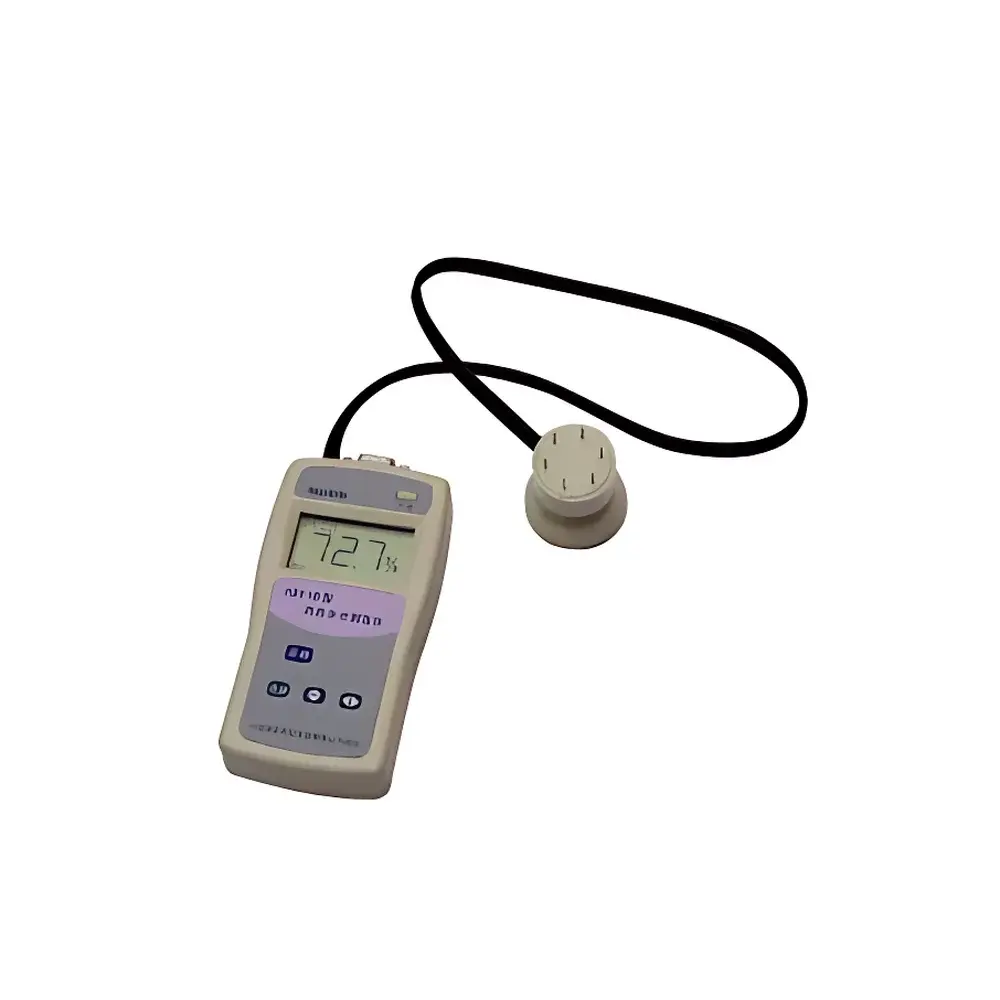
Ruixin RSY-1 Portable Meat Moisture Analyzer
| Brand | Ruixin |
|---|---|
| Origin | Shanghai, China |
| Manufacturer Type | Authorized Distributor |
| Model | RSY-1 |
| Price Range | USD 1,400–2,800 |
| Function Type | Single-parameter Detection |
| Sample Type | Single-species Dedicated |
| Detection Time | ≤3 min per sample |
| Repeatability | ≤0.3% (70–80% w/w moisture range) |
| Measurement Channels | 1 |
Overview
The Ruixin RSY-1 Portable Meat Moisture Analyzer is a field-deployable, direct-insertion impedance-based moisture measurement instrument engineered for rapid, non-destructive quantification of water content in fresh meat tissues—including pork, beef, mutton, and poultry. Unlike gravimetric reference methods (e.g., AOAC 950.46 or GB 18394–2001), which require sample homogenization, oven drying (>30 min at 103 ± 2°C), and post-drying mass calculation, the RSY-1 employs a calibrated multi-electrode needle probe to measure bulk electrical impedance—correlating resistivity and capacitance changes with tissue water concentration. Its design adheres strictly to the metrological requirements of China’s national standard GB 18394–2001 “Maximum Limits of Moisture Content in Livestock and Poultry Meat,” enabling regulatory-grade screening for adulteration (e.g., water injection) and quality control at point-of-sale, slaughterhouse lines, and market inspection stations.
Key Features
- Non-invasive, tissue-preserving measurement: The stainless-steel needle probe penetrates intact muscle tissue without structural disruption, preserving sample integrity for further testing or commercial use—unlike destructive oven-dry protocols.
- Adaptive calibration architecture: Supports user-defined species-specific baseline values derived from up to 20 reference measurements via standard loss-on-drying (LOD) validation, enabling compensation for biological variability across breeds, seasons, and geographical origins.
- Real-time statistical processing: Performs on-device arithmetic averaging of 10 consecutive impedance readings; automatically discards outliers deviating >2.0% from the running mean using iterative robust estimation algorithms.
- Regulatory decision logic: Allows programmable threshold setting aligned with statutory limits (e.g., ≤77% for pork, ≤78% for beef per GB 18394–2001); triggers visual flashing and optional voice alerts upon超标 detection.
- Low-power portable operation: Powered by a single 9 V alkaline battery (typical consumption: ~40 mW); operational for >8 hours per charge; compact housing (130 × 60 × 25 mm), weight < 250 g.
- Integrated data traceability: Stores up to 500 test records locally; exports timestamped results (moisture %, measurement count, pass/fail status) via RS-232 serial interface for integration into LIMS or QA databases.
Sample Compatibility & Compliance
The RSY-1 is validated exclusively for raw, unprocessed skeletal muscle tissue of terrestrial livestock and avian species. It is not intended for use on cured, frozen, cooked, or minced products, nor on adipose-rich or connective-tissue-dominant samples (e.g., skin, tendons). Its measurement range (65–90% w/w) covers physiological and adulterated moisture levels typical of fresh meat. While not certified to ISO/IEC 17025 or FDA 21 CFR Part 11, its algorithmic repeatability (≤0.3% RSD in 70–80% range) meets internal QC requirements for screening-level enforcement under GB 18394–2001. Calibration traceability relies on user-performed LOD validation against NIST-traceable analytical balances and controlled-temperature ovens.
Software & Data Management
The device operates firmware-controlled embedded software with menu-driven LCD interface (Chinese character support only). No external PC software is required for basic operation. RS-232 output delivers ASCII-formatted records containing: test ID, date/time stamp, measured moisture value (%), number of valid readings, pass/fail flag, and battery voltage. Exported datasets are compatible with spreadsheet applications (e.g., Microsoft Excel) and basic statistical packages for trend analysis, audit reporting, or batch-level compliance documentation. Audit trails are limited to stored timestamps and result values—no user login, electronic signature, or change-log functionality is implemented.
Applications
- Routine surveillance at municipal food markets and supermarket meat counters
- On-line quality verification during slaughterhouse carcass grading
- Field inspections by market supervision bureaus (e.g., SAMR-affiliated units)
- Pre-shipment screening for export-oriented meat processors
- Educational demonstrations in food science laboratories focusing on rapid sensory-physical property correlation
- Internal QA checks for catering supply chains and institutional kitchens
FAQ
What is the principle of measurement?
It uses multi-point electrical impedance spectroscopy at low frequency (<10 kHz) to infer moisture concentration based on the dielectric properties of muscle tissue.
Can it measure frozen or cooked meat?
No. Only fresh, unfrozen, uncooked, and non-marinated muscle tissue yields reliable results.
How often must calibration be performed?
Baseline calibration is recommended before first use and after any significant environmental shift (e.g., >10°C ambient change); revalidation every 30 days or 100 measurements is advised for audit readiness.
Is the probe sterilizable?
The stainless-steel probe may be wiped with 70% ethanol; autoclaving or immersion in boiling water is not recommended due to sensor encapsulation limitations.
Does it comply with EU or US regulatory standards?
It is designed to meet Chinese national standard GB 18394–2001; no CE marking, FDA clearance, or USDA FSIS recognition is held.
What battery type is required?
One standard 9 V alkaline battery (IEC 6LR61); rechargeable NiMH variants are not supported due to voltage regulation constraints.




