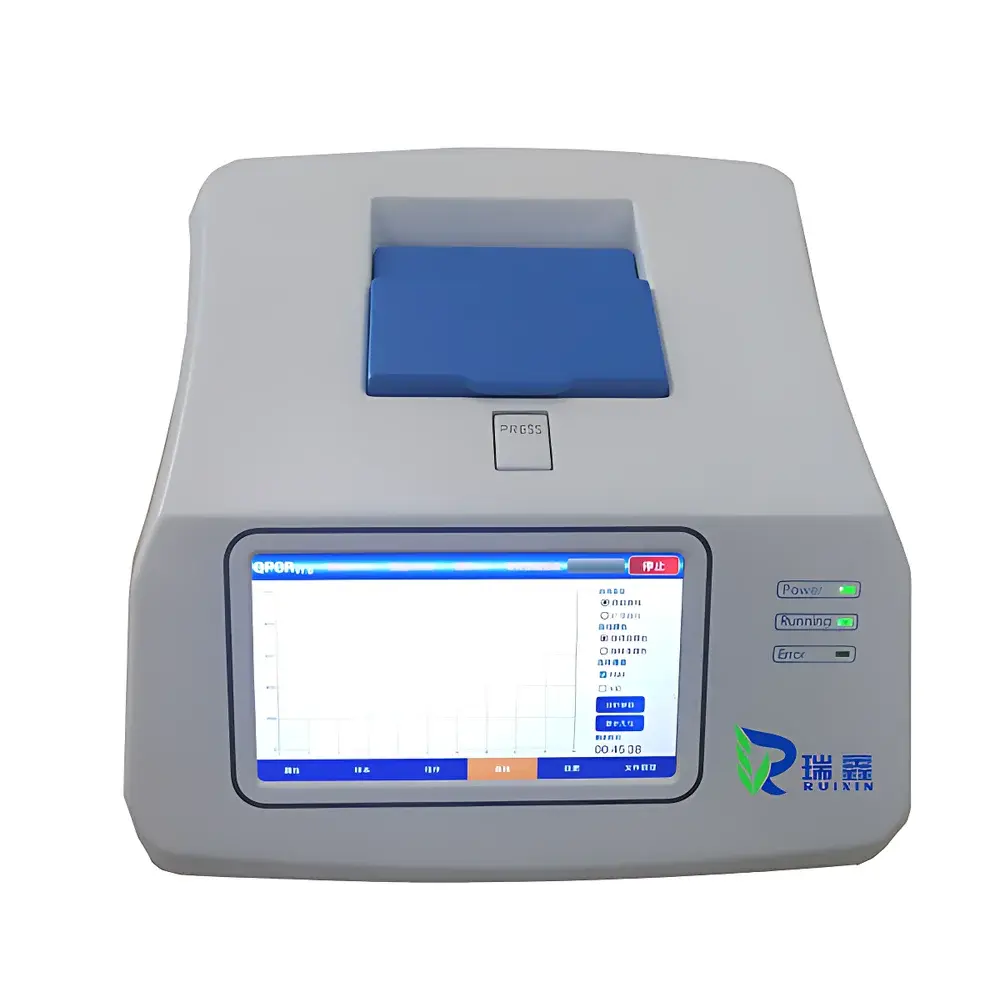
Ruixin HYG-16 Constant-Temperature Fluorescent Nucleic Acid Amplification & Detection System
| Brand | Ruixin |
|---|---|
| Origin | Shanghai, China |
| Manufacturer Type | Authorized Distributor |
| Model | HYG-16 |
| Price | USD 6,300 (approx.) |
| Function Type | Multiplex Detection (≥5 targets per run) |
| Sample Compatibility | Universal for food matrices (liquid, homogenized tissue, swab eluates) |
| Excitation Wavelengths | 470 nm |
| Emission Wavelengths | 520 nm (FAM channel) |
| Detection Throughput | 16 wells (8×2 block), up to 14 samples + 2 controls per run |
| Cycle Time | ≤60 min (positive call in ≤15 min |
| Repeatability | ≤0.2% CV |
| Reaction Volume | 10–100 µL |
| Temperature Range | Ambient to 90 °C |
| Temperature Accuracy | ±0.4 °C |
| Temperature Uniformity | ±0.4 °C across block |
| Heating Rate | ≥1 °C/s |
| Thermal Lid | Integrated active pressure-controlled lid |
| Power Supply | 100–240 V AC, 50–60 Hz |
| Dimensions | 300 × 260 × 150 mm |
| Net Weight | 4.0 kg |
Overview
The Ruixin HYG-16 Constant-Temperature Fluorescent Nucleic Acid Amplification & Detection System is an integrated, benchtop molecular diagnostics platform engineered for rapid, on-site detection of nucleic acid targets in food safety laboratories and field-deployable quality control environments. Unlike conventional thermal-cycling PCR instruments, the HYG-16 implements isothermal amplification—specifically loop-mediated isothermal amplification (LAMP) and recombinase polymerase amplification (RPA)—coupled with real-time fluorescent signal monitoring. This eliminates the need for complex thermocycling hardware, enabling robust performance under variable ambient conditions while maintaining high analytical sensitivity and specificity. The system is designed for compliance-driven workflows in food testing labs operating under ISO/IEC 17025, AOAC INTERNATIONAL guidelines, and national regulatory frameworks such as China’s GB standards and EU Regulation (EC) No 852/2004. Its closed-tube, single-step workflow minimizes carryover contamination risk and eliminates post-amplification gel electrophoresis—a critical advantage for routine high-throughput screening in QC/QA settings.
Key Features
- 16-well independent detection module: Precision-machined aluminum heating block with uniform thermal distribution (±0.4 °C), supporting standard 0.2 mL tubes or 8-well strips without adapter requirements.
- Real-time dual-channel fluorescence detection: LED excitation at 470 nm and emission capture at 520 nm (FAM-compatible), with optimized optical filtering for low-background signal acquisition and high signal-to-noise ratio.
- On-device intelligent analysis engine: Built-in Android OS enables autonomous data acquisition, curve fitting, threshold-based positivity calling, and semi-quantitative estimation—all executed without external computing resources.
- Multi-terminal operational flexibility: Local touchscreen (7-inch capacitive display), PC-connected software suite, and cloud-synced mobile application (iOS/Android) support remote experiment initiation, live progress monitoring, and report generation.
- Regulatory-ready data integrity architecture: Audit-trail logging, user access control, electronic signature support, and encrypted local storage comply with GLP principles and align with FDA 21 CFR Part 11 expectations for electronic records.
- Open reagent compatibility: Designed for use with commercially available, lyophilized, one-tube LAMP/RPA master mixes—eliminating cold-chain dependency and reducing hands-on time per assay.
Sample Compatibility & Compliance
The HYG-16 accommodates diverse food-related sample types—including raw meat homogenates, dairy extracts, grain slurries, environmental swab eluates, and processed food digests—following standardized nucleic acid extraction protocols (e.g., magnetic bead-based or column purification). It supports validated detection of over 80 analytes across four major categories: (1) pathogenic microorganisms (e.g., Salmonella spp., Listeria monocytogenes, norovirus GI/GII, Campylobacter jejuni); (2) species identification markers (porcine, bovine, equine, poultry, goat, deer, dog, cat DNA); (3) GMO screening elements (CaMV 35S, NOS terminator, MON810, NK603, Roundup Ready soy, Bt11, etc.); and (4) animal disease agents (ASFV, CSFV, FMDV). Each assay has been verified against reference materials traceable to CNAS-accredited sources, with stated limits of detection meeting or exceeding requirements in GB/T 38167–2019, GB/T 38518–2020, and AOAC PTM validation criteria. Instrument calibration remains stable after relocation—no field recalibration required.
Software & Data Management
The embedded Ruixin Molecular Analysis Suite (RMAS) provides a unified interface for protocol selection, run configuration, real-time curve visualization, automatic Ct/Ct-like value calculation, and binary result classification. All raw fluorescence data (.rfu files), metadata (user ID, timestamp, lot numbers), and final reports are stored locally in SQLite databases with SHA-256 hashing for tamper evidence. Export options include CSV, PDF, and Excel-compatible formats suitable for LIMS integration. Cloud synchronization via Wi-Fi or Ethernet enables centralized data aggregation, cross-lab method comparison, and automated regulatory submission (e.g., to provincial food safety surveillance platforms). Firmware and assay library updates are delivered over-the-air, including periodic revisions to embedded regulatory document repositories (GB, NY/T, SN standards, and Codex Alimentarius references).
Applications
The HYG-16 serves as a primary screening tool in food production facilities, third-party testing laboratories, port-of-entry inspection units, and municipal food safety bureaus. Typical use cases include: verification of raw material authenticity (e.g., horsemeat adulteration in beef products); rapid confirmation of pathogen presence during outbreak investigations; pre-shipment GMO compliance checks for export-oriented processors; and surveillance testing of feed ingredients for zoonotic virus contamination. Its portability (4.0 kg), low power draw (<120 W), and battery-operated operation capability (via optional external power bank) make it suitable for mobile lab deployments, farmer cooperative extension services, and border inspection checkpoints where infrastructure reliability is limited.
FAQ
Does the HYG-16 require thermal cycling?
No. It utilizes isothermal nucleic acid amplification technologies (LAMP/RPA), eliminating the need for repeated heating and cooling cycles.
Can I use third-party reagents with this instrument?
Yes. The system is compatible with any open-format, fluorescently labeled isothermal amplification kits that operate within the 470/520 nm excitation-emission window.
Is the instrument compliant with international food testing standards?
It meets functional and performance benchmarks aligned with AOAC Official Methods of Analysis (OMA) for isothermal assays and supports documentation practices consistent with ISO/IEC 17025 clause 7.7 on result reporting.
How is data security ensured during cloud transmission?
All data transfers employ TLS 1.2+ encryption; device authentication uses X.509 certificates, and uploaded datasets are stored in AES-256 encrypted containers on ISO 27001-certified cloud infrastructure.
What maintenance is required for long-term accuracy?
No routine optical recalibration is needed. Annual verification using NIST-traceable temperature probes and fluorescence reference standards is recommended for audit readiness.