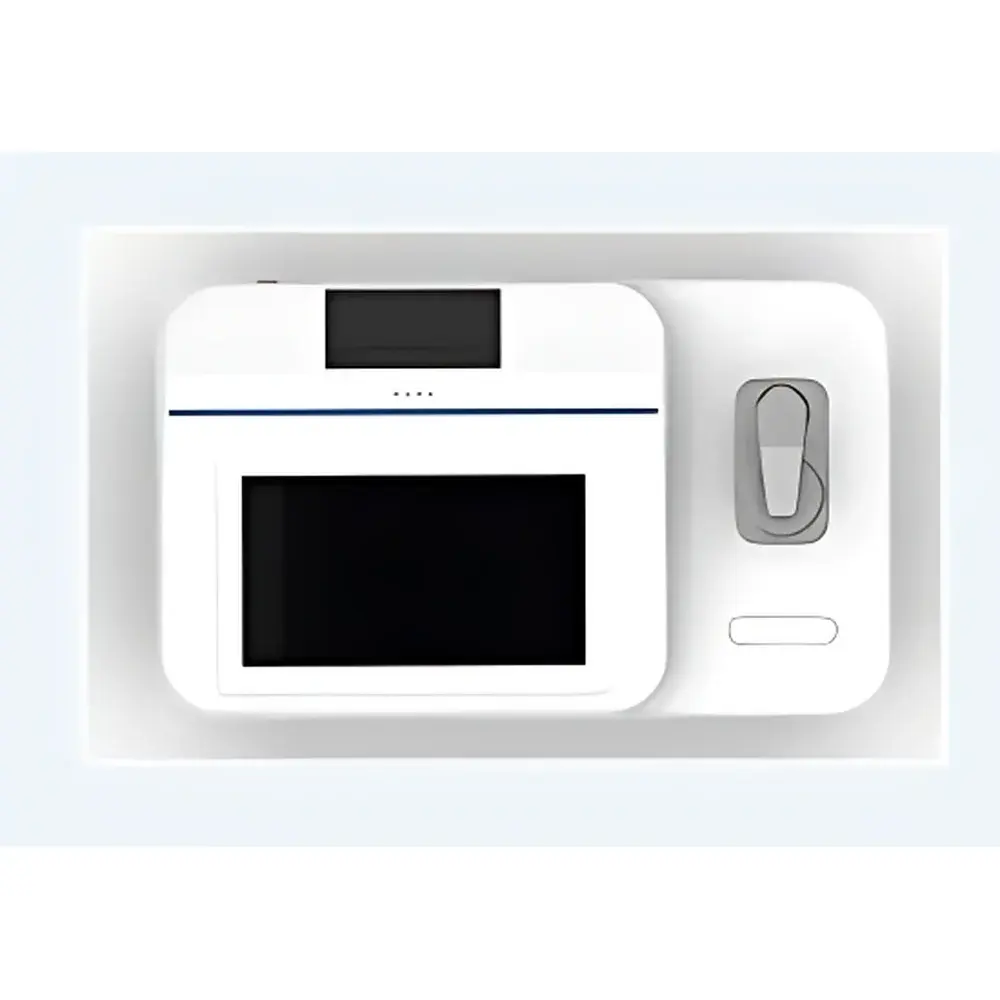
Ruixin YJ-107B Heavy Metal Quantitative Analyzer
| Brand | Ruixin |
|---|---|
| Origin | Shanghai, China |
| Manufacturer Type | Authorized Distributor |
| Country of Origin | China |
| Model | YJ-107B |
| Function Type | Multi-analyte (Pb, Cd) |
| Sample Applicability | Universal for grain, vegetable, and aquatic products |
| Wavelength Range | 380–680 nm |
| Detection Time | ≤3 min per test |
| Repeatability | ≤0.3% RSD |
| Detection Channels | 1 |
| Detection Range (Pb/Cd) | 0.03–2.0 mg/kg |
| Power Supply | AC 220 V / 50 Hz + built-in rechargeable Li-ion battery |
| Display | 7-inch capacitive touchscreen |
| OS | Android |
| Processor | 1.2 GHz quad-core |
| Memory | 1 GB RAM + 8 GB internal storage |
| Connectivity | Wi-Fi |
| Data Output | Excel-compatible report generation |
| Electrode Type | Disposable screen-printed carbon electrode (SPCE), plug-and-play |
Overview
The Ruixin YJ-107B Heavy Metal Quantitative Analyzer is a field-deployable electrochemical instrument engineered for rapid, on-site quantification of lead (Pb) and cadmium (Cd) in food matrices—including cereal grains (rice, wheat, corn), fresh vegetables, and aquatic products. It employs anodic stripping voltammetry (ASV), a well-established electroanalytical technique that leverages controlled electrodeposition and subsequent oxidative dissolution of metal ions to achieve high sensitivity and selectivity at trace levels. Unlike conventional ASV systems requiring polished solid electrodes and rigorous surface pretreatment, the YJ-107B utilizes single-use, screen-printed carbon electrodes (SPCEs) with integrated working, reference, and counter electrodes—eliminating electrode polishing, cleaning, and calibration drift associated with reusable electrodes. Its compact footprint (280 × 210 × 120 mm), lightweight chassis (8 hours continuous operation) make it suitable for mobile laboratories, grain procurement stations, port quarantine zones, and regional food safety inspection teams operating under GLP-aligned workflows.
Key Features
- Electrochemical platform optimized for ASV-based Pb and Cd detection at sub-ppm concentrations—validated against ISO 11040-2 and GB 5009.12–2023 (Chinese National Standard for Pb in foods) and GB 5009.15–2014 (for Cd).
- Disposable SPCEs ensure batch-to-batch consistency, eliminate carryover risk, and reduce operator-dependent variability—critical for untrained personnel in decentralized testing environments.
- Integrated micro-mixer enables precise, low-volume (≤100 µL) reagent handling and homogeneous sample-electrolyte interaction, minimizing reagent consumption and waste generation.
- Android-based embedded system with 7-inch IPS touchscreen delivers intuitive workflow navigation, real-time voltammogram visualization, and automatic peak integration using derivative-based peak identification algorithms.
- On-device data management includes timestamped result logging, user-defined sample ID tagging, and encrypted local storage compliant with basic audit trail requirements for routine screening.
- Wi-Fi connectivity supports secure data export via HTTPS or SFTP to LIMS endpoints; firmware updates are delivered over-the-air without hardware intervention or service center return.
- Self-contained operation: all critical functions—including potential sweep control, deposition timing, signal amplification, and background subtraction—are executed by the onboard microcontroller with no external PC dependency.
Sample Compatibility & Compliance
The YJ-107B is validated for homogenized, acid-digested extracts prepared from raw and processed food samples per AOAC 999.10 and GB/T 5009.17–2023 protocols. It accommodates aqueous digestates with total dissolved solids ≤0.5% w/v and chloride concentrations <100 mg/L to prevent interference during stripping. While not intended for regulatory compliance reporting in final product release (e.g., FDA or EU Commission Regulation (EC) No 1881/2006), its performance meets screening-level accuracy criteria outlined in ISO/IEC 17025:2017 Annex A.2 for rapid qualitative/semi-quantitative triage. Instrument design adheres to IEC 61010-1 safety standards for portable electrical equipment used in non-laboratory settings.
Software & Data Management
The proprietary Ruixin AnalyzeOS v3.2 provides full method configuration (deposition time, scan rate, pulse amplitude), calibration curve generation (linear or quadratic fit with forced zero-intercept option), and QC flagging based on internal standard recovery (if spiked controls are run). All measurement metadata—including electrode lot number, ambient temperature, humidity, and operator ID—is embedded in each exported Excel (.xlsx) report. Audit logs record user login/logout events, calibration actions, and report generation timestamps. Data encryption follows AES-128; no cloud storage occurs unless explicitly enabled by administrator. The system does not comply with FDA 21 CFR Part 11 electronic signature requirements but supports manual signature verification workflows for paper-based reporting.
Applications
- Routine surveillance of paddy rice, maize, and wheat at grain elevators and storage facilities prior to milling or distribution.
- Field-level verification of heavy metal contamination in aquaculture ponds and fish markets following suspected industrial runoff exposure.
- Pre-screening of leafy vegetables and root crops at farm gate or wholesale markets to prioritize samples for confirmatory ICP-MS analysis.
- Training and capacity-building in provincial CDCs and agricultural extension centers where access to centralized instrumentation is limited.
- Emergency response deployment during foodborne incident investigations involving suspected heavy metal adulteration or environmental contamination events.
FAQ
What electrochemical technique does the YJ-107B employ?
Anodic stripping voltammetry (ASV) with square-wave modulation, optimized for simultaneous Pb and Cd detection in acidic digestate matrices.
Is method validation documentation available?
Yes—Ruixin provides instrument-specific validation reports covering linearity (r² ≥ 0.998), limit of detection (LOD ≤ 0.02 mg/kg), and inter-day precision (RSD ≤ 2.1%) per ISO Guide 35 and GB/T 27404–2008.
Can the instrument detect other metals such as mercury or arsenic?
No—the YJ-107B is factory-configured exclusively for Pb and Cd. Other elements require electrode redesign and separate calibration; no third-party electrode compatibility is supported.
What sample preparation is required before analysis?
Samples must undergo microwave-assisted acid digestion (HNO₃/H₂O₂) followed by dilution to 1–5% v/v nitric acid matrix; filtration through 0.45 µm PVDF membrane is mandatory.
Does the device support external printers or barcode scanners?
No—output is restricted to on-screen display and Excel file export via Wi-Fi or USB OTG; peripheral interface expansion is not implemented in current firmware.