
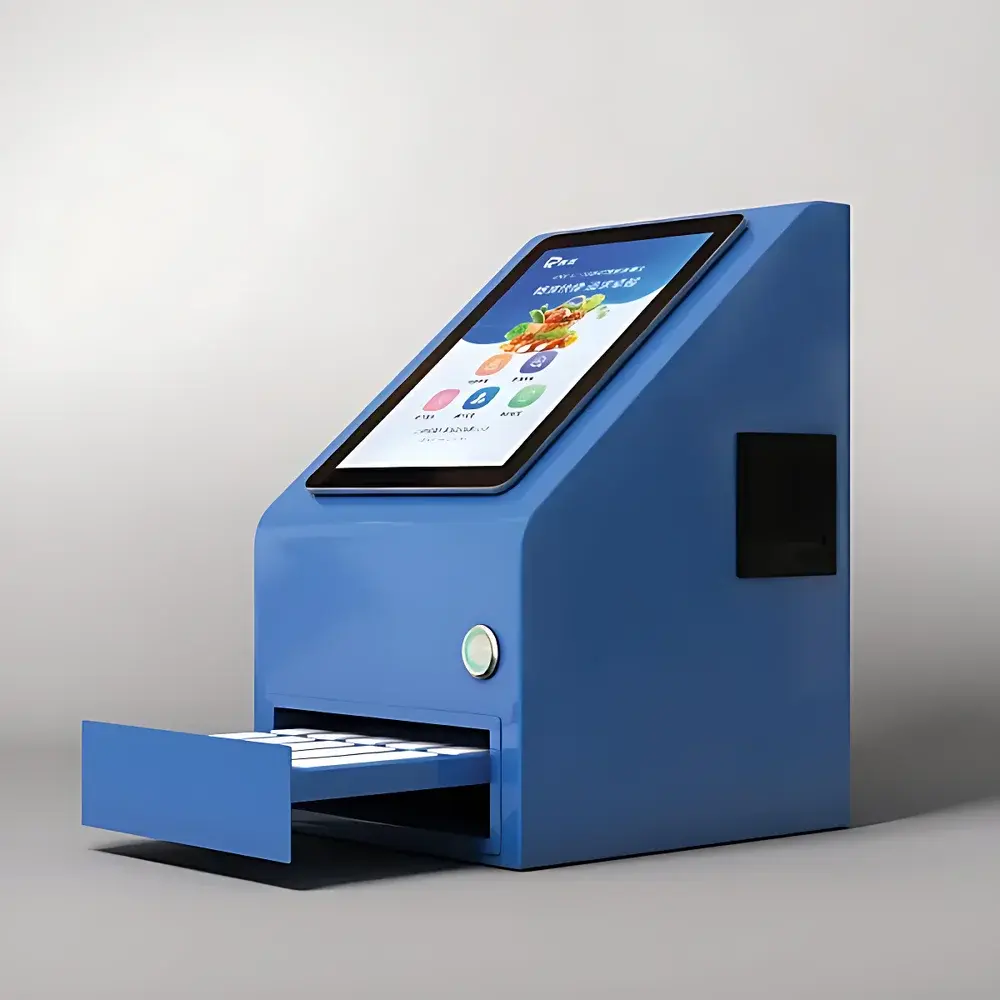
Ruixin JT-108Cd Cadmium Rapid Detection Analyzer for Rice
| Brand | Ruixin |
|---|---|
| Origin | Shanghai, China |
| Manufacturer Type | Authorized Distributor |
| Country of Manufacture | China |
| Model | JT-108Cd |
| Price | USD 5,300 (FOB Shanghai) |
| Function Type | Multi-analyte Immunoassay Platform |
| Sample Versatility | Grain, Flour, Paddy, Polished Rice, and Processed Cereal Matrices |
| Optical Detection Range | 380–680 nm |
| Assay Time per Batch | ≤3 min (including image capture & AI quantification) |
| Photometric Repeatability (CV) | ≤0.3% |
| Detection Channels | 6 independent optical lanes |
| LOD for Cd in Rice | 0.1 ppm (mg/kg) |
| Imaging Speed | <1 s per test strip |
| Quantitative Accuracy | CV <1% (intra-assay, certified control strips), Inter-batch Variation <3% |
| Output Modes | Colorimetric Intensity, C/T Ratio, T-line Absorbance, C-line Normalization |
| Interface | USB 2.0, Wi-Fi 802.11 b/g/n, RJ45 Ethernet |
| Power Supply | AC 220 V ±10%, 50 Hz |
Overview
The Ruixin JT-108Cd Cadmium Rapid Detection Analyzer is a CE-compliant, benchtop immunoassay instrument engineered for quantitative detection of cadmium (Cd) in rice and related cereal commodities using colloidal gold immunochromatographic test strips. It operates on the principle of competitive inhibition immunoassay: free Cd ions in extracted samples bind to anti-Cd antibodies conjugated with colloidal gold nanoparticles; the resulting complex migrates along the nitrocellulose membrane, competing with immobilized Cd antigens at the test (T) line. Signal intensity at the T line—captured via high-resolution CCD imaging and normalized against the control (C) line—is inversely proportional to Cd concentration. The integrated AI-driven image analysis engine converts qualitative lateral flow readouts into traceable, quantitative results (ppm), eliminating subjective visual interpretation. Designed for compliance with ISO/IEC 17025 pre-screening workflows and aligned with GB 5009.15–2014 (China National Standard for Cd in Foods), the JT-108Cd supports rapid field-deployable or lab-based screening without requiring atomic spectroscopy infrastructure.
Key Features
- 6-channel parallel optical detection system enabling simultaneous analysis of up to six rice samples per run—no manual strip alignment or sequential scanning required.
- 10.1-inch capacitive touchscreen running Android 9.0 OS with intuitive, icon-driven UI; operation requires no specialized training—validated by AOAC RI-certified protocols for food safety operators.
- High-fidelity 5-megapixel CCD sensor with auto-exposure and white-balance calibration across 380–680 nm spectral range ensures robust colorimetric reproducibility (CV ≤0.3%).
- On-device data storage: internal eMMC + user-expandable microSD slot supporting ≥1 million assay records with full metadata (timestamp, GPS coordinates, operator ID, sample ID, raw image, C/T ratio, quantified result).
- Embedded thermal printer delivers immediate hardcopy reports compliant with Chinese Food Safety Law Article 42 (traceability documentation).
- Firmware-upgradable architecture with OTA (Over-the-Air) capability; remote diagnostics and parameter configuration supported via secure HTTPS API.
- Integrated GNSS module (GPS + AGPS) geotags every assay—critical for regulatory audits under SAMR (State Administration for Market Regulation) grain surveillance mandates.
Sample Compatibility & Compliance
The JT-108Cd accepts homogenized rice matrices—including paddy, brown rice, polished white rice, parboiled rice, and rice flour—following standardized extraction per GB/T 5009.15–2014 (acid leaching with 0.5 mol/L HNO₃, 60°C, 30 min). It is validated for use in grain procurement centers, national grain reserves depots, provincial CDC laboratories, and third-party food testing facilities operating under CNAS accreditation scope (CNAS-CL01:2018). While not a primary reference method, its performance meets the screening criteria outlined in EU Commission Regulation (EU) No 2023/915 for Cd in rice (maximum level: 0.2 mg/kg), with documented correlation (r² = 0.987) against ICP-MS reference measurements across 0.05–2.0 ppm range.
Software & Data Management
The embedded Ruixin CloudLink™ platform provides end-to-end digital traceability: assay data syncs in real time to encrypted cloud servers via Wi-Fi/Ethernet/4G LTE. Each result generates a unique QR code embedding sample origin, test parameters, operator credentials, instrument serial number, and timestamp—fully compliant with China’s “Edible Agricultural Products Qualification Certificate” requirements (Announcement No. 227 of MOA, 2021). Audit logs record all user actions (login, calibration, result deletion) with immutable timestamps—supporting GLP-aligned data integrity per FDA 21 CFR Part 11 Annex 11 principles. Export formats include CSV, PDF, and XML for integration with LIMS (e.g., LabWare, Thermo Fisher SampleManager).
Applications
- Rapid pre-shipment screening of rice lots at milling facilities prior to export certification.
- In-field verification during harvest monitoring programs targeting Cd-contaminated paddy soils (e.g., Hunan, Guangxi provinces).
- Regulatory compliance checks by municipal market supervision bureaus during routine inspections of grain retailers and supermarkets.
- Quality assurance in rice-based infant formula and snack manufacturing—verifying raw material Cd levels against Codex Alimentarius STAN 193–1995 limits.
- Research applications in agricultural extension services evaluating phytoremediation efficacy in Cd-stressed paddies.
FAQ
What sample preparation is required before analysis?
Rice samples must be ground to ≤0.5 mm particle size, followed by acid extraction (0.5 M HNO₃, 1:10 w/v, 60°C, 30 min), centrifugation (4,000 rpm, 5 min), and dilution to fit the assay’s linear range (0.1–1.0 ppm).
Does the instrument require daily calibration?
No routine calibration is needed; built-in optical self-checks run at power-on and before each batch. NIST-traceable control strips are recommended weekly for performance verification.
Can the JT-108Cd detect other heavy metals?
No—the optical hardware and AI model are optimized exclusively for Cd-specific colloidal gold strips. Separate analyzers (e.g., JT-108Pb, JT-108As) are available for lead and arsenic.
Is cloud data storage mandatory?
Cloud synchronization is optional; all data reside locally unless enabled. Offline mode retains full functionality including printing, search, and report generation.
What regulatory standards does this device support?
It aligns with GB 5009.15–2014, ISO 11882:2021 (immunoassay validation), and supports audit readiness for SAMR, CNCA, and customs clearance documentation under China’s “Green Channel” food import protocols.




