
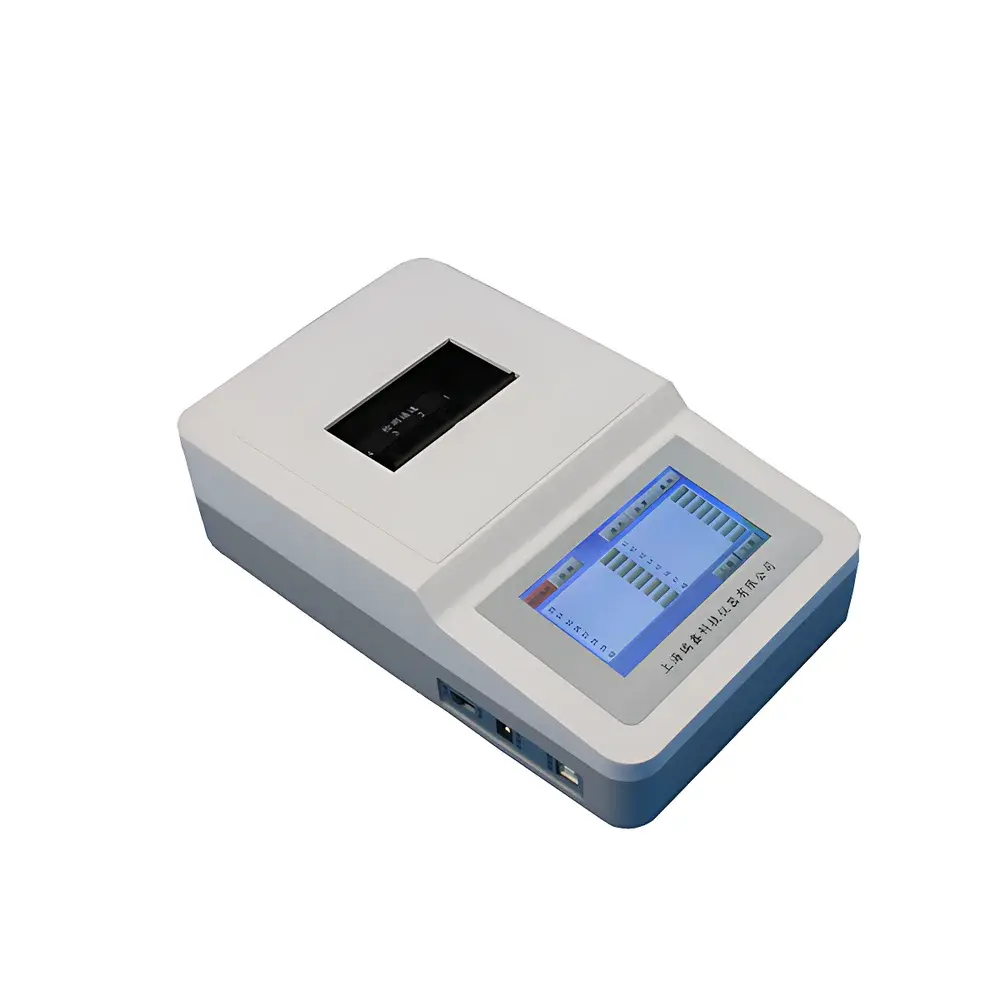
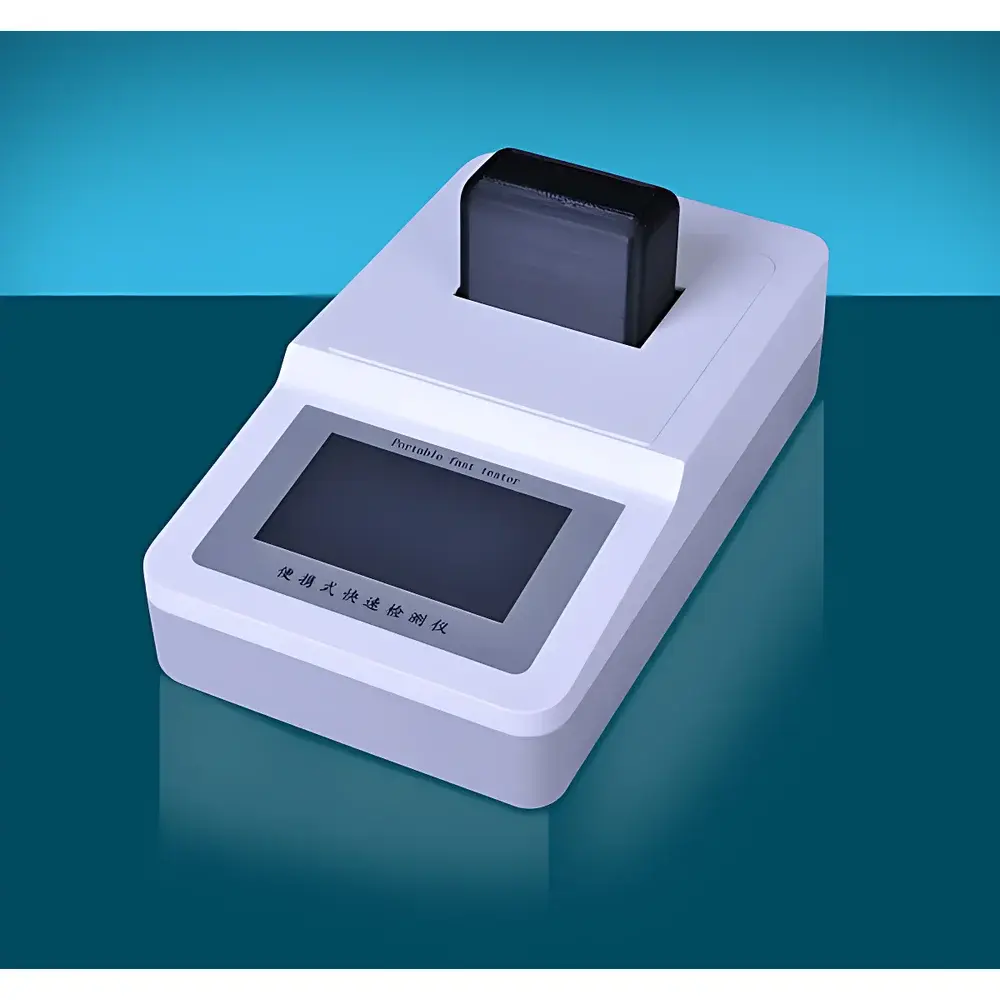
Ruixin SZ-YXSY2 Nitrite Analyzer
| Brand | Ruixin |
|---|---|
| Origin | Shanghai, China |
| Manufacturer Type | Authorized Distributor |
| Region | Domestic (China) |
| Model | SZ-YXSY2 |
| Function Type | Single-Analyte Quantitative Detection |
| Sample Type | Single-Sample Dedicated |
| Wavelength Range | 380–630 nm |
| Detection Time | ≤3 min |
| Repeatability | ≤0.2% |
| Detection Channels | 1 |
| Absorbance Range | 0.000–4.000 |
| Transmittance Range | 0.00–100.00% |
| Transmittance Resolution | 0.01% |
| Absorbance Resolution | 0.001 |
| Photometric Accuracy (Transmittance) | ±2.0% |
| Stability (3-min drift) | ≤0.3% |
| Measurement Range (NO₂⁻) | 0.00–2.00 mg/L |
| Communication Interfaces | RS232, USB |
| Power Supply | AC 220 V / DC 5 V / Rechargeable Li-ion Battery |
Overview
The Ruixin SZ-YXSY2 Nitrite Analyzer is a portable, single-analyte spectrophotometric instrument engineered for rapid, field-deployable quantification of nitrite (NO₂⁻) in aqueous matrices. It operates on the principle of visible-light absorbance spectroscopy—specifically, the diazotization-coupling reaction between nitrite and sulfanilamide under acidic conditions, followed by coupling with N-(1-naphthyl)ethylenediamine dihydrochloride to form a stable pink azo dye with maximum absorbance between 530–550 nm. The instrument integrates a fixed-wavelength optical path within its 380–630 nm spectral window, enabling precise photometric measurement without scanning optics. Designed for regulatory-compliant screening in food safety, environmental monitoring, and public health laboratories, the SZ-YXSY2 delivers trace-level quantification (0.00–2.00 mg/L NO₂⁻) with high reproducibility (≤0.2% RSD) and minimal operator dependency.
Key Features
- Compact aluminum alloy chassis optimized for field portability and mechanical durability under variable ambient conditions.
- 4.5-inch high-resolution color TFT touchscreen with full Chinese GUI—supporting touch-pen input and intelligent Chinese character entry for real-time annotation of sample IDs, locations, and operator notes.
- Built-in calibration curve library with multiple preloaded absorbance-concentration relationships, adaptable to matrix-specific interferences (e.g., turbidity, chloride, or organic matter).
- Integrated thermal line printer for immediate hard-copy reporting—each printout includes timestamp, sample ID, measured concentration, calibration status, and instrument serial number.
- Automated data logging: stores ≥1,000 test records with date/time stamp, absorbance value, transmittance, and calculated concentration; supports recall, export, and chronological filtering.
- Dual-mode power architecture: operable via AC 220 V mains, DC 5 V external adapter, or internal rechargeable lithium-ion battery (≥8 hours continuous operation).
Sample Compatibility & Compliance
The SZ-YXSY2 is validated for quantitative nitrite analysis in distilled water, potable water, domestic wastewater, surface water, seawater (with salinity correction), and food process rinse waters. It complies with core methodological requirements of GB/T 5750.5–2023 (Standard Methods for Examination of Drinking Water – Inorganic Nonmetallic Indices) and aligns with the analytical principles referenced in ISO 6775:1984 (Water quality — Determination of nitrite — Spectrophotometric method). While not certified for GLP/GMP production environments, its data integrity features—including timestamped audit trails, non-editable result storage, and RS232/USB traceable output—support documentation requirements for HACCP-based food safety plans and municipal water quality surveillance programs.
Software & Data Management
Data acquisition and reporting are managed through embedded firmware—not external PC software—ensuring deterministic response and immunity to OS-level vulnerabilities. All measurements are automatically tagged with UTC timestamp, instrument ID, and user-defined metadata. Exported datasets (via USB mass storage mode) conform to CSV format with UTF-8 encoding, preserving Chinese characters in sample descriptors. RS232 interface supports Modbus RTU protocol for integration into centralized SCADA or LIMS platforms. Firmware supports over-the-air updates via USB stick, maintaining version control and traceability per ISO/IEC 17025 Clause 5.9 (Method Validation and Verification).
Applications
- Routine screening of nitrite residuals in meat curing brines and processed vegetable products per China’s GB 2760–2024 food additive standards.
- Field verification of nitrite removal efficiency in wastewater treatment plants prior to discharge compliance checks.
- Emergency response testing following suspected contamination events in rural drinking water supplies.
- Quality control in aquaculture facilities monitoring nitrite accumulation in recirculating systems.
- Educational use in university environmental science labs for teaching colorimetric assay fundamentals and Beer–Lambert law applications.
FAQ
What sample preparation is required prior to analysis?
Minimal pretreatment: samples must be filtered (0.45 µm membrane) if visibly turbid; no digestion or distillation is needed for typical water or liquid food extracts.
Does the instrument require annual recalibration by an accredited lab?
No—user-performed calibration using NIST-traceable nitrite standard solutions (e.g., potassium nitrite CRM) is sufficient; factory calibration certificate is provided with each unit.
Can the device store custom calibration curves for non-standard matrices?
Yes—up to five user-defined curves may be saved and recalled via the touchscreen interface, with slope, intercept, and correlation coefficient displayed for validation.
Is the thermal printer compatible with third-party label stock?
It accepts standard 57 mm wide thermal paper rolls only; adhesive-backed labels are not supported due to feed mechanism design.
How is data security ensured during USB export?
Exported files contain no embedded passwords or encryption; however, all records are write-protected on-device and cannot be modified post-acquisition—meeting basic ALCOA+ data integrity expectations for screening-grade instruments.






