
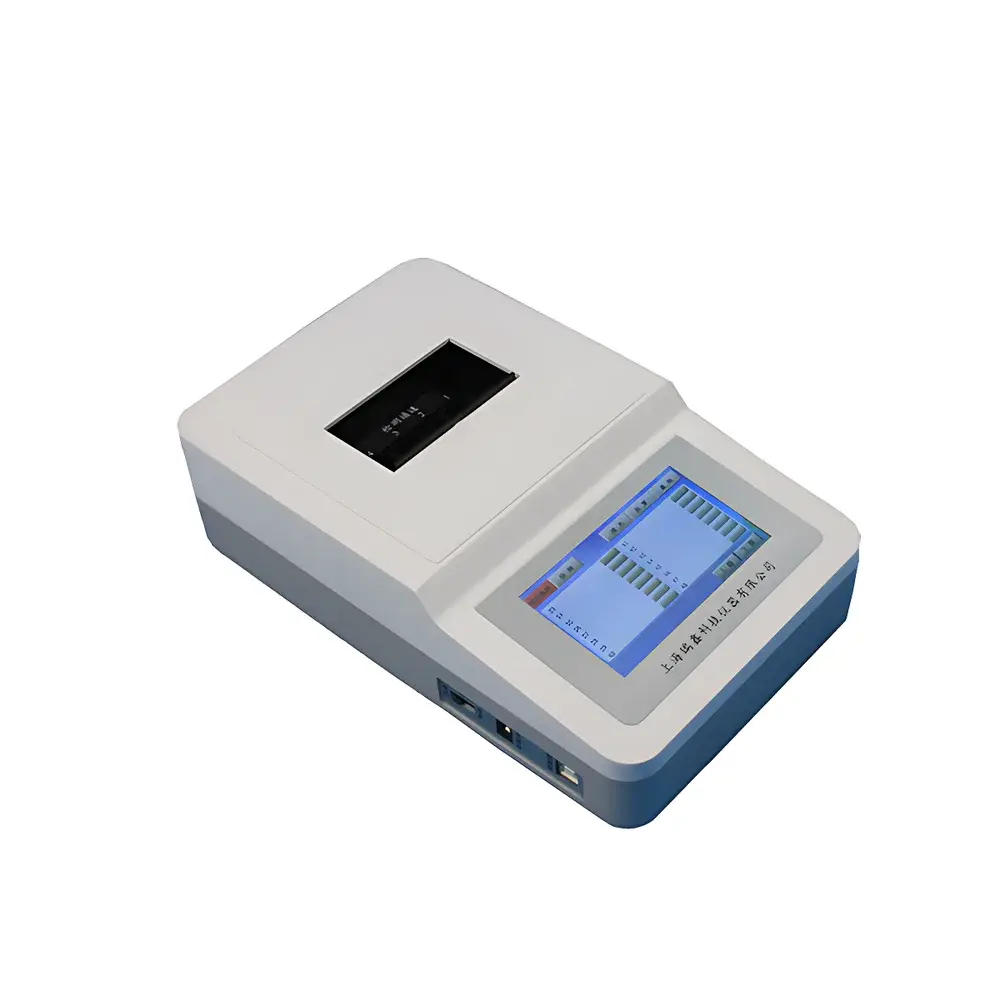
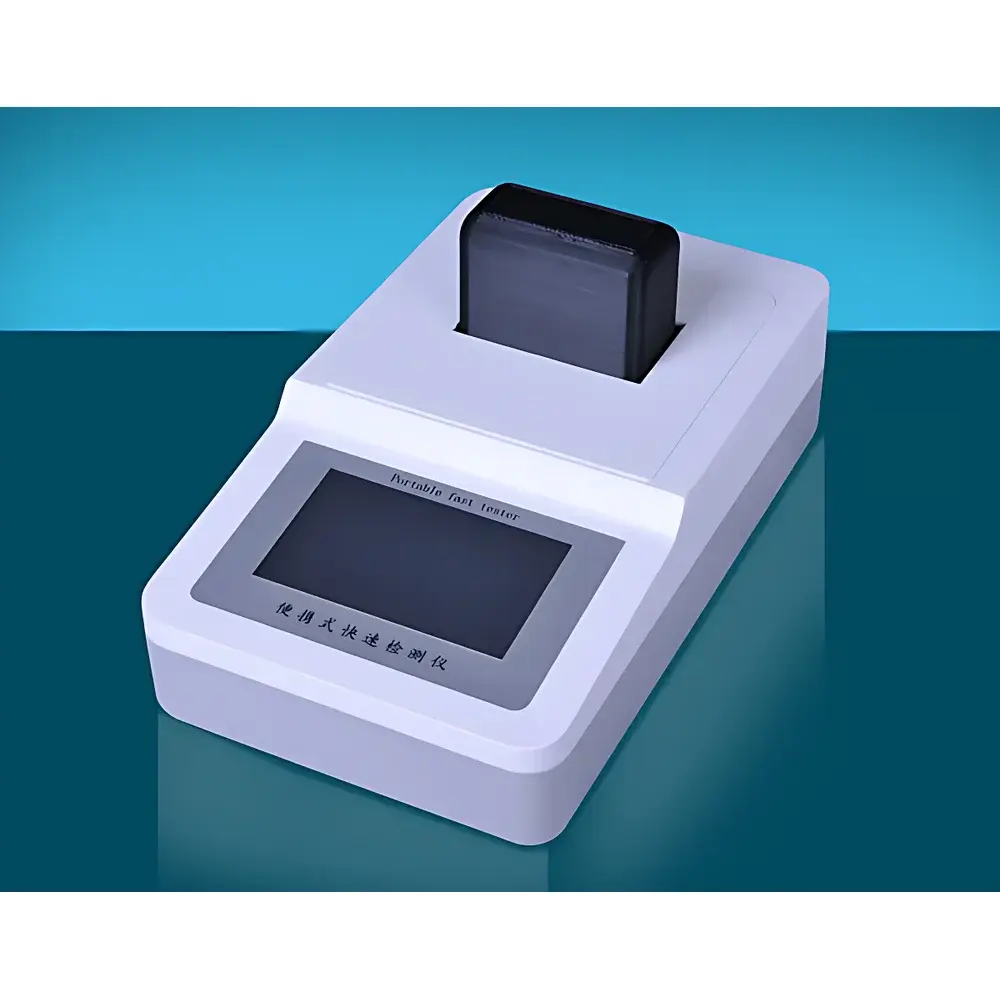
Ruixin SZ-AD2 Ammonia-Nitrogen Water Quality Analyzer
| Brand | Ruixin |
|---|---|
| Origin | Shanghai, China |
| Manufacturer Type | Authorized Distributor |
| Origin Category | Domestic (China-made) |
| Model | SZ-AD2 |
| Price | USD 780 (FOB Shanghai) |
| Function Type | Single-Analyte Dedicated Analyzer |
| Sample Format | Single-Sample Mode |
| Wavelength Range | 380–630 nm |
| Analysis Time | ≤ 180 seconds |
| Photometric Repeatability | ≤ 0.2% (at 540 nm, using standard ammonia-nitrogen reference solution) |
| Optical Channels | 1 |
Overview
The Ruixin SZ-AD2 Ammonia-Nitrogen Water Quality Analyzer is a portable, single-channel photometric analyzer engineered for rapid, on-site and laboratory-based quantification of ammonia nitrogen (NH₃-N) in aqueous matrices. It operates on the principle of spectrophotometric detection following the Nesslerization reaction — where ammonia reacts with alkaline iodide-mercury reagent to form a yellow-brown colloidal complex, the absorbance of which is linearly proportional to NH₃-N concentration within the calibrated range (0.10–5.00 mg/L). Designed to meet field-deployable performance requirements without compromising metrological integrity, the SZ-AD2 integrates optical stability, thermal drift compensation, and embedded calibration management into a rugged aluminum alloy chassis. Its compact footprint (220 × 150 × 95 mm), dual-power architecture (AC 220 V / DC 5 V / rechargeable Li-ion battery), and IP54-rated enclosure enable reliable operation in environmental monitoring vehicles, water treatment plants, municipal health laboratories, and regulatory field inspection units.
Key Features
- 4.5-inch high-resolution color TFT-LCD touchscreen with full Chinese GUI — supports intuitive menu navigation, real-time spectral visualization, and on-device data annotation.
- Integrated intelligent Chinese input system — enables direct entry of sample IDs, operator names, and location metadata via virtual keyboard or stylus, ensuring traceable recordkeeping per GLP guidelines.
- Pre-loaded multi-point calibration curves — includes ≥8 factory-verified absorbance-concentration relationships optimized across low-, mid-, and high-range NH₃-N standards (0.10–5.00 mg/L), compliant with ISO 7150-1:1984 and HJ 535–2009.
- Embedded thermal line printer — outputs tamper-evident hard-copy reports containing date/time stamp, calibration ID, measured absorbance (0.000–4.000 AU), transmittance (0.00–100.00%), calculated NH₃-N concentration, and operator signature field.
- Photometric performance validation — achieves ±2.0% transmittance accuracy (certified at 540 nm using NIST-traceable neutral density filters) and ≤0.2% transmittance repeatability (n = 10, CV), verified per ASTM E275–21 Annex A1.
- Real-time instrument diagnostics — monitors lamp intensity, detector baseline drift, and cuvette alignment status; alerts users upon deviation exceeding ICH Q2(R2)-recommended thresholds.
Sample Compatibility & Compliance
The SZ-AD2 is validated for use with clarified, non-turbid aqueous samples including distilled water, potable water, surface water (rivers, lakes), treated wastewater effluents, and drinking water distribution system taps. Sample pretreatment — such as filtration (≤0.45 µm membrane), pH adjustment (to 10.0–11.0), and interference masking (e.g., EDTA for heavy metal chelation) — follows EPA Method 350.1 and ISO 7150-1 protocols. All internal firmware and data handling routines conform to basic audit trail requirements under FDA 21 CFR Part 11 (electronic signatures enabled via password-protected user roles). Device documentation includes Declaration of Conformity to GB/T 19001–2016 (ISO 9001) and CE marking per EMC Directive 2014/30/EU.
Software & Data Management
Data acquisition, storage, and export are managed through Ruixin’s proprietary ADLink v2.3 firmware. Each measurement session automatically logs timestamp, operator ID, calibration curve ID, raw absorbance, transmittance, and final NH₃-N result (mg/L) into an encrypted SQLite database (≥10,000 records retained locally). USB 2.0 interface supports direct export of CSV-formatted datasets to LIMS or Excel-compatible platforms. Optional cloud synchronization (via Ruixin Cloud Connect module, sold separately) enables remote QA/QC review, trend analysis across geographically dispersed sites, and automated report generation aligned with ISO/IEC 17025:2017 Clause 7.8.1.
Applications
- Regulatory compliance monitoring for municipal water utilities under China’s GB 5749–2022 and EU Drinking Water Directive (2020/2184).
- Routine effluent testing in WWTPs prior to discharge — supporting daily NH₃-N reporting required by local ecological bureaus.
- Emergency response screening during algal bloom events or agricultural runoff incidents.
- Quality assurance in bottled water production facilities — verifying post-ozonation residual ammonia levels.
- Field validation of online NH₃-N sensors (e.g., UV-Vis or ion-selective electrode systems) via grab-sample correlation studies.
FAQ
What is the certified detection range for ammonia nitrogen?
The linear dynamic range is 0.10–5.00 mg/L NH₃-N, validated per HJ 535–2009 using certified reference materials (CRM) from CNAS-accredited providers.
Does the instrument support external calibration verification?
Yes — users may load custom calibration curves or perform two-point verification using NIST SRM 2195 (Ammonia Nitrogen Standard Solution) via the “Advanced Calibration” menu.
Is battery life sufficient for full-day field deployment?
The integrated 3.7 V / 4400 mAh Li-ion battery provides ≥12 hours of continuous operation (with backlight on) or ≥180 tests per charge under typical ambient conditions (25°C, 50% humidity).
How is data integrity ensured during USB transfer?
All exported files include SHA-256 checksums and embedded digital signatures tied to device serial number and firmware version, satisfying traceability requirements under ISO/IEC 17025:2017 Clause 7.5.2.
Can the SZ-AD2 be integrated into existing SCADA or EMS platforms?
Via optional RS-232-to-Modbus RTU gateway (model AD-MB1), enabling read-only polling of real-time NH₃-N values at configurable intervals (1–300 sec) for integration with industrial automation systems.







