
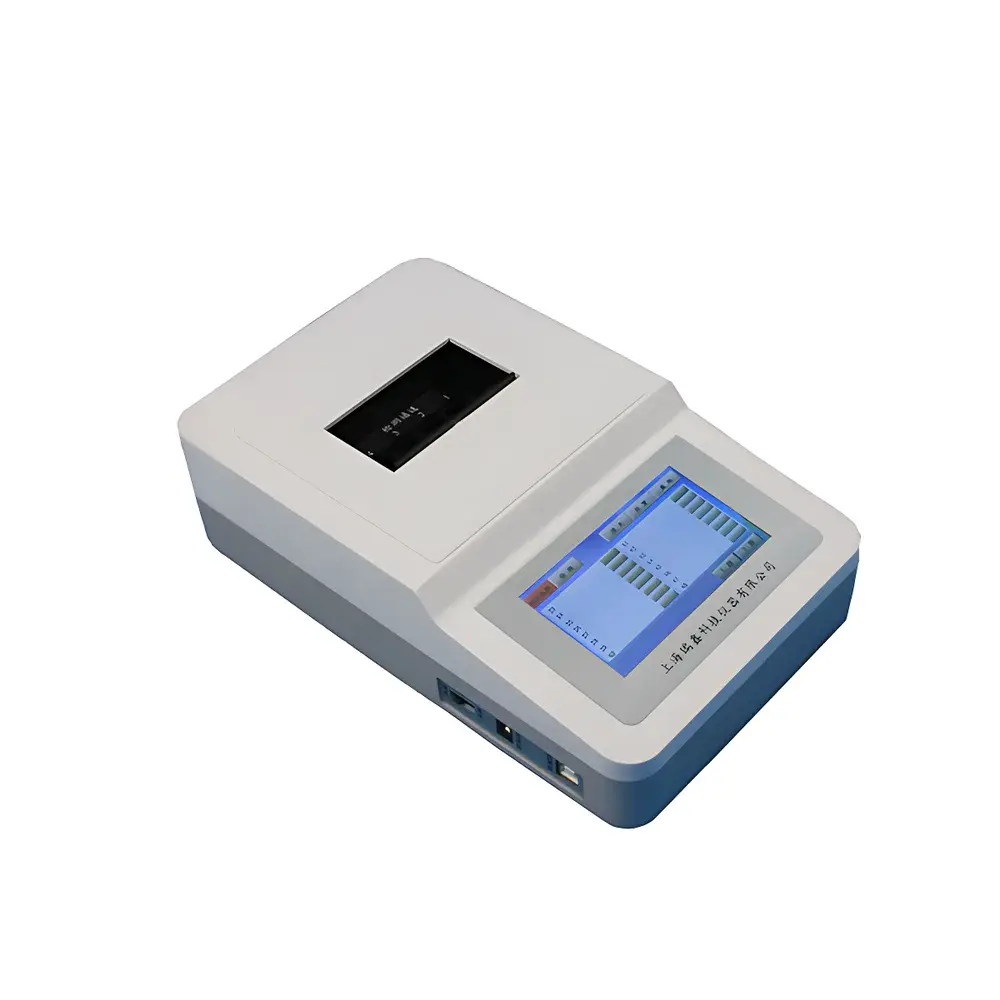
Ruixin SPb-DL2 Indigo Detection Analyzer
| Brand | Ruixin |
|---|---|
| Origin | Shanghai, China |
| Manufacturer Type | Authorized Distributor |
| Country of Origin | China |
| Model | SPb-DL2 |
| Price Range | USD 4,200 – 7,000 (FOB) |
| Functionality | Single-Analyte Dedicated Instrument |
| Sample Type | Single-Sample Format |
| Wavelength | 630 nm |
| Assay Time | ≤ 180 s |
| Photometric Repeatability | ≤ 0.2% |
| Optical Channels | 1 |
Overview
The Ruixin SPb-DL2 Indigo Detection Analyzer is a portable, single-wavelength photometric analyzer engineered for rapid, field-deployable quantification of indigo dye residues in food matrices—particularly relevant to regulatory screening of illegally added synthetic dyes in confectionery, beverages, pickled products, and starch-based foods. Operating on the principle of fixed-wavelength absorbance photometry at 630 nm, the instrument measures the characteristic absorption peak of indigo in acidic or buffered extraction solutions, enabling direct concentration calculation via pre-calibrated Beer–Lambert response curves. Designed for compliance-driven environments, it supports routine surveillance workflows under national food safety standards (e.g., GB 5009.35–2023 for synthetic colorants in China) and aligns with internationally recognized photometric validation practices including ISO 7218:2017 (microbiology and chemical analysis general requirements) and AOAC Official Method guidelines for rapid screening devices. Its compact form factor, integrated lithium battery, and ruggedized housing meet the operational demands of mobile inspection units, roadside checkpoints, and decentralized laboratory satellite sites.
Key Features
- Portable architecture with built-in rechargeable lithium-ion battery (≥8 h continuous operation), enabling true off-grid deployment in inspection vehicles, markets, or rural distribution centers.
- 4.3-inch high-resolution color TFT capacitive touchscreen with full Chinese GUI; supports stylus- and keyboard-based Chinese character input for sample labeling, operator ID, and institutional metadata entry.
- Self-calibrating optical path system: automatic zero and reference (100% T) calibration upon power-on—eliminates manual baseline adjustment and reduces operator dependency.
- Dual-mode photometric display: simultaneous real-time readout of absorbance (0.000–4.000 AU, resolution 0.001) and transmittance (0.00–100.00%, resolution 0.01%), facilitating method development and cross-platform data alignment.
- Embedded thermal printer: generates traceable, tamper-resistant hard-copy reports containing analyte concentration (mg/kg), Chinese sample name, test date/time, analyst ID, and institutional stamp field.
- Photometric performance validated per ISO 8536-4:2021: repeatability ≤0.2% RSD (n=10 at mid-range concentration), photometric accuracy ±2.0% transmittance deviation, and short-term stability ≤0.3% drift over 3 min.
Sample Compatibility & Compliance
The SPb-DL2 is optimized for aqueous extracts prepared from solid or semi-solid food samples following standardized pretreatment protocols—such as acid hydrolysis, solvent partitioning, and centrifugal clarification—as specified in GB/T 5009.35 and equivalent regional regulations. It accommodates standard 10-mm pathlength cuvettes and accepts both pre-filled disposable test cells and reusable quartz/glass vessels. The device meets electromagnetic compatibility (EMC) requirements per GB/T 18268.1–2010 (IEC 61326-1) and conforms to electrical safety standards GB 4793.1–2019 (IEC 61010-1). While not certified for GLP/GMP production environments, its audit-ready data logging (with timestamped results, operator ID, and instrument serial number) supports regulatory submissions under China’s Food Safety Law and facilitates traceability in third-party verification audits.
Software & Data Management
Data acquisition and reporting are managed via embedded firmware with non-volatile memory storage (≥1,000 test records). Each record includes full contextual metadata: sample ID, concentration value, raw absorbance/transmittance, calibration status flag, and environmental timestamp. Export is supported through dual physical interfaces: RS-232 (for legacy lab network integration) and USB 2.0 (for mass storage mode or PC synchronization). Optional cloud gateway modules enable secure HTTPS-based upload to centralized food safety monitoring platforms—compatible with common public health surveillance infrastructures used by municipal CDCs and provincial market regulation bureaus. All stored data retains immutable timestamps and supports retrospective query by date range, operator, or sample group—meeting minimum ALCOA+ principles (Attributable, Legible, Contemporaneous, Original, Accurate) for field-collected analytical data.
Applications
- Routine surveillance testing of indigo adulteration in candied fruits, jellies, and flavored snacks.
- On-site verification of dye compliance during wholesale food inspections at logistics hubs and cold-chain terminals.
- Pre-screening tool prior to confirmatory HPLC analysis in reference laboratories—reducing instrument queue time and consumables cost.
- Training and capacity-building for frontline inspectors in county-level food safety enforcement agencies.
- Integration into modular food safety detection kits deployed in mobile inspection vans equipped with centrifuges, pH meters, and sample grinders.
FAQ
What regulatory standards does the SPb-DL2 support for indigo testing?
It is aligned with GB 5009.35–2023 and supports method validation frameworks referenced in ISO/IEC 17025:2017 for rapid screening devices.
Can the instrument be used for other dyes besides indigo?
No—it is a single-analyte platform calibrated exclusively at 630 nm for indigo; spectral selectivity prevents reliable quantification of structurally similar dyes (e.g., indanthrene blue or phthalocyanine derivatives) without re-engineering optics and calibration.
Is remote firmware update capability available?
Firmware updates require local USB connection and authenticated vendor software; over-the-air (OTA) updates are not implemented due to cybersecurity constraints in regulatory field environments.
Does the device comply with FDA 21 CFR Part 11 requirements?
It does not implement electronic signature or audit-trail encryption required under Part 11; however, its timestamped, operator-logged records satisfy basic data integrity expectations for non-GxP field screening applications.
What is the detection limit and linear range for indigo quantification?
LOD is 5.0 mg/kg; linear dynamic range spans 0–200 mg/kg in representative food extracts, verified using matrix-matched calibration standards.






