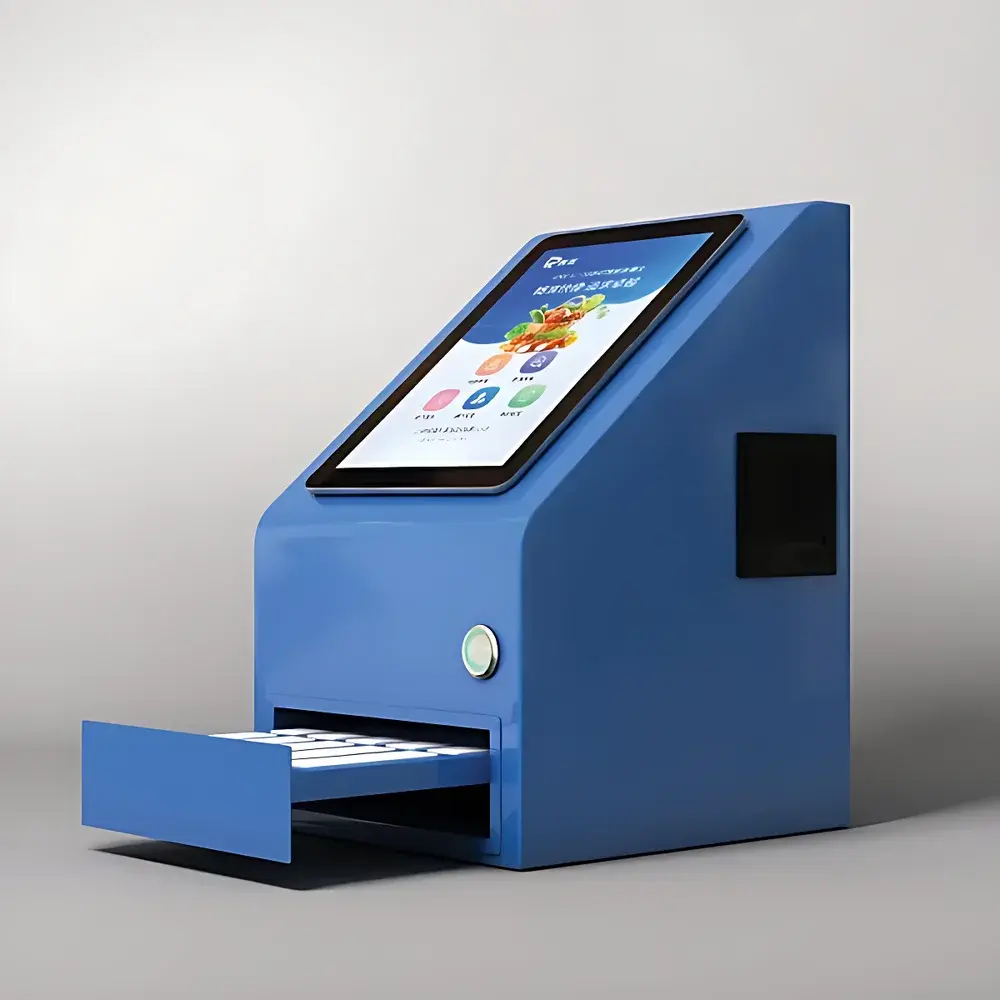
Ruixin JT-108SY Veterinary Drug Residue Analyzer
| Brand | Ruixin |
|---|---|
| Origin | Shanghai, China |
| Manufacturer Type | Authorized Distributor |
| Model | JT-108SY |
| Price | USD 5,300 (FOB Shanghai) |
| Function Type | Multi-analyte Immunoassay Platform |
| Sample Versatility | Universal for Animal-Derived Food Matrices |
| Wavelength Range | 380–680 nm |
| Detection Time | ≤ 180 s per test strip |
| Repeatability (CV) | ≤ 0.3% |
| Detection Channels | 8 independent optical lanes |
| Measurement Speed | < 1 s per lane |
| Precision | CV < 1% (certified control strips), Inter-batch Variation < 3% |
| Sensitivity | LOD < 0.001 ng/mL (matrix-dependent, per analyte) |
| Output Modes | Colorimetric intensity, C/T ratio, Test line (T) signal, Control line (C) validation |
| Interface | USB 2.0 |
| Network | Wi-Fi (802.11 b/g/n), RJ45 Ethernet, Optional 4G LTE module |
| Power Supply | AC 220 V ±10%, 50 Hz (with optional Li-ion battery pack) |
| Operating System | Android 9.0 |
| Display | 10.1-inch capacitive touchscreen |
| Data Storage | Internal eMMC + microSD slot (up to 512 GB), ≥ 1,000,000 records |
| Connectivity Protocols | HTTP/HTTPS, MQTT, TLS 1.2 |
| Cloud Integration | RESTful API compliant with ISO/IEC 17025 traceability framework |
| Compliance | Designed in alignment with GB/T 27404–2008 (CNAS GLP guidelines), supports audit-ready data logs per FDA 21 CFR Part 11 requirements (electronic signatures, time-stamped audit trails, role-based access) |
Overview
The Ruixin JT-108SY Veterinary Drug Residue Analyzer is a CE-marked, field-deployable immunoassay platform engineered for quantitative and semi-quantitative detection of veterinary drug residues in food matrices using colloidal gold immunochromatographic test strips. It operates on the principle of lateral flow immunoassay (LFIA) coupled with high-resolution CCD imaging and calibrated reflectance photometry across the visible spectrum (380–680 nm). Unlike subjective visual interpretation, the JT-108SY digitizes the optical density of both control (C) and test (T) lines, computes normalized C/T ratios, and applies algorithmic correction for background noise, strip batch variation, and ambient lighting interference. This enables trace-level residue quantification—down to sub-ng/mL concentrations—with metrological traceability suitable for regulatory screening in food safety laboratories, slaughterhouse QC labs, dairy cooperatives, and border inspection posts.
Key Features
- Eight independent optical detection channels with simultaneous multi-strip analysis—no mechanical sample handling or manual alignment required.
- 10.1-inch industrial-grade Android touchscreen interface with intuitive icon-driven workflow; preloaded with multilingual UI (English, Spanish, Arabic, Vietnamese) and embedded instructional videos accessible offline.
- Automated strip recognition: distinguishes valid assay cards from expired, damaged, or non-compatible formats via QR/barcode scanning and spectral signature validation.
- Real-time result generation: automatic classification (negative/positive/inconclusive), concentration estimation (where calibration curves are loaded), and pass/fail flagging against configurable MRL thresholds per Codex Alimentarius or national standards (e.g., China’s GB 31650–2019).
- Modular hardware architecture: supports firmware over-the-air (FOTA) updates, remote diagnostics via SSH, and secure TLS-encrypted cloud synchronization.
- Dual-mode reporting: thermal label printing (with GS1-compliant traceability QR codes per the PRC’s Edible Agricultural Products Certificate Scheme), A4 certificate export (PDF), and adhesive-label batch certification.
- Integrated GNSS module (GPS + AGPS) geotags every test record with timestamp, location, operator ID, and instrument serial number—enabling spatial-temporal mapping of contamination hotspots.
Sample Compatibility & Compliance
The JT-108SY is validated for use with homogenized extracts from raw and processed animal-derived commodities, including muscle tissue (porcine, bovine, poultry), fish fillets, shellfish, raw milk, pasteurized milk, egg homogenates, honey dilutions, and soup base slurries. Sample preparation follows standardized extraction protocols (e.g., QuEChERS variants for antibiotics, acid hydrolysis for steroid hormones) compatible with AOAC Official Method 2012.01 and GB/T 21312–2007. All measurement data—including raw CCD images, pixel-intensity heatmaps, and C/T ratio logs—are stored with immutable metadata (ISO/IEC 17025 Clause 7.9). The system supports 21 CFR Part 11-compliant electronic signatures, user access controls, and audit-trail generation for GLP/GMP environments. Calibration verification is performed daily using NIST-traceable reference strips certified by CNAS-accredited providers.
Software & Data Management
Built on a Linux-based Android 9.0 kernel, the JT-108SY runs Ruixin’s proprietary RUICloud Connect Suite—a FHIR-aligned middleware that exports structured JSON payloads containing analyte name, measured concentration, uncertainty estimate, matrix type, LOD/LOQ flags, and compliance status. Data syncs to private or public cloud instances (AWS IoT Core, Azure IoT Hub, or on-premise LIMS) via configurable MQTT topics. Local database employs SQLite with WAL journaling for ACID compliance; full backup/restore is supported via microSD or network share. Role-based permissions (Admin, Lab Technician, Auditor) govern report generation, parameter editing, and firmware update privileges. All data exports include digital signatures compliant with IEC 62443-3-3 security profiles.
Applications
- Routine surveillance testing at abattoirs and cold-chain distribution hubs for β-agonists (clenbuterol, ractopamine), nitrofurans (furazolidone, furaltadone), and malachite green metabolites.
- On-farm dairy quality assurance: rapid screening of β-lactams, tetracyclines, sulfonamides, and aflatoxin M1 in bulk tank milk prior to processing.
- Honey authenticity verification: detection of chloramphenicol, quinolones, and nitroimidazoles prohibited in apiculture under EU Regulation (EC) No 37/2010.
- Import inspection at port-of-entry laboratories: parallel analysis of multiple antibiotic classes in composite seafood samples per USDA-FSIS Directive 7120.1.
- Research applications: method development support for novel LFIA strip validation, including limit-of-detection profiling and cross-reactivity assessment under controlled humidity/temperature conditions.
FAQ
What regulatory standards does the JT-108SY support for data integrity?
It meets ISO/IEC 17025:2017 documentation requirements and implements 21 CFR Part 11 controls—including electronic signatures, audit trails, and data encryption—at the firmware level.
Can the instrument validate third-party colloidal gold strips?
Yes—provided the strip format (dimensions, conjugate pad placement, membrane type) and spectral response fall within the calibrated operational envelope defined in Ruixin’s Strip Compatibility Matrix v3.2.
Is remote calibration possible?
No—calibration requires physical insertion of certified reference strips; however, remote diagnostic validation of optical path stability and CCD linearity is supported via encrypted command-line interface.
How is data traceability enforced across cloud and local storage?
Each test record carries a SHA-256 hash of its raw image and metadata; cloud-uploaded records are signed with an X.509 certificate bound to the instrument’s unique TPM 2.0 chip.
Does the system support integration with national food safety monitoring platforms?
Yes—preconfigured API adapters exist for China’s National Food Safety Risk Monitoring Information System (NFMRIS), Vietnam’s VNACCS/VCIS, and ASEAN’s ASEAN Food Safety Network (AFSN) data exchange schema.