
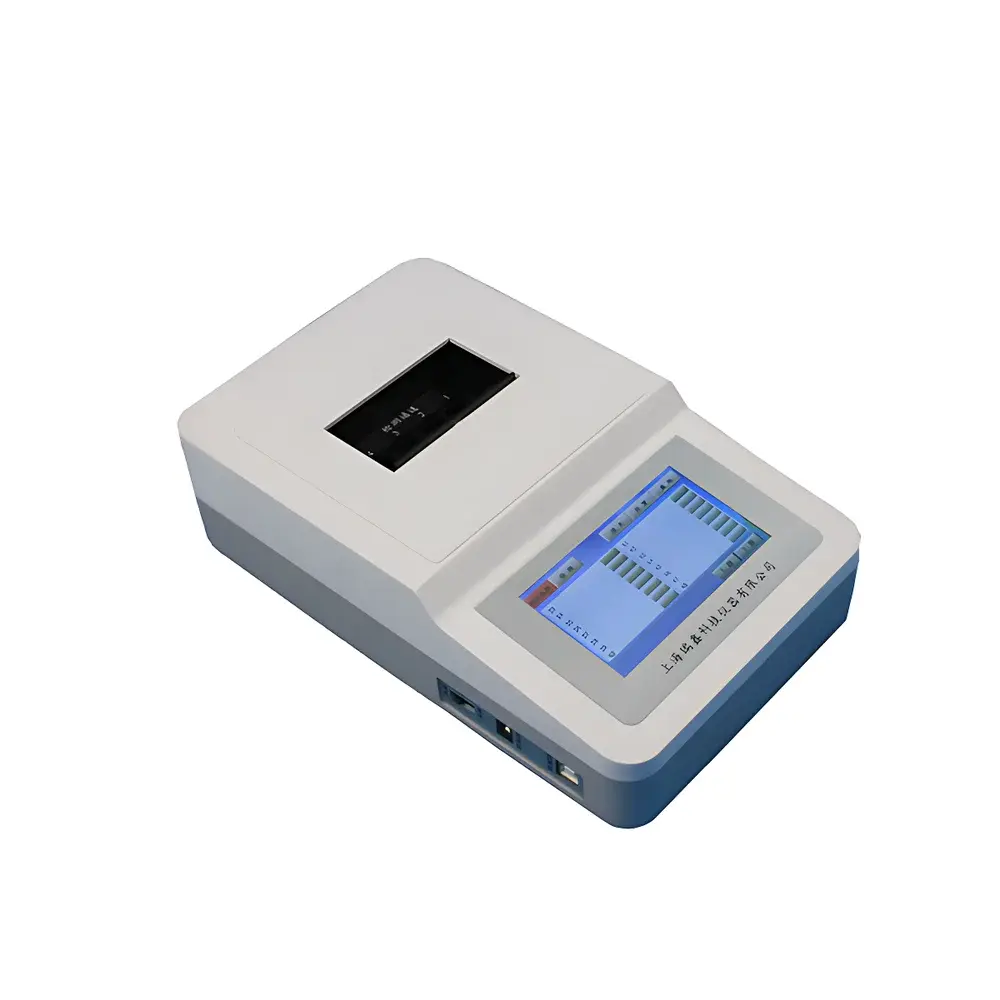
Ruixin SPb-XS2 Nitrate Analyzer
| Brand | Ruixin |
|---|---|
| Origin | Shanghai, China |
| Manufacturer Type | Authorized Distributor |
| Country of Manufacture | China |
| Model | SPb-XS2 Nitrate |
| Function Type | Single-Analyte Detection System |
| Sample Format | Single-Sample Dedicated Platform |
| Optical Wavelength | 410 nm |
| Assay Time | ≤ 3 min |
| Photometric Repeatability | ≤ 0.2% |
| Detection Channels | 1 |
| Absorbance Range | 0.000–4.000 AU |
| Transmittance Range | 0.00–100.00% |
| Transmittance Resolution | 0.01% |
| Absorbance Resolution | 0.001 AU |
| Photometric Accuracy (Transmittance) | ±2.0% |
| Baseline Stability (3 min) | ≤ 0.3% |
| Nitrate LOD | 100.0 mg/kg |
| Nitrate Measurement Range | 0–3000 mg/kg |
| Communication Interfaces | RS-232, USB |
| Power Supply Options | Integrated Li-ion Battery, AC 220 V, DC 5 V |
| Display | 4.3-inch High-Resolution Color TFT Touchscreen with Full Chinese UI |
| Onboard Thermal Printer | Embedded Micro-Thermal Printer for Channel-Specific Reports |
| Data Management | Auto-Save, Local Query, Real-Time Upload via Serial/USB |
| Calibration | Automated Optical Path Self-Alignment at Startup |
| Dual-Mode Output | Simultaneous Absorbance & Transmittance Readouts |
Overview
The Ruixin SPb-XS2 Nitrate Analyzer is a dedicated photometric instrument engineered for rapid, field-deployable quantification of nitrate (NO₃⁻) in food matrices—primarily fresh produce, cured meats, dairy products, and drinking water samples. It operates on the principle of visible-spectrum spectrophotometry, utilizing a fixed-wavelength LED source centered at 410 nm to excite the chromophore formed during the Griess reaction between nitrate-derived nitrite and sulfanilamide under acidic conditions. The resulting pink azo dye exhibits strong absorbance at this wavelength, enabling direct correlation between optical density and nitrate concentration. Designed for regulatory compliance workflows, the SPb-XS2 delivers trace-level sensitivity (LOD: 100.0 mg/kg) and linear response across a broad dynamic range (0–3000 mg/kg), supporting both routine screening and confirmatory testing in accordance with national food safety standards including GB 5009.33–2016 (China) and aligned methodologies referenced in Codex Alimentarius CXS 277–2011. Its compact form factor, integrated power management, and self-calibrating optical path eliminate dependency on external lab infrastructure.
Key Features
- Portable architecture with integrated rechargeable lithium-ion battery, enabling continuous operation for ≥8 hours per charge—optimized for mobile food inspection units, roadside checkpoints, and decentralized surveillance.
- 4.3-inch capacitive touchscreen with native Chinese graphical user interface (GUI), supporting touch-based navigation, stylus input, and intelligent Chinese character entry for sample annotation and operator logging.
- Automated photometric calibration system: real-time optical path alignment upon power-on eliminates manual zeroing and 100% transmittance adjustment, reducing operator-induced variability and improving inter-day reproducibility.
- Dual photometric readout mode: simultaneous display of absorbance (0.000–4.000 AU) and transmittance (0.00–100.00%), facilitating method transfer validation and cross-platform data harmonization with legacy spectrophotometers.
- Embedded thermal printer outputs compliant test reports per channel—including quantitative result (mg/kg), Chinese-labeled sample ID, date/time stamp, analyst ID, and institutional header—supporting GLP documentation requirements.
- Robust data integrity framework: automatic timestamped storage of all results (≥1000 records), local retrieval by date/sample ID, and export-ready formatting via RS-232 or USB 2.0 interfaces.
Sample Compatibility & Compliance
The SPb-XS2 is validated for use with homogenized aqueous extracts prepared from solid food samples following standardized pretreatment protocols (e.g., ultrasonic-assisted extraction, centrifugation, filtration through 0.45 µm membranes). It accommodates pre-reduced nitrate-to-nitrite conversion using cadmium column reduction or enzymatic (nitrate reductase) methods. Instrument performance meets critical metrological criteria defined in ISO/IEC 17025:2017 for testing laboratories, including photometric repeatability (≤0.2%), short-term stability (≤0.3% over 3 min), and transmittance accuracy (±2.0%). While not FDA 21 CFR Part 11-certified out-of-the-box, its audit-trail-capable data log and immutable report generation support alignment with GMP/GLP record-keeping expectations when deployed within controlled quality systems.
Software & Data Management
No proprietary PC software is required for basic operation; all functions are executed onboard. However, optional Windows-compatible desktop utility enables batch export of CSV-formatted datasets, custom report templating, and integration with centralized food safety monitoring platforms via TCP/IP gateways (when paired with USB-to-Ethernet adapters). Raw absorbance values, calculated concentrations, and metadata (operator, location tag, calibration status) are stored in non-volatile memory with write-protection against accidental overwrite. Firmware updates are delivered via USB stick and include version-locked cryptographic signatures to ensure traceability and prevent unauthorized modification.
Applications
- Routine surveillance of nitrate levels in leafy vegetables (e.g., spinach, lettuce), root crops (e.g., beetroot, radish), and processed meats at municipal food safety inspection stations.
- On-site verification of supplier compliance during cold-chain audits and wholesale market inspections.
- Supporting risk-based sampling strategies mandated under China’s National Food Safety Risk Monitoring Program (NFSRMP).
- Training and capacity-building for frontline inspectors where access to benchtop UV-Vis spectrophotometers is limited.
- Integration into modular food safety detection kits—paired with complementary analyzers for pesticide residues, sulfites, or formaldehyde—to enable multi-parameter field assessment.
FAQ
What extraction method is recommended prior to analysis?
Standardized aqueous extraction per GB 5009.33–2016 is required; samples must be homogenized, extracted with hot water (≥70 °C), cooled, filtered, and optionally subjected to cadmium reduction prior to color development.
Can the instrument store calibration curves for multiple reagent lots?
No—calibration is performed via standard addition or external reference standards before each assay batch; the device does not retain multipoint curve coefficients.
Is remote firmware update supported over cellular networks?
Firmware updates require physical USB media; over-the-air (OTA) capability is not implemented due to cybersecurity constraints in regulated environments.
Does the thermal printer support barcode label output?
The embedded printer generates text-only reports; barcode generation requires external label software and a compatible USB thermal label printer.
How is photometric drift compensated during extended field use?
The self-alignment optical system performs periodic baseline verification every 15 minutes during active measurement sessions, correcting for LED intensity drift and detector thermal drift without user intervention.




