
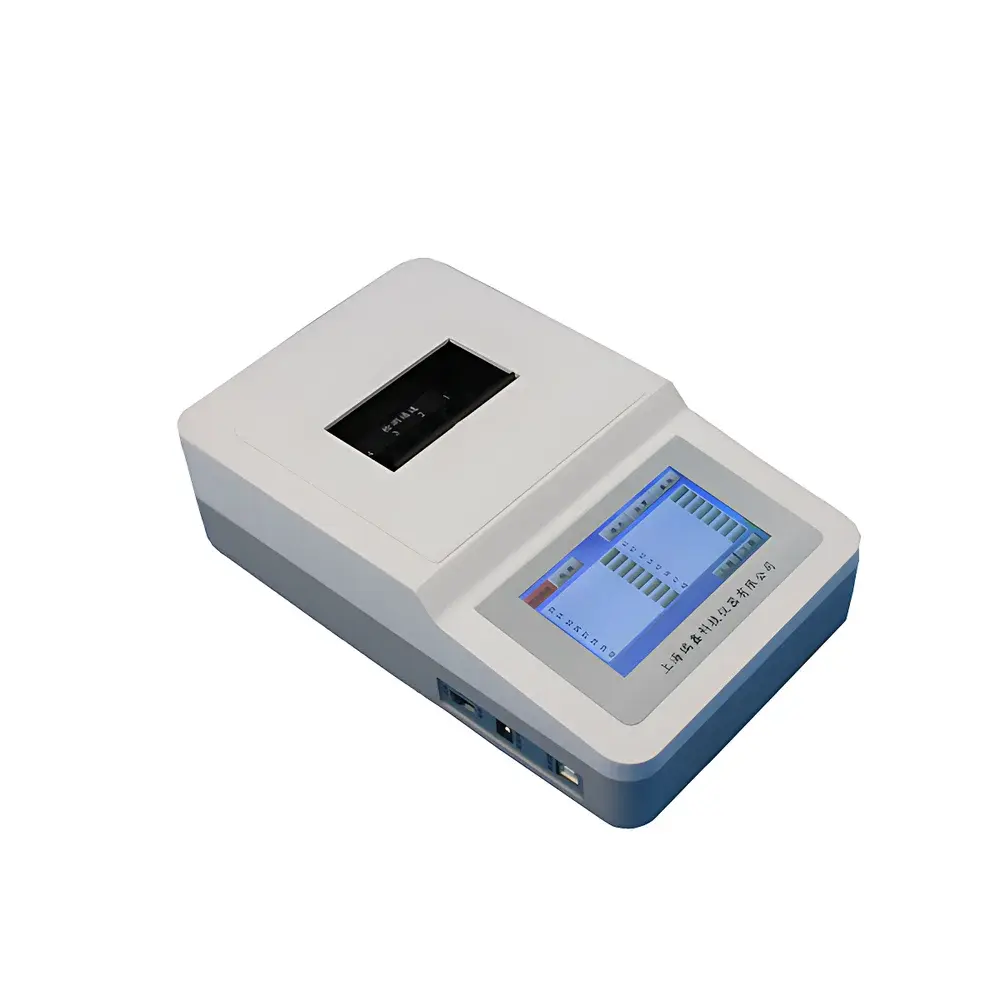
Ruixin SZ-2 Series Portable Water Quality Analyzer
| Brand | Ruixin |
|---|---|
| Origin | Shanghai, China |
| Manufacturer Type | Authorized Distributor |
| Country of Origin | China |
| Model | SZ-2 |
| Price Range | USD 4,200 – 7,000 |
| Function Type | Single-parameter Analyzer |
| Sample Type | Single-sample dedicated platform |
| Detection Time | ≤3 minutes |
| Repeatability | ≤0.2% |
| Detection Channels | 1 |
| Display | 4.5-inch high-resolution color LCD touchscreen (Chinese UI) |
| Absorbance Range | 0.000–4.000 |
| Transmittance Range | 0.00–100.00% |
| Transmittance Resolution | 0.01% |
| Absorbance Resolution | 0.001 |
| Photometric Accuracy | ±2.0% (transmittance) |
| Stability | ≤0.3% (over 3 min) |
| Communication Interfaces | RS232, USB |
| Power Supply | AC 220 V / DC 5 V / Rechargeable Li-ion battery |
Overview
The Ruixin SZ-2 Series Portable Water Quality Analyzer is a field-deployable, single-channel photometric analyzer engineered for rapid, on-site quantification of key water quality parameters in compliance with standard colorimetric and spectrophotometric methods. It operates on the principle of absorbance measurement at fixed wavelengths—optimized per reagent chemistry—using LED-based optical detection to determine analyte concentration via pre-calibrated calibration curves. Designed for regulatory-grade screening rather than laboratory-grade validation, the instrument supports routine monitoring workflows in environmental, municipal, and food safety contexts where speed, portability, and operational simplicity are prioritized over multi-wavelength flexibility or ultra-low detection limits. Its architecture conforms to the functional requirements of ISO 7027 (turbidity), ISO 6060 (COD), ISO 10303 (ammonia-nitrogen), and APHA Standard Methods for the Examination of Water and Wastewater (e.g., 4500-Cl G for chlorine, 4500-NO₃⁻ F for nitrate), enabling traceable, repeatable measurements across diverse aqueous matrices including drinking water, surface water, treated wastewater, and process water.
Key Features
- Compact aluminum chassis with ergonomic carrying handle—designed for rugged field use and benchtop operation without external support infrastructure.
- 4.5-inch full-color capacitive touchscreen with native Chinese-language interface; supports stylus and on-screen QWERTY input for direct annotation of sample IDs, operator names, and site metadata.
- Pre-loaded calibration curves for 23 distinct water quality parameters—including ammonia-nitrogen (0.10–5.00 mg/L), CODCr (10.0–500.0 mg/L), hexavalent chromium (0.01–1.00 mg/L), sulfate (5.0–250.0 mg/L), fluoride (0.01–1.00 mg/L), ozone (0.05–5.00 mg/L), free/total chlorine (0.05–5.00 mg/L), turbidity (0.5–60.0 NTU), and dissolved oxygen (1.0–10.0 mg/L)—each validated against reference standards.
- Integrated thermal printer enables immediate hardcopy generation of test reports with timestamp, parameter name, measured value, unit, and pass/fail flag relative to user-defined thresholds.
- Onboard memory stores ≥1,000 test records with automatic time/date stamping; data export via USB mass storage or RS232 serial protocol to LIMS or QA/QC databases.
- Dual power operation: AC mains (220 V), DC 5 V adapter, or internal rechargeable lithium-ion battery (≥8 hours continuous use).
Sample Compatibility & Compliance
The SZ-2 analyzer accepts standard 10–25 mm round glass or plastic cuvettes and accommodates both liquid samples and extract solutions derived from solid-phase digestion (e.g., textile formaldehyde extraction per GB/T 2912.1). It is validated for use with EPA-compliant reagent kits and manufacturer-supplied test strips compatible with its optical path geometry. While not certified to ISO/IEC 17025 as a standalone testing laboratory, the instrument meets functional performance criteria aligned with GLP documentation practices—including audit-trail-capable data logging, operator ID entry, and calibration verification logs. Its photometric repeatability (≤0.2%) and stability (≤0.3% over 3 min) satisfy minimum requirements for field screening under US EPA Method 1600 series and China’s HJ/T 399–2007 (COD), HJ 535–2009 (ammonia), and GB/T 5750.5–2006 (fluoride).
Software & Data Management
No proprietary PC software is required for basic operation; however, optional Windows-compatible configuration utility enables firmware updates, curve editing, threshold definition, and batch report generation. All stored results include immutable metadata: test ID, date/time, operator code, parameter selected, raw absorbance/transmittance, calculated concentration, and QC status. Data files export in CSV format for integration into enterprise systems compliant with FDA 21 CFR Part 11 (when used with validated electronic signature protocols). Audit trail functionality records all configuration changes, calibration events, and user logins—supporting internal quality audits and third-party inspections.
Applications
- Field verification of disinfectant residuals (free/total chlorine, ClO₂, O₃) in municipal distribution networks and bottled water facilities.
- Routine surveillance of ammonia, nitrate, and nitrite in aquaculture systems and irrigation sources per FAO guidelines.
- Screening of heavy metals (Cd, Pb, Hg, Cr⁶⁺) in source water and effluent streams prior to confirmatory ICP-MS analysis.
- Verification of sulfate, fluoride, and turbidity compliance in bottled water production lines per GB 19298–2014 and EU Directive 2009/54/EC.
- Supporting HACCP plans in food processing plants by monitoring rinse water quality, CIP solution strength, and boiler feedwater parameters.
FAQ
Is the SZ-2 compliant with international regulatory standards such as ISO or ASTM?
The instrument implements measurement principles consistent with ISO 7027 (turbidity), ISO 6060 (COD), and ASTM D1253 (residual chlorine), but it is not individually certified to these standards. Its performance specifications meet the minimum accuracy and repeatability thresholds referenced in those documents for field screening applications.
Can calibration curves be customized or imported from external sources?
Yes—up to 10 user-defined curves may be loaded via USB using the optional configuration tool. Each curve requires wavelength, slope, intercept, and R² validation data.
Does the device support GLP-compliant electronic recordkeeping?
It provides time-stamped, non-editable result storage and exportable CSV logs. Full GLP compliance requires supplementary procedural controls (e.g., defined user roles, password protection, and periodic backup verification), which are implemented at the organizational level.
What is the expected service life of the optical system and LED light source?
The LED emitter is rated for ≥50,000 hours of operation under normal usage conditions. No routine lamp replacement is required during the typical 5–7 year service interval.
Are reagents and consumables supplied by Ruixin or third parties?
Ruixin offers OEM-recommended reagent kits for all 23 parameters. Third-party kits may be used if they conform to the same reaction chemistry and cuvette dimensions—but method validation is the user’s responsibility.






